Loading...
Done
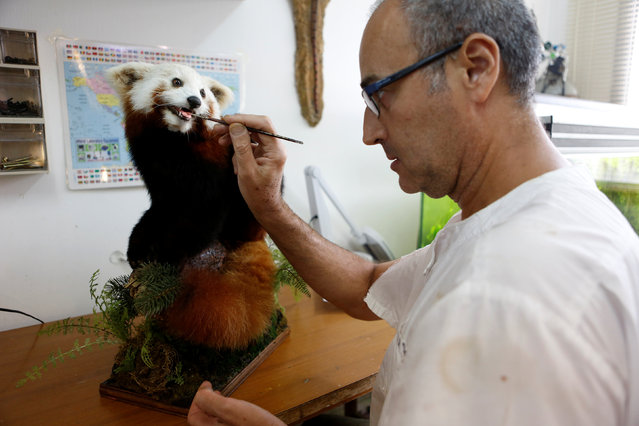
Igor Gavrilov, the main taxidermist of the Zoological centre at Tel Aviv University, works on a taxidermied animal, part of a collection which will be housed at the Steinhardt Museum of Natural History, a new Israeli natural history museum set to open next year in Tel Aviv, Israel June 8, 2016. Legions of insects, sea creatures and ancient fossils are lining up in a new museum shaped liked a giant Noah's Ark, telling the story of a crucial evolutionary byway across Israel. Experts say all humans and other animals had to pass through Israel on their first journey out of Africa into Europe and Asia. (Photo by Nir Elias/Reuters)

Igor Gavrilov, the main taxidermist of the Zoological centre at Tel Aviv University, works on a taxidermied animal, part of a collection which will be housed at the Steinhardt Museum of Natural History, a new Israeli natural history museum set to open next year in Tel Aviv, Israel June 8, 2016. Legions of insects, sea creatures and ancient fossils are lining up in a new museum shaped liked a giant Noah's Ark, telling the story of a crucial evolutionary byway across Israel. (Photo by Nir Elias/Reuters)
Details
25 Aug 2016 09:42:00
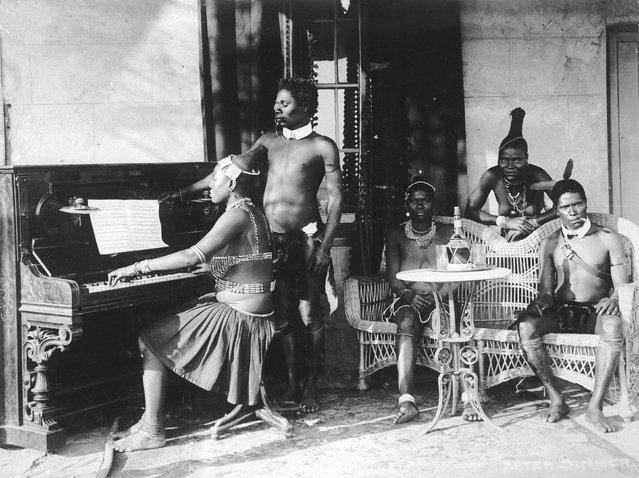
circa 1925:  A Zulu woman playing the piano while a group of others sit and listen.  (Photo by General Photographic Agency/Getty Images)

“The Zulu are the largest South African ethnic group, with an estimated 10–11 million people living mainly in the province of KwaZulu-Natal. Small numbers also live in Zimbabwe, Zambia, and Mozambique. Their language, Zulu, is a Bantu language; more specifically, part of the Nguni subgroup. The Zulu Kingdom played a major role in South African history during the 19th and 20th centuries. Under apartheid, Zulu people were classed as third-class citizens and suffered from state-sanctioned discrimination. They remain today the most numerous ethnic group in South Africa, and now have equal rights along with all other citizens”. – Wikipedia.

Photo: A Zulu woman playing the piano while a group of others sit and listen (to put it briefly, Englishmen scoff over Zulu). South Africa, circa 1925. (Photo by General Photographic Agency)

Details
03 Feb 2014 09:40:00
People watch as an acrobat rides his motorcycle around a circular track at an entertainment park set up outside a shrine in Rawalpindi, Pakistan, on June 19, 2013. (Photo by Muhammed Muheisen/Associated Press)

People watch as an acrobat rides his motorcycle around a circular track at an entertainment park set up outside a shrine in Rawalpindi, Pakistan, on June 19, 2013. (Photo by Muhammed Muheisen/Associated Press)
Details
22 Jun 2013 13:32:00
Fishermen move a fishing boat to a safer place along the shore ahead of cyclone Hudhud at Ganjam district in Odisha October 11, 2014. (Photo by Reuters/Stringer)

Fishermen move a fishing boat to a safer place along the shore ahead of cyclone Hudhud at Ganjam district in Odisha October 11, 2014. The India Meteorological Department described Cyclone Hudhud as a “very severe” storm that could pack winds of 195 kilometers (120 miles) per hour and cause torrential rains when it makes landfall near the port city of Visakhapatnam around noon Sunday. (Photo by Reuters/Stringer)
Details
13 Oct 2014 10:43:00
People travel by tube on the London Underground to take part in the Pride in London parade, London, Saturday, July 1, 2023. (Photo by Jordan Pettitt/PA Wire via AP Photo)

People travel by tube on the London Underground to take part in the Pride in London parade, London, Saturday, July 1, 2023. (Photo by Jordan Pettitt/PA Wire via AP Photo)
Details
09 Oct 2024 04:14:00
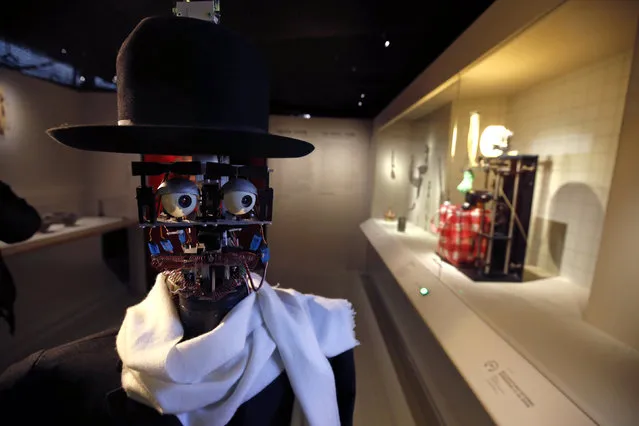
The Berenson robot strolls among visitors during the exhibition “Persona : Oddly Human” at the Quai Branly museum in Paris, France, February 23, 2016. The Berenson robot, developed in France in 2011, is the brainchild of anthropologist Denis Vidal and robotics engineer Philippe Gaussier. Its programming allows it to record reactions of museum visitors to certain pieces of art and then use the data to develop its own unique taste, which allows “Berenson” to judge whether or not it likes a certain work of art within an exhibition. (Photo by Philippe Wojazer/Reuters)

The Berenson robot strolls among visitors during the exhibition “Persona : Oddly Human” at the Quai Branly museum in Paris, France, February 23, 2016. The Berenson robot, developed in France in 2011, is the brainchild of anthropologist Denis Vidal and robotics engineer Philippe Gaussier. Its programming allows it to record reactions of museum visitors to certain pieces of art and then use the data to develop its own unique taste, which allows “Berenson” to judge whether or not it likes a certain work of art within an exhibition. (Photo by Philippe Wojazer/Reuters)
Details
25 Feb 2016 12:26:00
German fan Didi Senft known as El Diablo cheers as the pack rides past during the 234.5 km seventh stage of the 101st edition of the Tour de France cycling race on July 11, 2014 between Epernay and Nancy, northeastern France. (Photo by Lionel Bonaventure/AFP Photo)

German fan Didi Senft known as El Diablo cheers as the pack rides past during the 234.5 km seventh stage of the 101st edition of the Tour de France cycling race on July 11, 2014 between Epernay and Nancy, northeastern France. (Photo by Lionel Bonaventure/AFP Photo)
Details
20 Jul 2014 11:07:00
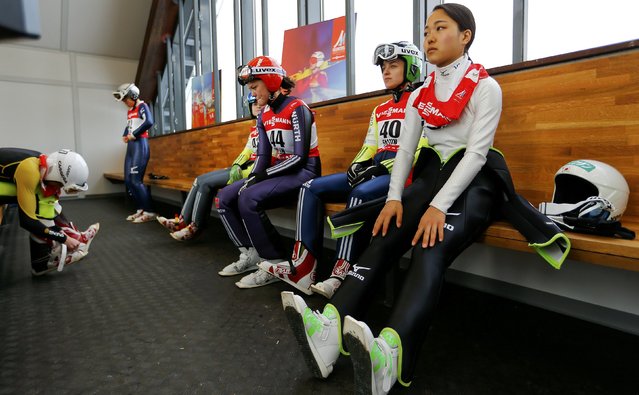
Sara Takanashi of Japan, Maja Vtic from Slovenia and Germany's Carina Vogt (R-L) prepare for a training session of the women's Individual normal hill HS100 ski jumping at the Nordic World Ski Championships in Falun February 18, 2015. (Photo by Kai Pfaffenbach/Reuters)

Sara Takanashi of Japan, Maja Vtic from Slovenia and Germany's Carina Vogt (R-L) prepare for a training session of the women's Individual normal hill HS100 ski jumping at the Nordic World Ski Championships in Falun February 18, 2015. (Photo by Kai Pfaffenbach/Reuters)
Details
19 Feb 2015 14:39:00