Loading...
Done
People enjoy carnival while shouting slogans of female empowerment and anti harrassment in Sao Paulo, Brazil on January 28, 2018. The carnival is marked by a lot of fun, but also has space to talk about more serious things – without losing the good mood. Parading for the first time in São Paulo, the Vaca Profana block proposed a reflection on sieges and machismo. With the breasts on display singing not only frevos but, mainly, shouting words of disorder, in order to stimulate female empowerment and against harassment. Our body is our struggle. The preservation of our physical integrity, our freedom of choice. Nude or clothed, we demand respect. (Photo by Cris Faga/Rex Features/Shutterstock)

People enjoy carnival while shouting slogans of female empowerment and anti harrassment in Sao Paulo, Brazil on January 28, 2018. The carnival is marked by a lot of fun, but also has space to talk about more serious things – without losing the good mood. Parading for the first time in São Paulo, the Vaca Profana block proposed a reflection on sieges and machismo. (Photo by Cris Faga/Rex Features/Shutterstock)
Details
29 Jan 2018 08:29:00
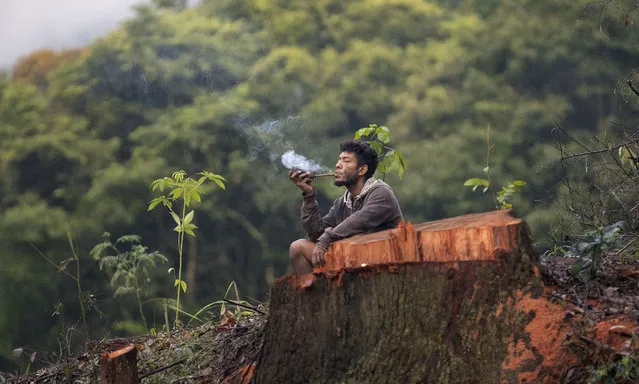
A Guarani Mbya man smokes a pipe next to a cut tree as he occupies land as a protest against real estate developer Tenda which plans to build apartment buildings here, next to his indigenous community's land in Sao Paulo, Brazil, Thursday, February 6, 2020. In response to an injunction filed by the builder, a judge has authorized the eviction of the indigenous protesters from the builder's property. (Photo by Andre Penner/AP Photo)

A Guarani Mbya man smokes a pipe next to a cut tree as he occupies land as a protest against real estate developer Tenda which plans to build apartment buildings here, next to his indigenous community's land in Sao Paulo, Brazil, Thursday, February 6, 2020. In response to an injunction filed by the builder, a judge has authorized the eviction of the indigenous protesters from the builder's property. (Photo by Andre Penner/AP Photo)
Details
22 Feb 2020 00:05:00
Revelers look at a cellphone during the annual street block party know as “Explode Coracao” on the third day of Carnival on February 19, 2023 in Sao Paulo, Brazil. According to the São Paulo City Council, during Carnival week more than 500 street blocks (blocos de rua) are held and more than 15 million people are expected to participate in them. Created in 2017, Explode Coracao is one of the most popular street blocks and attracted 150,000 revelers in its last edition, before the pandemic, in 2020. (Photo by Alexandre Schneider/Getty Images)

Revelers look at a cellphone during the annual street block party know as “Explode Coracao” on the third day of Carnival on February 19, 2023 in Sao Paulo, Brazil. According to the São Paulo City Council, during Carnival week more than 500 street blocks (blocos de rua) are held and more than 15 million people are expected to participate in them. Created in 2017, Explode Coracao is one of the most popular street blocks and attracted 150,000 revelers in its last edition, before the pandemic, in 2020. (Photo by Alexandre Schneider/Getty Images)
Details
22 Feb 2023 04:58:00
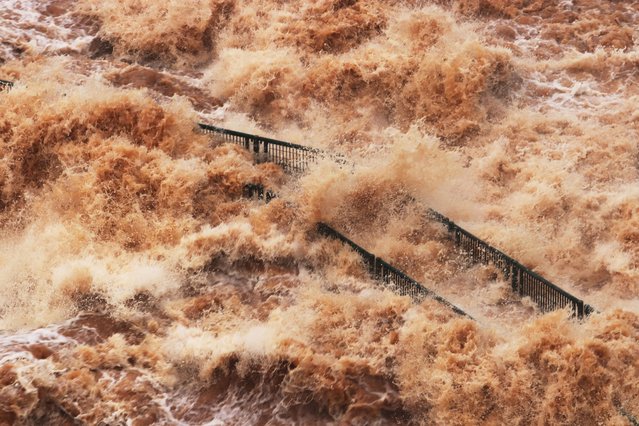
View of the visitor walkway at the Iguazu Falls, which was destroyed by the strong current of the river on the triple border between Brazil, Argentina and Paraguay, on October 30, 2023. The Falls are flowing at over 24 million liters of water per second, according to hydrological monitoring by Companhia Paranaense de Energia (Copel). This is the second highest flow since 1997, when monitoring became automatic and was measured hourly. (Photo by Christian Rizzi/AFP Photo)

View of the visitor walkway at the Iguazu Falls, which was destroyed by the strong current of the river on the triple border between Brazil, Argentina and Paraguay, on October 30, 2023. The Falls are flowing at over 24 million liters of water per second, according to hydrological monitoring by Companhia Paranaense de Energia (Copel). This is the second highest flow since 1997, when monitoring became automatic and was measured hourly. (Photo by Christian Rizzi/AFP Photo)
Details
21 Dec 2024 03:30:00
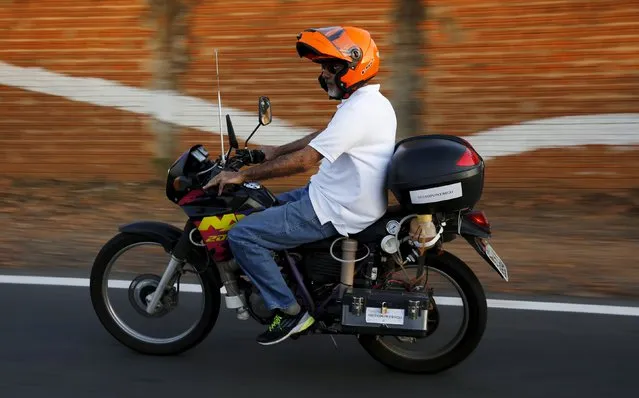
Ricardo Azevedo rides his Honda NX 200 motorbike, which he converted to be powered by water, in Salto, northwest of Sao Paulo, Brazil, August 6, 2015. The Sao Paulo civil servant built the motorbike which can cover up to 500 kilometres (311 miles) fueled by just one liter of water. Dubbed "Moto Power H2O", the bike is powered by a process of electrolysis by which the water molecule is broken down into its constituent elements. (Photo by Nacho Doce/Reuters)

Ricardo Azevedo rides his Honda NX 200 motorbike, which he converted to be powered by water, in Salto, northwest of Sao Paulo, Brazil, August 6, 2015. The Sao Paulo civil servant built the motorbike, which can cover up to 500 kilometres (311 miles) fuelled by just one litre of water. Dubbed “Moto Power H2O” the bike is powered by the process of electrolysis, which breaks the water molecule down into its constituent elements. (Photo by Nacho Doce/Reuters)
Details
13 Aug 2015 12:00:00
A gaucho is unseat by a wild horse during the annual celebration of Criolla Week in Montevideo, March 30, 2015. Throughout Easter Week, “gauchos”, the Latin American equivalent of the North American cowboy, from all over Uruguay and neighboring Argentina and Brazil will visit Montevideo to participate in the Criolla Week to win the best rider award. The competition is held from March 29 to April 5 this year. (Photo by Andres Stapff/Reuters)

A gaucho is unseat by a wild horse during the annual celebration of Criolla Week in Montevideo, March 30, 2015. Throughout Easter Week, “gauchos”, the Latin American equivalent of the North American cowboy, from all over Uruguay and neighboring Argentina and Brazil will visit Montevideo to participate in the Criolla Week to win the best rider award. The competition is held from March 29 to April 5 this year. (Photo by Andres Stapff/Reuters)
Details
01 Apr 2015 12:22:00
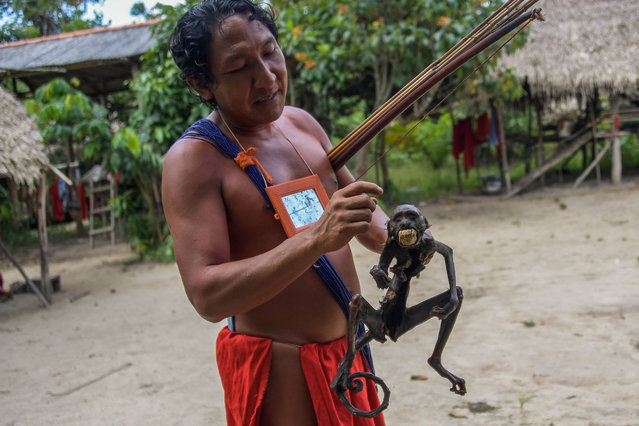
Chieftain Japarupi Waiapi shows a roasted monkey -part of Waiapi's diet, also based in Manioc and fruits- at the reserve in Amapa state in Brazil on October 13, 2017. When Waiapis walks into the Amazon forest surrounding their village, they do not see trees, but a kind of shopping mall providing medicine, food, shelter, tools and weapons  all under the eye of multiple spirits. (Photo by Apu Gomes/AFP Photo)

Chieftain Japarupi Waiapi shows a roasted monkey -part of Waiapi's diet, also based in Manioc and fruits- at the reserve in Amapa state in Brazil on October 13, 2017. When Waiapis walks into the Amazon forest surrounding their village, they do not see trees, but a kind of shopping mall providing medicine, food, shelter, tools and weapons all under the eye of multiple spirits. (Photo by Apu Gomes/AFP Photo)
Details
27 Oct 2017 08:39:00
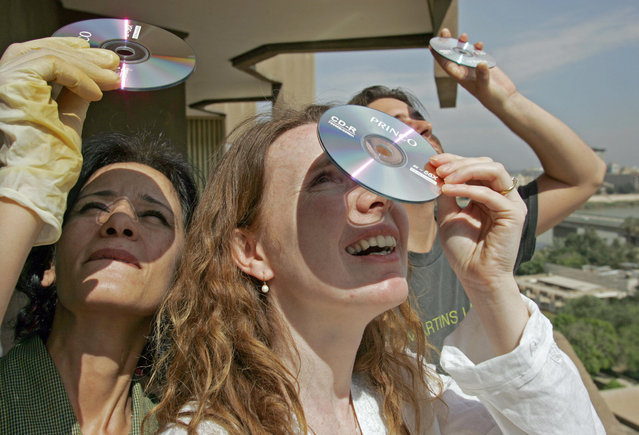
An Iraqi woman and foreigners use  pair of compact discs as a filter to watch the partial solar eclipse in war-torn Baghdad, 29 March 2006. Without access to proper equipment to protect their eyes from the sun's rays, eclipse watchers in Iraq used makeshift filters.  The moon blotted out the sun over northwest Africa early Wednesday, turning day into night in a total solar eclipse as it swept a shadowy path from the outer tip of Brazil to the steppes of Mongolia. (Photo by Hassan Ammar/AFP Photo)

An Iraqi woman and foreigners use pair of compact discs as a filter to watch the partial solar eclipse in war-torn Baghdad, 29 March 2006. Without access to proper equipment to protect their eyes from the sun's rays, eclipse watchers in Iraq used makeshift filters. The moon blotted out the sun over northwest Africa early Wednesday, turning day into night in a total solar eclipse as it swept a shadowy path from the outer tip of Brazil to the steppes of Mongolia. (Photo by Hassan Ammar/AFP Photo)
Details
25 Jul 2017 09:31:00