Loading...
Done
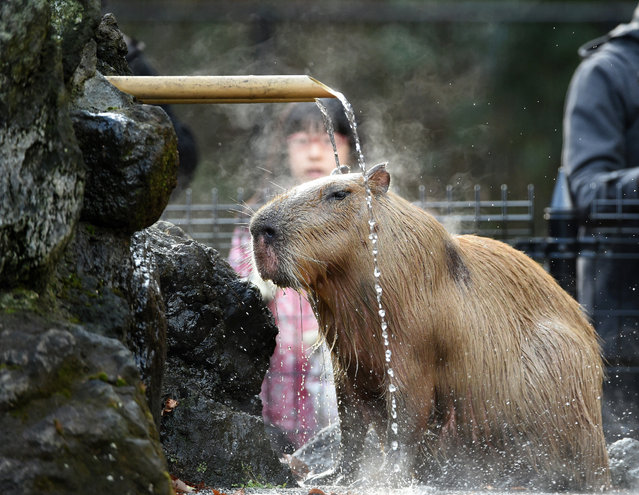
A Capybara bathes in the hot spring water at the Saitama Children's zoo in Higashi Matsuyama city, Saitama prefecture on December 21, 2014. Seven capybaras in the zoo, originally from South America, enjoyed the hot spring water on the chilly winter day in Japan. (Photo by Toshifumi Kitamura/AFP Photo)

A Capybara bathes in the hot spring water at the Saitama Children's zoo in Higashi Matsuyama city, Saitama prefecture on December 21, 2014. Seven capybaras in the zoo, originally from South America, enjoyed the hot spring water on the chilly winter day in Japan. (Photo by Toshifumi Kitamura/AFP Photo)
Details
27 Dec 2014 12:59:00
Black Nazarene devotees clamber on top of one another to to touch the cross on January 9, 2015 in Manila, Philippines. The Feast of the Black Nazarene culminates in a day long procession on January 9 as barefoot devotees march to see and touch the image of the Black Nazarene. (Photo by Dondi Tawatao/Getty Images)

Black Nazarene devotees clamber on top of one another to to touch the cross on January 9, 2015 in Manila, Philippines. The Feast of the Black Nazarene culminates in a day long procession on January 9 as barefoot devotees march to see and touch the image of the Black Nazarene. The Black Nazarene is a dark wood sculpture of Jesus brought to the Philippines in 1606 from Spain and considered miraculous by Filipino devotees. The event falls a week ahead of the visit of Pope Francis who will travel to Leyte and Manila during his visit to the Philippines from January 15–19. The visit is expected to attract crowds in the millions as Filipino Catholics flock to catch a glimpse of the leader of the Catholic Church. The Philippines is the only Catholic majority nation in Asia with around 90 percent of the population professing the faith. (Photo by Dondi Tawatao/Getty Images)
Details
11 Jan 2015 13:46:00
A woman sits in a cell at the Los Angeles County Women's jail in Lynwood, California April 26, 2013. (Photo by Lucy Nicholson/Reuters)

A woman sits in a cell at the Los Angeles County Women's jail in Lynwood, California April 26, 2013. (Photo by Lucy Nicholson/Reuters)
Details
16 Jul 2015 10:46:00
Bottlenose dolphins swim over visitors in water tank at the Hakkeijima Sea Paradise aquarium-amusement park complex in Yokohama, southwest of Tokyo, Tuesday, July 21, 2015. Temperatures in Tokyo's metropolitan area neared around 96 degree Fahrenheit, or 35 degree Celsius, on Tuesday. (Photo by Shuji Kajiyama/AP Photo)

Bottlenose dolphins swim over visitors in water tank at the Hakkeijima Sea Paradise aquarium-amusement park complex in Yokohama, southwest of Tokyo, Tuesday, July 21, 2015. Temperatures in Tokyo's metropolitan area neared around 96 degree Fahrenheit, or 35 degree Celsius, on Tuesday. (Photo by Shuji Kajiyama/AP Photo)
Details
22 Jul 2015 12:33:00
A Tenggerese shaman praying for worshippers at Widodaren cave during the Tenggerese Hindu Yadnya Kasada festival on July 31, 2015 in Probolinggo, East Java, Indonesia. The festival is the main festival of the Tenggerese people and lasts about a month. On the fourteenth day, the Tenggerese make the journey to Mount Bromo to make offerings of rice, fruits, vegetables, flowers and livestock to the mountain gods by throwing them into the volcano's caldera. (Photo by Ulet Ifansasti/Getty Images)

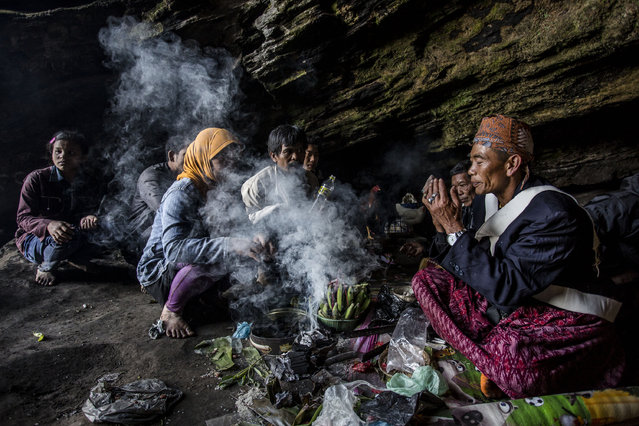
A Tenggerese shaman praying for worshippers at Widodaren cave during the Tenggerese Hindu Yadnya Kasada festival on July 31, 2015 in Probolinggo, East Java, Indonesia. The festival is the main festival of the Tenggerese people and lasts about a month. On the fourteenth day, the Tenggerese make the journey to Mount Bromo to make offerings of rice, fruits, vegetables, flowers and livestock to the mountain gods by throwing them into the volcano's caldera. The origin of the festival lies in the 15th century when a princess named Roro Anteng started the principality of Tengger with her husband Joko Seger, and the childless couple asked the mountain Gods for help in bearing children. The legend says the Gods granted them 24 children but on the provision that the 25th must be tossed into the volcano in sacrifice. The 25th child, Kesuma, was finally sacrificed in this way after initial refusal, and the tradition of throwing sacrifices into the caldera to appease the mountain Gods continues today. (Photo by Ulet Ifansasti/Getty Images)

Details
01 Aug 2015 12:07:00
A former paratrooper demonstrates his strength and skills while lifting a chair during the celebrations for the Paratroopers Day at the Central park in the Siberian city of Krasnoyarsk, Russia, August 2, 2015. (Photo by Ilya Naymushin/Reuters)

A former paratrooper demonstrates his strength and skills while lifting a chair during the celebrations for the Paratroopers Day at the Central park in the Siberian city of Krasnoyarsk, Russia, August 2, 2015. Paratroopers are an elite unit of the Soviet Army, and everyone in the country recognize their blue berets. (Photo by Ilya Naymushin/Reuters)
Details
03 Aug 2015 12:13:00
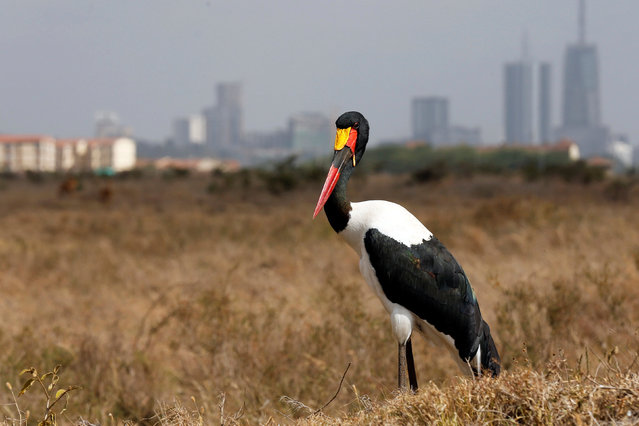
A saddle-billed stork stands in the grassland at the Nairobi National Park near Nairobi, Kenya January 23, 2017. (Photo by Thomas Mukoya/Reuters)

A saddle-billed stork stands in the grassland at the Nairobi National Park near Nairobi, Kenya January 23, 2017. (Photo by Thomas Mukoya/Reuters)
Details
29 Jan 2017 11:32:00
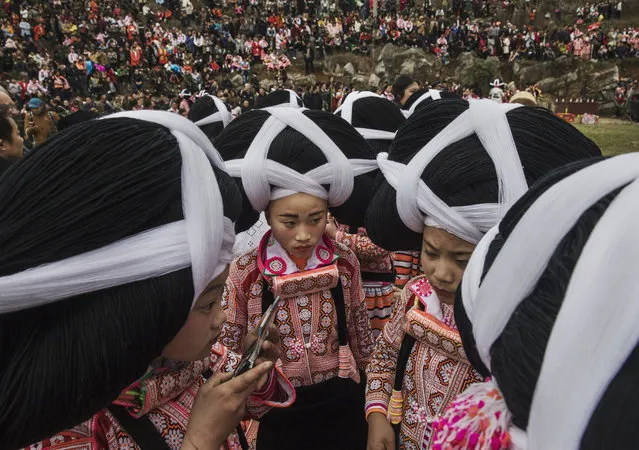
Girls of the Long Horn Miao ethnic minority group wear headdresses as they prepare gather for Tiaohua or Flower Festival as part of the Lunar New Year on February 6, 2017 in Longga village, Guizhou province, southern China. The Long Horn Miao are recognized for their declining practice of wrapping a blend of linen, wool, and the hair of their ancestors around animal horns or a wooden clip to make headdresses. Many young women say they now wear the headdresses only for special occasions and festivals, as the ornaments, which are attached by the horns to their real hair, have proved impractical for modern daily life in a fast changing world. China officially recognizes 56 different ethnic minorities, and statistics show over 7 million Chinese identifying themselves as Miao. But the small Long Horn Miao community counts only around 5000 people living in 12 villages, whose age-old traditions, language, and culture are fading. It is increasingly difficult in a modernizing China, as young people are drawn from remote rural villages to opportunities in bigger cities amongst wide-scale urbanization. Farming and labour remain the mainstays of life for the Long Horn Miao, leaving the area relatively poor in comparison with many parts of China. The government has invested significant amounts into local infrastructure and the tourism industry to try to bolster the local economy. (Photo by Kevin Frayer/Getty Images)

Girls of the Long Horn Miao ethnic minority group wear headdresses as they prepare gather for Tiaohua or Flower Festival as part of the Lunar New Year on February 6, 2017 in Longga village, Guizhou province, southern China. (Photo by Kevin Frayer/Getty Images)
Details
13 Feb 2017 00:01:00