Loading...
Done
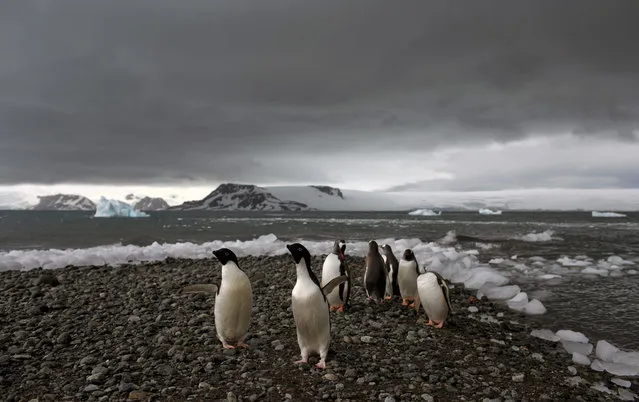
In this January 27, 2015 photo, penguins walk on the shore of Bahia Almirantazgo in Antarctica.  Antarctica “is big and it's changing and it affects the rest of the planet and we can't afford to ignore what's going on down there”, said David Vaughan, science director of the British Antarctic Survey. (Photo by Natacha Pisarenko/AP Photo)

In this January 27, 2015 photo, penguins walk on the shore of Bahia Almirantazgo in Antarctica. Antarctica “is big and it's changing and it affects the rest of the planet and we can't afford to ignore what's going on down there”, said David Vaughan, science director of the British Antarctic Survey. (Photo by Natacha Pisarenko/AP Photo)
Details
22 Feb 2015 10:45:00
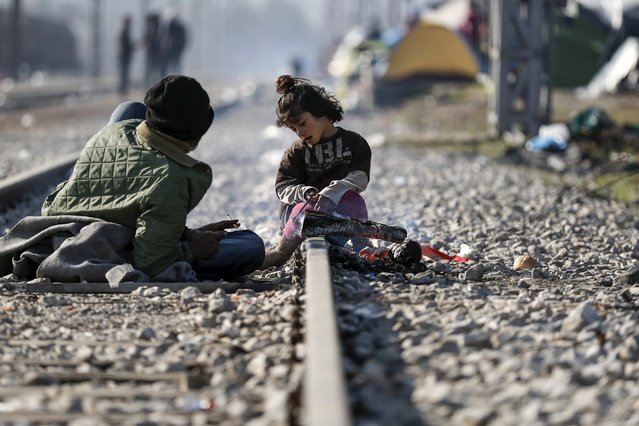
A girl sits on railway tracks at a makeshift camp for refugees and migrants at the Greek-Macedonian border near the village of Idomeni, Greece, March 19, 2016. (Photo by Alkis Konstantinidis/Reuters)

A girl sits on railway tracks at a makeshift camp for refugees and migrants at the Greek-Macedonian border near the village of Idomeni, Greece, March 19, 2016. (Photo by Alkis Konstantinidis/Reuters)
Details
20 Mar 2016 11:43:00
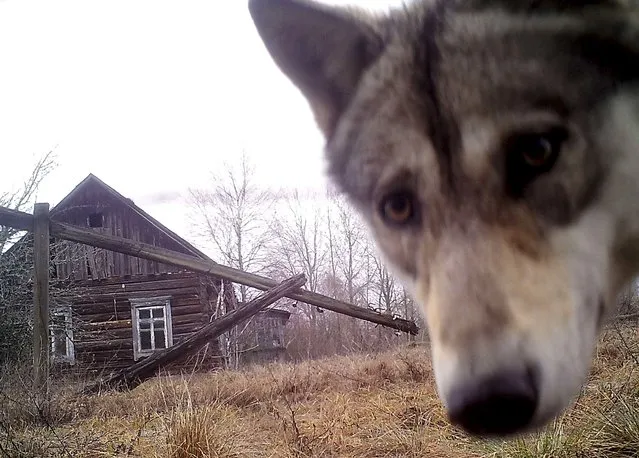
A wolf looks into the camera at the 30 km (19 miles) exclusion zone around the Chernobyl nuclear reactor in the abandoned village of Orevichi, Belarus, March 2, 2016. (Photo by Vasily Fedosenko/Reuters)

A wolf looks into the camera at the 30 km (19 miles) exclusion zone around the Chernobyl nuclear reactor in the abandoned village of Orevichi, Belarus, March 2, 2016. What happens to the environment when humans disappear? Thirty years after the Chernobyl nuclear disaster, booming populations of wolf, elk and other wildlife in the vast contaminated zone in Belarus and Ukraine provide a clue. (Photo by Vasily Fedosenko/Reuters)
Details
08 Apr 2016 15:13:00
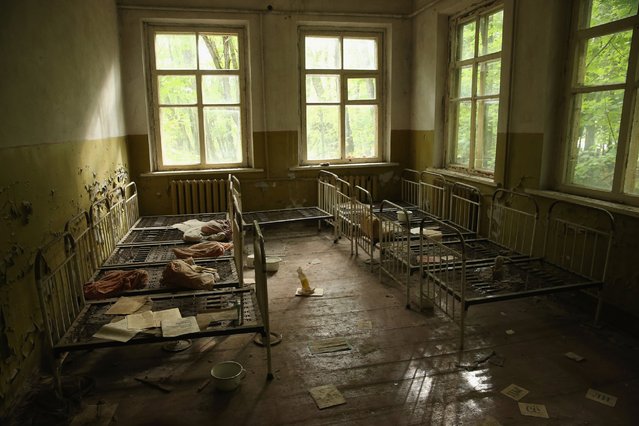
The 30th anniversary of the meltdown at the Chernobyl nuclear plant that caused large amounts of radioactive particles to be released into the air will be commemorated on April 26, 2016. Photojournalist Sean Gallup returned to the area to document the lasting effects of the world's worst nuclear power plant accident. Pictured, children's beds are seen in an abandoned kindergarten in Kopachi village located inside the Chernobyl exclusion zone, Sept. 29, 2015, near Chernobyl, Ukraine. (Photo by Sean Gallup/Getty Images)

The 30th anniversary of the meltdown at the Chernobyl nuclear plant that caused large amounts of radioactive particles to be released into the air will be commemorated on April 26, 2016. Photojournalist Sean Gallup returned to the area to document the lasting effects of the world's worst nuclear power plant accident. Pictured, children's beds are seen in an abandoned kindergarten in Kopachi village located inside the Chernobyl exclusion zone, September 29, 2015, near Chernobyl, Ukraine. (Photo by Sean Gallup/Getty Images)
Details
14 Apr 2016 12:01:00
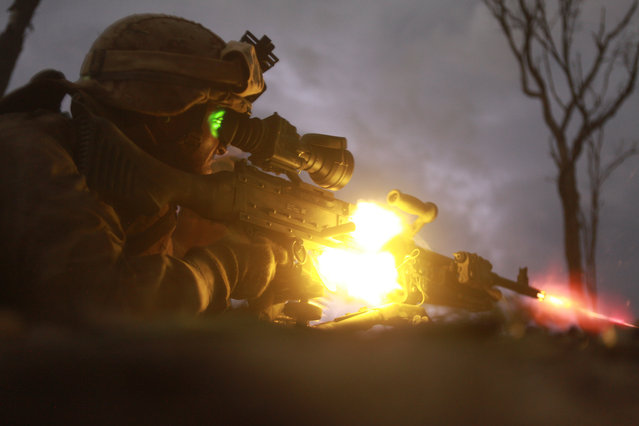
Pfc. Sebastian Rodriguez, machine gunner, Weapons Platoon, Lima Company, 3rd Battalion, 3rd Marine Regiment, Marine Rotational Force – Darwin, fires an M240 machine gun during a night squad-attack exercise, here, May 22, 2013. (Photo by Sgt. Sarah Fiocco/U.S. Marines)

Pfc. Sebastian Rodriguez, machine gunner, Weapons Platoon, Lima Company, 3rd Battalion, 3rd Marine Regiment, Marine Rotational Force – Darwin, fires an M240 machine gun during a night squad-attack exercise, here, May 22, 2013. (Photo by Sgt. Sarah Fiocco/U.S. Marines)
Details
17 Aug 2014 08:48:00
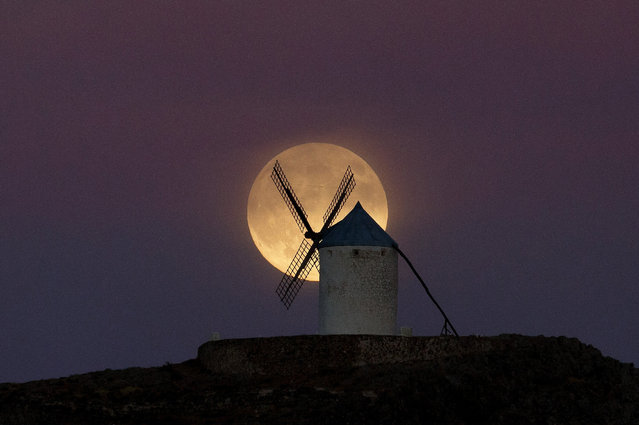
A moon appears behind a windmill a day before the supermoon is full on September 8, 2014 in Consuegra, in Toledo province, Spain. Consuegra belongs to a region made famous by the novel “Don Quijote de la Mancha” (Don Quixote) writed by Miguel De Cervantes. Some of the windmills belong to the 16th century. (Photo by Pablo Blazquez Dominguez/Getty Images)

A moon appears behind a windmill a day before the supermoon is full on September 8, 2014 in Consuegra, in Toledo province, Spain. Consuegra belongs to a region made famous by the novel “Don Quijote de la Mancha” (Don Quixote) writed by Miguel De Cervantes. Some of the windmills belong to the 16th century. (Photo by Pablo Blazquez Dominguez/Getty Images)
Details
10 Sep 2014 12:06:00
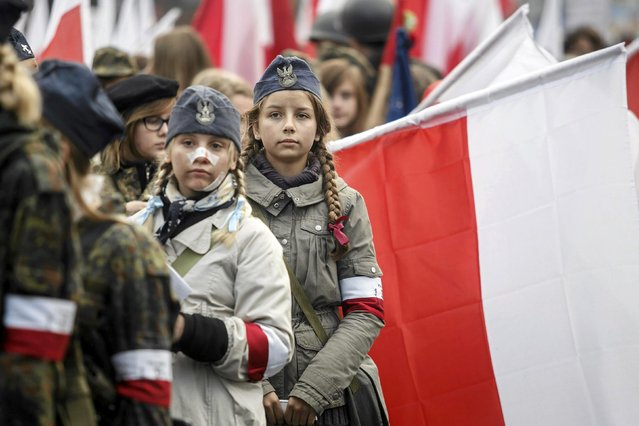
Youths parade wearing World War Two uniforms during the Independence Day celebrations in Gdansk November 11, 2014. (Photo by Lukasz Glowala/Reuters/Agencja Gazeta)

Youths parade wearing World War Two uniforms during the Independence Day celebrations in Gdansk November 11, 2014. (Photo by Lukasz Glowala/Reuters/Agencja Gazeta)
Details
13 Nov 2014 14:00:00
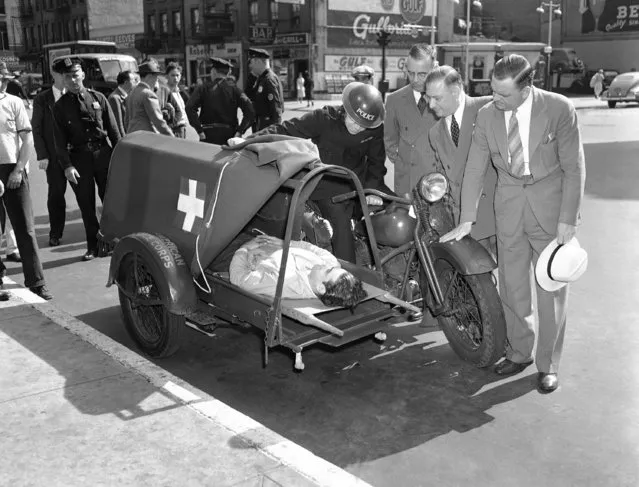
Developed for the British American Ambulance Corps, this new motorcycle ambulance is capable of speeding wounded soldiers 90 miles an hour from the front lines to field hospitals. Its springs are synchronized with the patient?s heartbeat to avoid increasing fever when traveling over various Terrain. Viewing it in New York  August 27, 1941, are left to right: constable Herbert Scott of England, driver; William E. Detlor, whose firm developed the vehicle; M. W. Stand, inspector-general of Civilian Defense, and Maj. Edward Riekert, also. (Photo by AP Photo)

Developed for the British American Ambulance Corps, this new motorcycle ambulance is capable of speeding wounded soldiers 90 miles an hour from the front lines to field hospitals. Its springs are synchronized with the patient's heartbeat to avoid increasing fever when traveling over various Terrain. Viewing it in New York August 27, 1941, are left to right: constable Herbert Scott of England, driver; William E. Detlor, whose firm developed the vehicle; M. W. Stand, inspector-general of Civilian Defense, and Maj. Edward Riekert, also. (Photo by AP Photo)
Details
28 Aug 2015 11:51:00