Loading...
Done
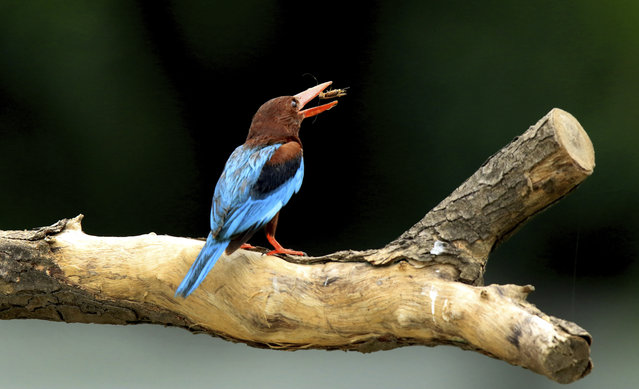
A common kingfisher sits on a branch of a tree after catching an insect in Allahabad, India, Sunday, July 9, 2017. The common kingfisher is a highly territorial bird that has to eat nearly sixty percent of its bodyweight every day. (Photo by Rajesh Kumar Singh/AP Photo)

A common kingfisher sits on a branch of a tree after catching an insect in Allahabad, India, Sunday, July 9, 2017. The common kingfisher is a highly territorial bird that has to eat nearly sixty percent of its bodyweight every day. (Photo by Rajesh Kumar Singh/AP Photo)
Details
16 Jul 2017 07:52:00
A worker pushes a wheelbarrow past a mural in Doha on November 8, 2022, ahead of the Qatar 2022 FIFA World Cup football tournament. (Photo by Gabriel Bouys/AFP Photo)

A worker pushes a wheelbarrow past a mural in Doha on November 8, 2022, ahead of the Qatar 2022 FIFA World Cup football tournament. (Photo by Gabriel Bouys/AFP Photo)
Details
15 Dec 2022 02:14:00
Visitors crowd an artificial wave swimming pool at a tourist resort to escape the summer heat in Daying county of Suining, Sichuan province, China, July 11, 2015. (Photo by Reuters/Stringer)

Visitors crowd an artificial wave swimming pool at a tourist resort to escape the summer heat in Daying county of Suining, Sichuan province, China, July 11, 2015. (Photo by Reuters/Stringer)
Details
12 Jul 2015 14:06:00
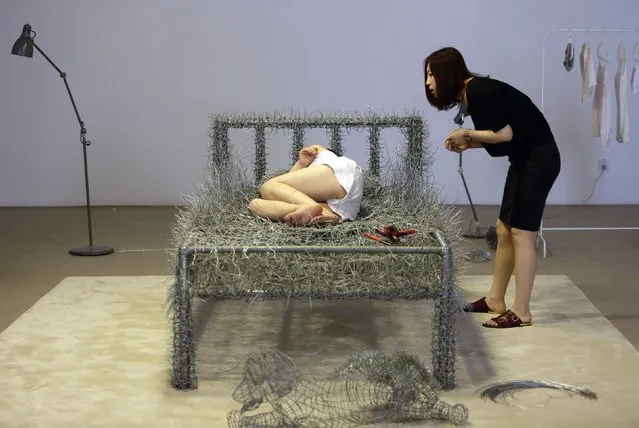
Chinese artist Zhou Jie takes a nap on an unfinished iron wire bed, one of her sculpture works, after lunch as a friend of hers looks on at Beijing Now Art Gallery, in Beijing August 11, 2014. (Photo by Jason Lee/Reuters)

Chinese artist Zhou Jie takes a nap on an unfinished iron wire bed, one of her sculpture works, after lunch as a friend of hers looks on at Beijing Now Art Gallery, in Beijing August 11, 2014. Zhou started her art project titled “36 Days” on August 9, in which she would live inside an exhibition hall with an unfinished iron wire bed, some iron wire sculptures in the shape of stuffed animal dolls, a certain amount of food and her mobile phone, for 36 days. The entire process is open to visitors and she may also interact with them, according to Zhou. (Photo by Jason Lee/Reuters)
Details
16 Aug 2014 10:37:00
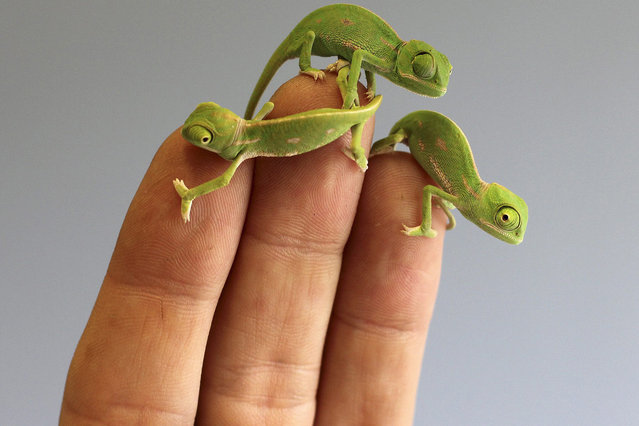
A handout image released by the Taronga Zoo shows Veiled Chameleon hatchlings at Taronga Zoo in Sydney, Australia, 11 March 2015. Taronga has welcomed more than 20 baby chameleons, with the last of three clutches of eggs hatching this week. Veiled Chameleons, or Chamaeleo calyptratus, are native to Saudi Arabia and Yemen and can live up to five years. (Photo by EPA/Taronga Zoo)

A handout image released by the Taronga Zoo shows Veiled Chameleon hatchlings at Taronga Zoo in Sydney, Australia, 11 March 2015. Taronga has welcomed more than 20 baby chameleons, with the last of three clutches of eggs hatching this week. Veiled Chameleons, or Chamaeleo calyptratus, are native to Saudi Arabia and Yemen and can live up to five years. (Photo by EPA/Taronga Zoo)
Details
21 Mar 2015 13:13:00
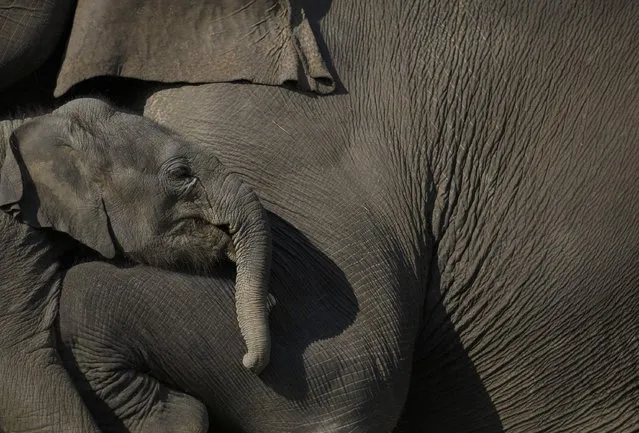
A one and a half months old baby elephant stands close to its mother at Chitwan National Park in Chitwan, south of Kathmandu December 30, 2014. (Photo by Navesh Chitrakar/Reuters)

A one and a half months old baby elephant stands close to its mother at Chitwan National Park in Chitwan, south of Kathmandu December 30, 2014. (Photo by Navesh Chitrakar/Reuters)
Details
01 Jan 2015 13:45:00
Refugees and migrants try to find a place on an already full train headed for Serbia, near the city of Gevgelija, The Former Yugoslav Republic of Macedonia, on February 24, 2016. Refugees and migrants from Iraq and Syria continue to pass through Macedonia on their way to the European Union. (Photo by Georgi Licovski/EPA)

Refugees and migrants try to find a place on an already full train headed for Serbia, near the city of Gevgelija, The Former Yugoslav Republic of Macedonia, on February 24, 2016. Refugees and migrants from Iraq and Syria continue to pass through Macedonia on their way to the European Union. (Photo by Georgi Licovski/EPA)
Details
25 Feb 2016 11:57:00
The Berenson robot strolls among visitors during the exhibition “Persona : Oddly Human” at the Quai Branly museum in Paris, France, February 23, 2016. The Berenson robot, developed in France in 2011, is the brainchild of anthropologist Denis Vidal and robotics engineer Philippe Gaussier. Its programming allows it to record reactions of museum visitors to certain pieces of art and then use the data to develop its own unique taste, which allows “Berenson” to judge whether or not it likes a certain work of art within an exhibition. (Photo by Philippe Wojazer/Reuters)

The Berenson robot strolls among visitors during the exhibition “Persona : Oddly Human” at the Quai Branly museum in Paris, France, February 23, 2016. The Berenson robot, developed in France in 2011, is the brainchild of anthropologist Denis Vidal and robotics engineer Philippe Gaussier. Its programming allows it to record reactions of museum visitors to certain pieces of art and then use the data to develop its own unique taste, which allows “Berenson” to judge whether or not it likes a certain work of art within an exhibition. (Photo by Philippe Wojazer/Reuters)
Details
25 Feb 2016 12:26:00