Loading...
Done
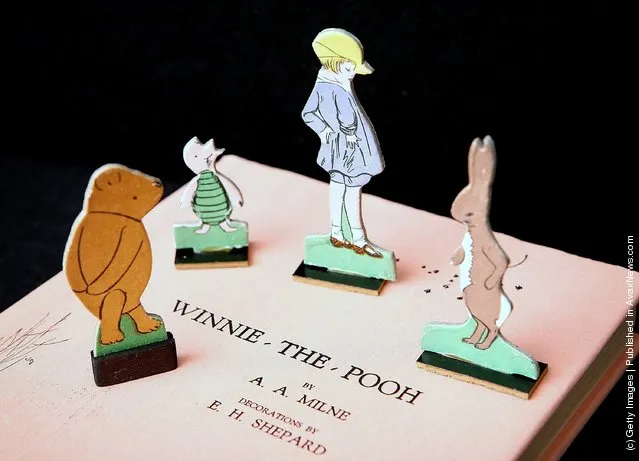
Winnie-The-Pooh

“Alan Alexander “A. A.” Milne (18 January 1882 – 31 January 1956) was an English author. Milne is most famous for his two Pooh books about a boy named Christopher Robin after his son, and various characters inspired by his son's stuffed animals, most notably the bear named Winnie-the-Pooh”. – Wikipedia

Photo: A rare American first edition of a Winnie-the-Pooh book signed by the author A.A. Milne and illustrator E. H. Shephard is displayed with Pooh characters form a 1930's game at a press preview at Sotheby's Auctioneers on December 15, 2008 in London. (Photo by Peter Macdiarmid/Getty Images)
Details
28 Aug 2011 13:34:00
A massive positive cloud-to-ground lightning strike hits in Coolidge, Arizona, 31 August 2016. (Photo by Mike Olbinski/Barcroft Images)

A massive positive cloud-to-ground lightning strike hits in Coolidge, Arizona, 31 August 2016. Thousands of rain drops merge to form mammoth travelling sheets of water in these breathtaking monsoons. Veteran storm chaser and photographer Mike Olbinski captured the stunning beauty of monsoons in timelapses and stills while chasing storm systems across America. (Photo by Mike Olbinski/Barcroft Images)
Details
10 Jan 2017 13:59:00
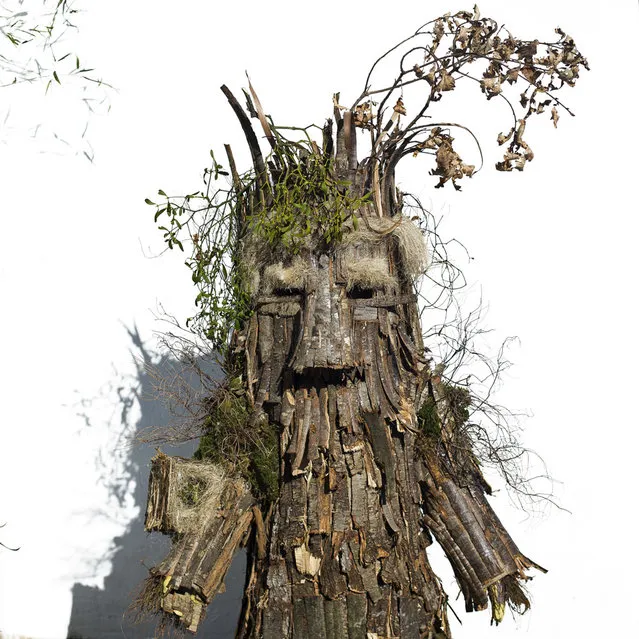
A man dressed as a  “Trapajon”, representing entities of nature, poses for a picture after taking part in the Vijanera Festival in Silio, northern Spain, Sunday, Jan. 6, 2013. The Vijanera masquerade, of pre-Roman origin, is the first carnival of the year in Europe symbolizing the triumph of good over evil and involving the participation of crowds of residents wearing different masks, animal skins and brightly colored clothing with its own complex function and symbolism and becoming the living example of the survival of archaic cults to nature. (Photo by Daniel Ochoa de Olza/AP Photo)

A man dressed as a “Trapajon”, representing entities of nature, poses for a picture after taking part in the Vijanera Festival in Silio, northern Spain, Sunday, Jan. 6, 2013. The Vijanera masquerade, of pre-Roman origin, is the first carnival of the year in Europe symbolizing the triumph of good over evil and involving the participation of crowds of residents wearing different masks, animal skins and brightly colored clothing with its own complex function and symbolism and becoming the living example of the survival of archaic cults to nature. (Photo by Daniel Ochoa de Olza/AP Photo)
Details
19 Jan 2013 13:01:00
An Orangutan named “Pacquiao” and zoo owner Manny Tangco, wearing Santa costumes, embrace in front of Brown Philippine Deer while giving school children a tour ahead of the next week's Christmas celebration Thursday, December 18, 2014 in suburban Malabon city, north of Manila, Philippines. The yearly treat is aimed at encouraging residents to be sensitive to the feelings of animals especially when exploding firecrackers for the raucous celebration. (Photo by Bullit Marquez/AP Photo)

An Orangutan named “Pacquiao” and zoo owner Manny Tangco, wearing Santa costumes, embrace in front of Brown Philippine Deer while giving school children a tour ahead of the next week's Christmas celebration Thursday, December 18, 2014 in suburban Malabon city, north of Manila, Philippines. The yearly treat is aimed at encouraging residents to be sensitive to the feelings of animals especially when exploding firecrackers for the raucous celebration. (Photo by Bullit Marquez/AP Photo)
Details
19 Dec 2014 13:04:00
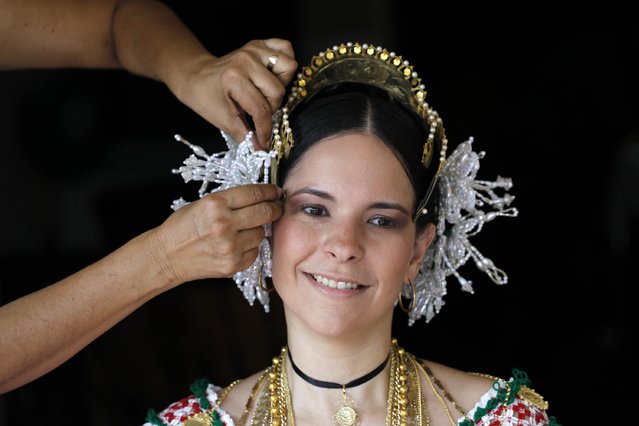
A woman is helped with adorning her hair with jewelry, part of the traditional clothing known as “Pollera”, before the annual Thousand Polleras parade in Las Tablas, in the province of Los Santos January 10, 2015. According to local residents, the Pollera dates back to the 18th century and was worn by the Spanish lower classes. (Photo by Carlos Jasso/Reuters)

A woman is helped with adorning her hair with jewelry, part of the traditional clothing known as “Pollera”, before the annual Thousand Polleras parade in Las Tablas, in the province of Los Santos January 10, 2015. According to local residents, the Pollera dates back to the 18th century and was worn by the Spanish lower classes. Today, it has become the Panamanian national costume. The dress is made entirely by hand and the jewellery worn is pure gold and worth thousands of dollars. (Photo by Carlos Jasso/Reuters)
Details
12 Jan 2015 15:46:00
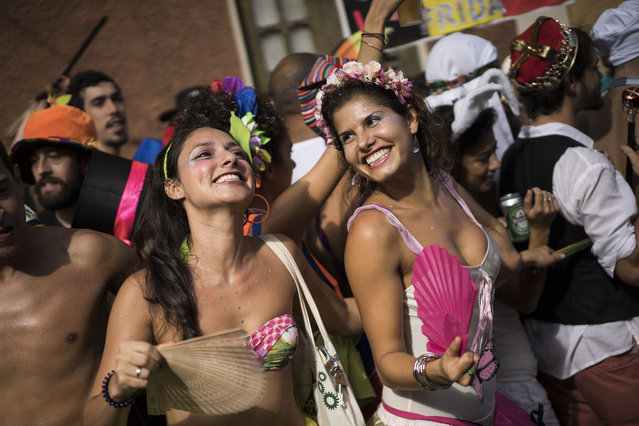
Revelers dance during the “Ceu na Terra”, or Heaven on earth, carnival parade in Rio de Janeiro, Brazil, Saturday, February 7, 2015. Rio's over-the-top Carnival is the highlight of the year for many local residents. Hundreds of thousands of merrymakers are beginning to take to the streets in open-air “blocos” parties. (Photo by Felipe Dana/AP Photo)

Revelers dance during the “Ceu na Terra”, or Heaven on earth, carnival parade in Rio de Janeiro, Brazil, Saturday, February 7, 2015. Rio's over-the-top Carnival is the highlight of the year for many local residents. Hundreds of thousands of merrymakers are beginning to take to the streets in open-air “blocos” parties. (Photo by Felipe Dana/AP Photo)
Details
10 Feb 2015 12:33:00
Shi'ite fighters launch a rocket during clashes with Islamic State militants on the outskirts of al-Alam March 8, 2015. Thaier Al-Sudani: “It was me and a few other Iraqi journalists working for local outlets. (Photo by Thaier Al-Sudani/Reuters)

Shi'ite fighters launch a rocket during clashes with Islamic State militants on the outskirts of al-Alam March 8, 2015. Thaier Al-Sudani: “It was me and a few other Iraqi journalists working for local outlets. We went to the frontlines in coordination with the Iraqi government forces and supporting militias. The press officer would come in the morning and take us to the frontline in a convoy. Whenever an area was won from Islamic State, the fighters would chant and pray and show victory signs. Most of the areas we were in didn't have residents, so after the battle they would resemble ghost towns; nothing but burnt cars and charred bodies of Islamic State fighters. Al-Alam was an exception as it had some residents who chanted for the government forces after their victory”. (Photo by Thaier Al-Sudani/Reuters)
Details
14 Mar 2015 14:33:00
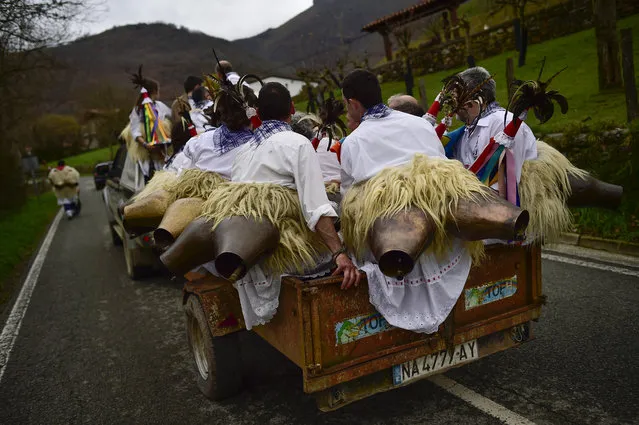
Joaldunaks return in a trailer to their town at the end of Carnival between of the Pyrenees villages of Ituren and Zubieta, northern Spain, Monday, February 1, 2016. In one of the most ancient carnivals in Europe, dating from before the Roman empire, companies of Joaldunak (cowbells) made up of residents of two towns, Ituren and Zubieta, parade the streets costumed in sandals, lace petticoats, sheepskins around the waist and shoulders, coloured neckerchiefs, conical caps with ribbons and a hyssop of horsehair in their right hands and cowbells hung across their lower back. (Photo by Alvaro Barrientos/AP Photo)

Joaldunaks return in a trailer to their town at the end of Carnival between of the Pyrenees villages of Ituren and Zubieta, northern Spain, Monday, February 1, 2016. In one of the most ancient carnivals in Europe, dating from before the Roman empire, companies of Joaldunak (cowbells) made up of residents of two towns, Ituren and Zubieta, parade the streets costumed in sandals, lace petticoats, sheepskins around the waist and shoulders, coloured neckerchiefs, conical caps with ribbons and a hyssop of horsehair in their right hands and cowbells hung across their lower back. (Photo by Alvaro Barrientos/AP Photo)
Details
02 Feb 2016 13:07:00