
02 Feb 2013 12:23:00,post received
0 comments

Details

An infrared portrait from NASA's Spitzer Space Telescope which shows generations of stars is seen in this undated NASA handout image released February 14, 2013. In this wispy star-forming region, called W5, the oldest stars can be seen as blue dots in the centers of the two hollow cavities (other blue dots are background and foreground stars not associated with the region). Red shows heated dust that pervades the region's cavities, while green highlights dense clouds. (Photo by NASA/Reuters/JPL-Caltech/Harvard-Smithsonian/Handout)
03 Mar 2013 08:44:00,post received
0 comments

#Petheadz – is an Instagram series by Zach Rose, a 23 year old photographer/filmmaker from Toronto. (Photo by Zach Rose)
10 Mar 2015 14:06:00,post received
0 comments

A giant sinkhole in Guatemala City, on May 31, 2010. More than 94,000 were evacuated as the storm buried homes under mud, swept away a highway bridge near Guatemala City and opened up several sinkholes in the capital. (Photo by Casa Presidencial/Reuters via The Atlantic)
14 Jul 2013 07:22:00,post received
0 comments

Karis, an eleven week old lion cub, plays in fallen leaves brushed up by keepers in her enclosure at Blair Drummond Safari Park, near Stirling, Scotland, on November 20, 2013. (Photo by Andrew Milligan/PA Wire)
23 Nov 2013 11:44:00,post received
0 comments

A demonstrator with face painted in the colours of the Palestinian flag protests outside the Israeli Embassy in west London July 26, 2014. Foreign ministers from the United States, Europe and the Middle East called on Saturday for an extension of the 12-hour ceasefire between Israel and Hamas in the Gaza Strip, French Foreign Minister Laurent Fabius said. (Photo by Luke MacGregor/Reuters)
28 Jul 2014 10:41:00,post received
0 comments

Antelope Canyon is the most-visited and most-photographed slot canyon in the American Southwest. It is located on Navajo land near Page, Arizona. Antelope Canyon includes two separate, photogenic slot canyon sections, referred to individually as Upper Antelope Canyon or The Crack; and Lower Antelope Canyon or The Corkscrew.
28 Jul 2012 14:41:00,post received
0 comments
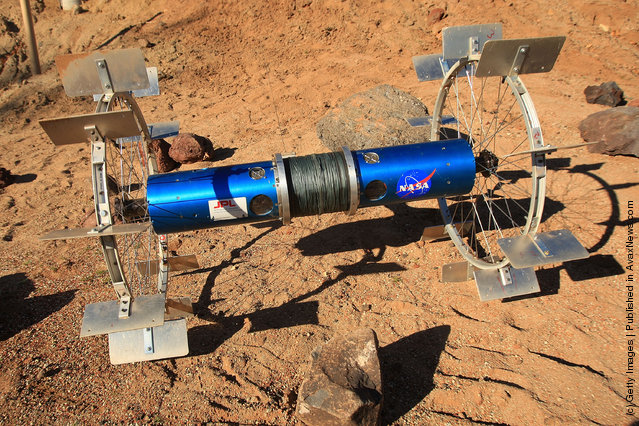
Axel, a research prototype rover for exploring the Moon, Mars and other planets, is remotely driven over rocks as engineers from Jet Propulsion (JPL) and grad students from Caltech (California Institute of Technology) demonstrate its mobile over the steep and rocky grounds of the JPL Mars Yard on January 14, 2009 in Pasadena, California. The rover is capable of descending cliffs or into craters and returning by a cable tethered to its starting point. Development of the Axel rover is a point effort funded by NASA Exploration Systems Mission Directorate (ESMD) and lead by Principal Investigator Issa Newnas and Co-Investigator and Caltech professor of mechanical engineering bio engineering Joel Burdick. (Photo by David McNew/Getty Images)
05 Apr 2011 07:47:00,post received
0 comments