Loading...
Done


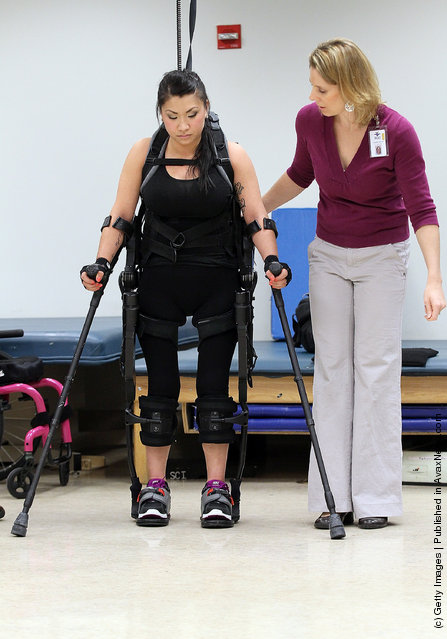
“eLEGS is a wearable, artificially intelligent, bionic device that enables people with paralysis to stand up and walk again. The exoskeleton is battery-powered and rechargeable, fitting comfortably and securely over clothing. Initially, eLEGS will be used under medical supervision for rehabilitation and training”. – BerkeleyBionics.com

Photo: Paralysis victim Stephanie Sablan (L) is helped by physical therapist Shonna Moran as she walks using eLEGS robotic legs at Santa Clara Valley Medical Center on May 25, 2011 in San Jose, California. Sablan, 24, was paralyzed from the waist down earlier this year when she was in a car accident and has begun using the newly developed eLEGS made by Berkeley Bionics. The robot-like battery powered eLEGS fit over clothing and enables people with paralysis to stand up and walk again. (Photo by Justin Sullivan/Getty Images)
Details
26 May 2011 09:56:00


“The Lovell Telescope is a radio telescope at Jodrell Bank Observatory, near Goostrey, Cheshire in the north-west of England. When it was constructed in 1955, the telescope was the largest steerable dish radio telescope in the world at 76.2 m (250 ft) in diameter; it is now the third largest, after the Green Bank telescope in West Virginia, USA, and the Effelsberg telescope in Germany. It was originally known as the 250 ft (76 m) telescope or the Radio Telescope at Jodrell Bank, before becoming the Mark I telescope around 1961 when future telescopes (the Mark II, III, and IV) were being discussed. It was renamed to the Lovell Telescope in 1987 after Bernard Lovell, and became a Grade I listed building in 1988. The telescope forms part of the MERLIN and European VLBI Network arrays of radio telescopes”. – Wikipedia

Photo: The Lovell Telescope listens to the night sky for radio signals from space at Jodrell Bank on June 22, 2011 in Holmes Chapel, England. Jodrell Bank Centre for Astrophysics and it's world famous Lovell Telescope is on the shortlist of Britain's submission for Unesco World Heritage Site status. (Photo by Christopher Furlong/Getty Images)
Details
24 Jun 2011 09:34:00


“NASA's Pathfinder, Pathfinder Plus, Centurion and Helios Prototype were an evolutionary series of solar- and fuel-cell-system-powered unmanned aerial vehicles. AeroVironment, Inc. developed the vehicles under NASA's Environmental Research Aircraft and Sensor Technology (ERAST) program. They were built to develop the technologies that would allow long-term, high-altitude aircraft to serve as “atmospheric satellites”, to perform atmospheric research tasks as well as serve as communications platforms”. – Wikipedia

Photo: The solar-electric Helios Prototype flying wing is flies over the Hawaiian islands of Niihau and Lehua during the first solar-powered test flight July 14, 2001 from the U.S. Navy's Pacific Missile Range Facility on Kauai, HI. The 18-hour flight was a functional checkout of the aircraft's systems and performance in preparation for an attempt to reach sustained flight at 100,000 feet altitude later in the summer. (Photo Courtesy of NASA/Getty Images)
Details
14 Jul 2011 09:24:00


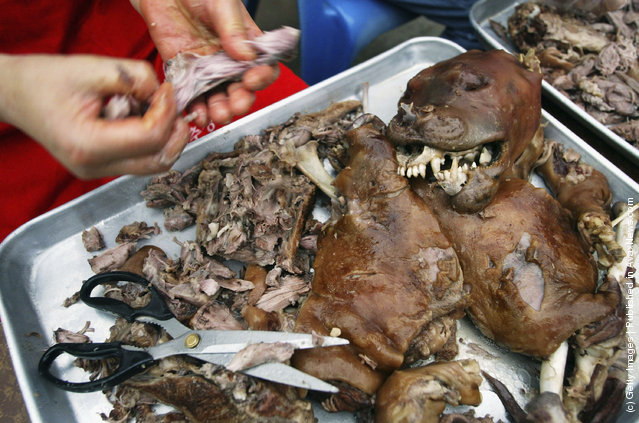
“Dog meat refers to edible parts and the flesh derived from (predominantly domestic) dogs. Human consumption of dog meat has been recorded in many parts of the world, including ancient China, ancient Mexico, and ancient Rome. According to contemporary reports, dog meat is consumed in a variety of countries such as Switzerland, China, Vietnam, the Philippines, and Korea. In addition, dog meat has also been used as survival food in times of war and/or other hardships”. – Wikipedia

Photo: A chef prepares dog meat at a restaurant on July 4, 2005 in Gwacheon, South Korea. Dog meat is a traditional dish in Korea dating back to the Samkuk period (period of the three kingdoms BC 57 – AD 668). Although many recipes existed historically for dog meat, now chefs only make soups, or dishes using boiled or roasted meat. Koreans traditionally eat dog meat on the hottest day of the summer, for it's reputed benefits of virility, invigoration and health. (Photo by Chung Sung-Jun/Getty Images)
Details
24 Jul 2011 13:21:00
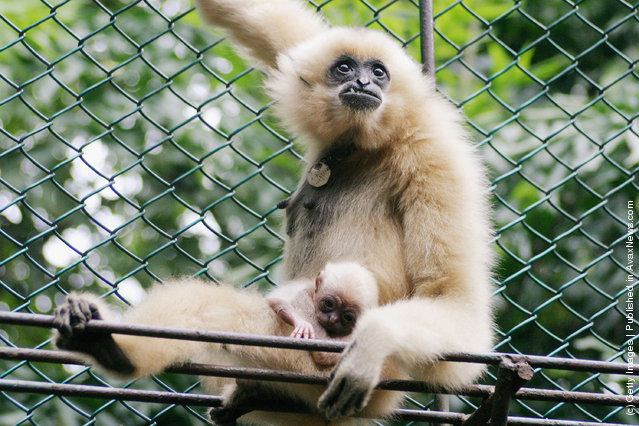
Newborn White-Cheeked Gibbon Nomascus

“Nomascus is the second most speciose genus of gibbons (family Hylobatidae). Originally this genus was a subgenus of Hylobates, and all individuals were considered one species, Hylobates concolor. Species within Nomascus are characterized by 52 chromosomes. Some species are all black, some light with a distinct black tuft of crown fur, and some by distinct, light-colored cheek patches. Nomascus is found from southern China (Yunnan) to southern Vietnam, and also on Hainan Island. One of the genus' species, Nomascus nasutus, has been deemed “the most critically endangered ape species in the world”. All of the species in this genus are endangered or critically endangered”. – Wikipedia

Photo: A newborn White-Cheeked Gibbon clings to its mother in the Nanning Zoo on April 12, 2004 in Nanning, Guangxi province, China. The White-Cheeked Gibbon's natural habitat is Southern China as well as Vietnam and Laos. They are classified as highly endangered and are on the brink of extinction due to poaching and reduction of natural rainforests. (Photo by Getty Images)
Details
12 Aug 2011 11:51:00
An actor dressed as a zombie performs during a drive-in haunted house show by Kowagarasetai (Scare Squad), for people inside a car in order to maintain social distancing amid the spread of the coronavirus disease (COVID-19), at a garage in Tokyo, Japan on July 3, 2020. (Photo by Issei Kato/Reuters)

An actor dressed as a zombie performs during a drive-in haunted house show by Kowagarasetai (Scare Squad), for people inside a car in order to maintain social distancing amid the spread of the coronavirus disease (COVID-19), at a garage in Tokyo, Japan on July 3, 2020. A Japanese performance group is starting a run of drive-in horror shows for people who are scared of catching the coronavirus but still want to get close-up frights from ghouls and zombies. Audience members will drive into a garage in Tokyo, one car at a time, and listen to a murder story and sound effects blared out of speakers, as actors dressed as monsters bang on the side of the vehicle and spray fake blood over the windows. (Photo by Issei Kato/Reuters)
Details
05 Jul 2020 00:05:00
Yedam Kim (L) and Chaewon Kim, both of South Korea, look at a smartphone backstage after performing on stage during the first day of the 51st Prix de Lausanne at the Theatre de Beaulieu, in Lausanne, Switzerland, 30 January 2023. Launched in 1973, the Prix de Lausanne is an international dance competition for young dancers aged 15 to 18. Closing the six-day event, scholarships granting free tuition in a world-renowned dance school or dance company will be award to the best dancers out of 87 participants who come from 18 different countries this year. (Photo by Laurent Gillieron/EPA)

Yedam Kim (L) and Chaewon Kim, both of South Korea, look at a smartphone backstage after performing on stage during the first day of the 51st Prix de Lausanne at the Theatre de Beaulieu, in Lausanne, Switzerland, 30 January 2023. (Photo by Laurent Gillieron/EPA)
Details
01 Feb 2023 00:08:00
Two visitors look at an artwork “Home Sweet Home: Pandemic Love 1” created by Hong Kong artist Mak Ying Tung at Art Basel in Hong Kong Wednesday, May 19, 2021. (Photo by Vincent Yu/AP Photo)

Two visitors look at an artwork “Home Sweet Home: Pandemic Love 1” created by Hong Kong artist Mak Ying Tung at Art Basel in Hong Kong Wednesday, May 19, 2021. Art Basel, one of the world's most prestigious modern and contemporary art exhibitions, is returning to Hong Kong in its ninth edition. The prestige art fair is hosting 104 galleries from 23 countries and territories. (Photo by Vincent Yu/AP Photo)
Details
22 May 2021 08:48:00