Loading...
Done
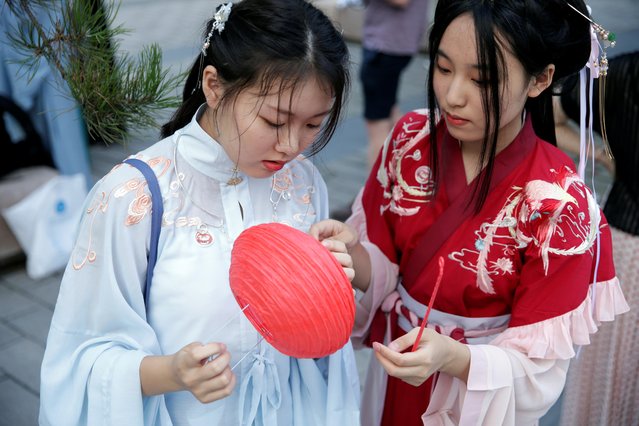
Girls dressed in “Hanfu”, or Han clothing, prepare for an event to mark the traditional Qixi festival, the Chinese equivalent of Valentine's Day, at a park in Beijing, China, August 7, 2019. Chinese for “Han clothing”, “Hanfu” is based on the idea of donning costumes worn in bygone eras by China's dominant Han ethnicity. Some of the most popular styles are from the Ming, Song and Tang dynasties. Hanfu enthusiasts doubled to two million in 2018 from a year earlier, according to a survey by Hanfu Zixun, a popular community account on the Wechat social media platform. (Photo by Jason Lee/Reuters)

Girls dressed in “Hanfu”, or Han clothing, prepare for an event to mark the traditional Qixi festival, the Chinese equivalent of Valentine's Day, at a park in Beijing, China, August 7, 2019. Chinese for “Han clothing”, “Hanfu” is based on the idea of donning costumes worn in bygone eras by China's dominant Han ethnicity. Some of the most popular styles are from the Ming, Song and Tang dynasties. Hanfu enthusiasts doubled to two million in 2018 from a year earlier, according to a survey by Hanfu Zixun, a popular community account on the Wechat social media platform. (Photo by Jason Lee/Reuters)
Details
23 Sep 2019 00:05:00
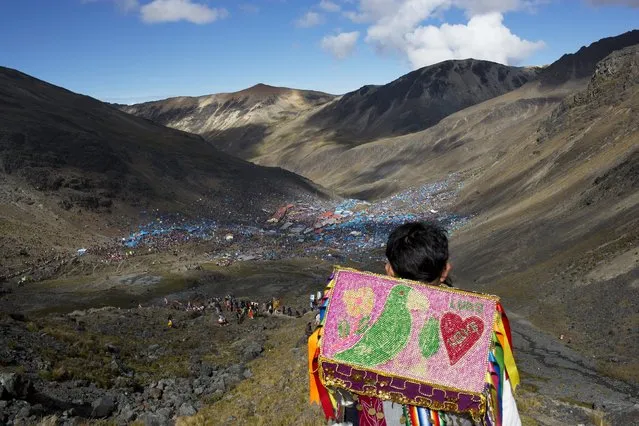
In this May 24, 2016 photo, a young boy descends the Qullqip'unqu mountain looking out at the tens of thousands of pilgrims gathered to celebrate the three-day festival Qoyllur Rit’i, translated from the Quechua language as Snow Star, in the Andean Sinakara Valley, in Peru's Cusco region. The celebration that mixes Catholic and indigenous beliefs honors Jesus as well as the area’s glacier, which is considered sacred among some indigenous people. While the native celebration is far older, the Christian part of the ritual stretches back to the 1700s, when Jesus is said to have appeared to a young shepherd in the form of another boy. (Photo by Rodrigo Abd/AP Photo)

In this May 24, 2016 photo, a young boy descends the Qullqip'unqu mountain looking out at the tens of thousands of pilgrims gathered to celebrate the three-day festival Qoyllur Rit’i, translated from the Quechua language as Snow Star, in the Andean Sinakara Valley, in Peru's Cusco region. The celebration that mixes Catholic and indigenous beliefs honors Jesus as well as the area’s glacier, which is considered sacred among some indigenous people. While the native celebration is far older, the Christian part of the ritual stretches back to the 1700s, when Jesus is said to have appeared to a young shepherd in the form of another boy. (Photo by Rodrigo Abd/AP Photo)
Details
04 Jun 2016 11:52:00
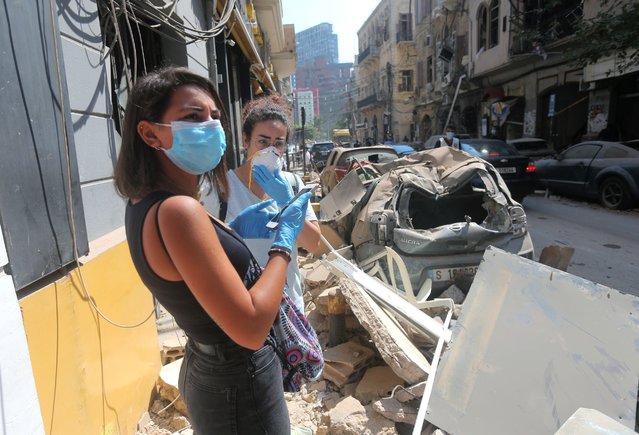
Young Lebanese women wearing protective masks and gloves against the coronavirus pandemic, stand on August 5, 2020 amid the rubble in Beirut's Gimmayzeh commercial district which was heavily damaged by the previous day's powerful explosion that tore through Lebanon's capital, resulting from the ignition of a huge depot of ammonium nitrate at the city's main port. Rescuers searched for survivors in Beirut after a cataclysmic explosion at the port sowed devastation across entire neighbourhoods, killing more than 100 people, wounding thousands and plunging Lebanon deeper into crisis. The blast, which appeared to have been caused by a fire igniting 2,750 tonnes of ammonium nitrate left unsecured in a warehouse, was felt as far away as Cyprus, some 150 miles (240 kilometres) to the northwest. (Photo by AFP Photo/Stringer)

Young Lebanese women wearing protective masks and gloves against the coronavirus pandemic, stand on August 5, 2020 amid the rubble in Beirut's Gimmayzeh commercial district which was heavily damaged by the previous day's powerful explosion that tore through Lebanon's capital, resulting from the ignition of a huge depot of ammonium nitrate at the city's main port. Rescuers searched for survivors in Beirut after a cataclysmic explosion at the port sowed devastation across entire neighbourhoods, killing more than 100 people, wounding thousands and plunging Lebanon deeper into crisis. The blast, which appeared to have been caused by a fire igniting 2,750 tonnes of ammonium nitrate left unsecured in a warehouse, was felt as far away as Cyprus, some 150 miles (240 kilometres) to the northwest. (Photo by AFP Photo/Stringer)
Details
10 Aug 2020 00:05:00
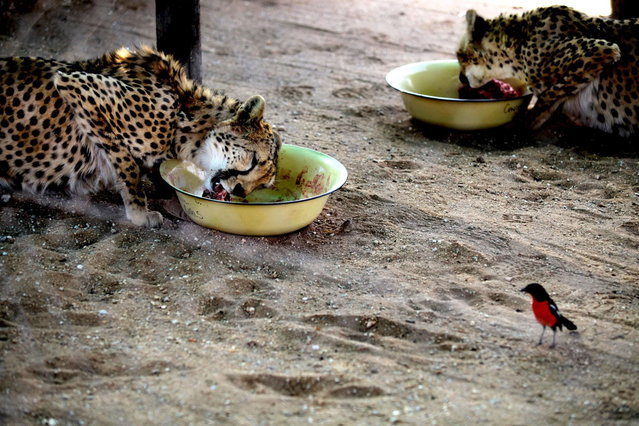
Young cheetahs eat meat at The Cheetah Conservation Fund (CCF) center in Otjiwarongo, Namibia, on August 13, 2013. The CCF started breeding Anatolian livestock dogs to promote cheetah-friendly farming after some 10,000 big cats – the current total worldwide population – were killed or moved off farms in the 1980s.  Up to 1,000 cheetahs were being killed a year, mostly by farmers who saw them as livestock killers. But the use of dogs has slashed losses for sheep and goat farmers and led to less retaliation against the vulnerable cheetah. (Photo by Jennifer Bruce/AFP Photo)

Young cheetahs eat meat at The Cheetah Conservation Fund (CCF) center in Otjiwarongo, Namibia, on August 13, 2013. The CCF started breeding Anatolian livestock dogs to promote cheetah-friendly farming after some 10,000 big cats – the current total worldwide population – were killed or moved off farms in the 1980s. Up to 1,000 cheetahs were being killed a year, mostly by farmers who saw them as livestock killers. But the use of dogs has slashed losses for sheep and goat farmers and led to less retaliation against the vulnerable cheetah. (Photo by Jennifer Bruce/AFP Photo)
Details
29 Aug 2013 10:56:00
The underbelly of fetish parties has been exposed in photographs captured by Belgian photographer MagLau. The photographer dedicated three years to capturing the obsession with leather and chains, visiting fetish parties through Europe and Japan. The photographer told: “I just took pictures, always finding some beauty in the dark side”. He said that most people were happy to be photographed for the project, with the images included in a new book Fetish Ballad. Aiming to capture the candid moments, he said he never judged but instead wanted to simply observe and understand. Here: Picture from Fetish Ballad book. (Photo by MagLau/Laurent Muschel)

The underbelly of fetish parties has been exposed in photographs captured by Belgian photographer MagLau. The photographer dedicated three years to capturing the obsession with leather and chains, visiting fetish parties through Europe and Japan. The photographer told: “I just took pictures, always finding some beauty in the dark side”. He said that most people were happy to be photographed for the project, with the images included in a new book Fetish Ballad. Aiming to capture the candid moments, he said he never judged but instead wanted to simply observe and understand. Here: Picture from Fetish Ballad book. (Photo by MagLau/Laurent Muschel)
Details
16 Oct 2016 10:49:00
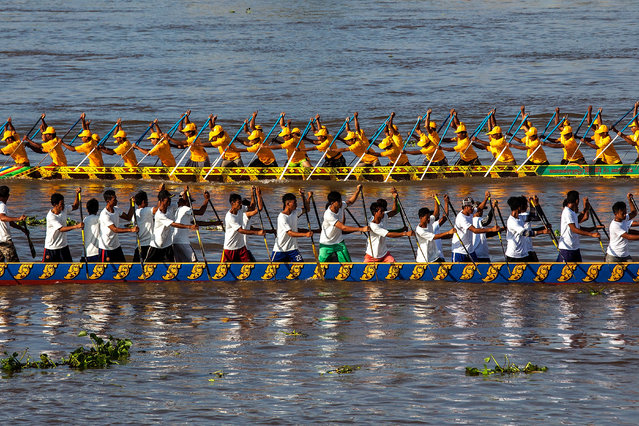
Boat crew members train on the waters of the Tonle Sap River on the morning of the first day of the Water Festival on November 13, 2016 in Phnom Penh, Cambodia. The yearly three-day Water Festival is one of the most important holidays in Cambodia and celebrates the end of the rainy season and the start of the rice harvesting. The Festival also coincides with the Tonle Sap river reversing course, which it does twice a year. Approximately 2 million people are expected to attend this year's festival, during which 259 boats and nearly 20,000 oarsmen will participate in the races. After a fatal stampede resulting in the death of some 353 people during the Water Festival in 2010, it has been cancelled four times over the past five years, with weather used as an official excuse. (Photo by Omar Havana/Getty Images)

Boat crew members train on the waters of the Tonle Sap River on the morning of the first day of the Water Festival on November 13, 2016 in Phnom Penh, Cambodia. The yearly three-day Water Festival is one of the most important holidays in Cambodia and celebrates the end of the rainy season and the start of the rice harvesting. The Festival also coincides with the Tonle Sap river reversing course, which it does twice a year. Approximately 2 million people are expected to attend this year's festival, during which 259 boats and nearly 20,000 oarsmen will participate in the races. After a fatal stampede resulting in the death of some 353 people during the Water Festival in 2010, it has been cancelled four times over the past five years, with weather used as an official excuse. (Photo by Omar Havana/Getty Images)
Details
15 Nov 2016 11:26:00
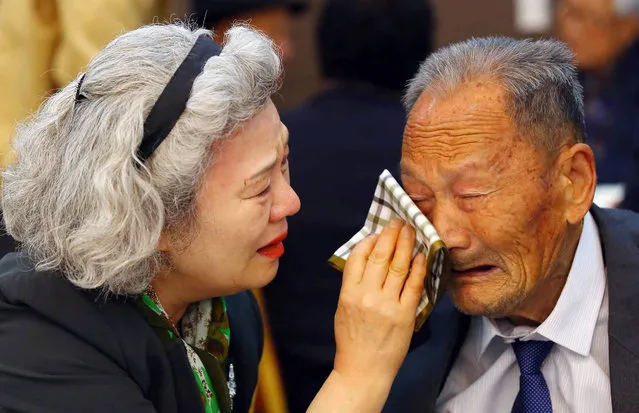
South Korean Lee Jung-sook (L), 68, wipes the tears from her North Korean father Lee Heung-jong, 88, as they bid each other a sad farewell at a resort on Mount Kumgang, North Korea, 22 October 2015. About 390 South Koreans arrived at the resort two days ago for the first face-to-face reunion of families separated by the 1950-53 Korean War in nearly 20 months. A second group of some 260 South Koreans will do the same for three days starting on 24 October. (Photo by Yonhap/EPA)

South Korean Lee Jung-sook (L), 68, wipes the tears from her North Korean father Lee Heung-jong, 88, as they bid each other a sad farewell at a resort on Mount Kumgang, North Korea, 22 October 2015. About 390 South Koreans arrived at the resort two days ago for the first face-to-face reunion of families separated by the 1950-53 Korean War in nearly 20 months. A second group of some 260 South Koreans will do the same for three days starting on 24 October. (Photo by Yonhap/EPA)
Details
24 Oct 2015 08:06:00
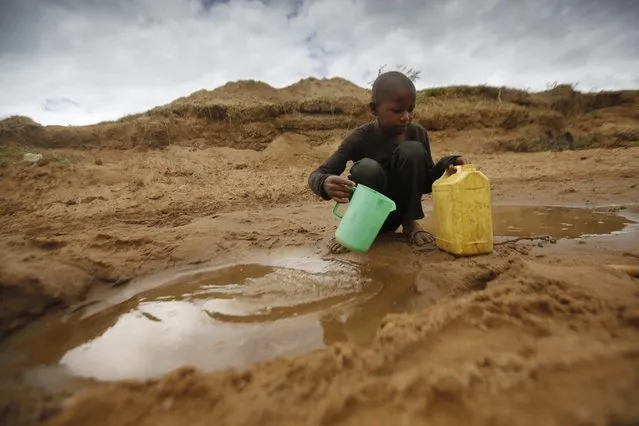
A young boy scoops water from a hand-dug well in the dry riverbed near Matinyani, in the semi-arid Kitui County in southeastern Kenya, 22 March 2015, the World Water Day. Residents of Kitui County and other arid and semi-arid areas of the country have been hard-hit by extremely poor rainfall this year while the government said in previous month that some 1.6 million people countrywide are facing acute starvation due to the drought and will need relief food over the next six months. (Photo by Dai Kurokawa/EPA)

A young boy scoops water from a hand-dug well in the dry riverbed near Matinyani, in the semi-arid Kitui County in southeastern Kenya, 22 March 2015, the World Water Day. Residents of Kitui County and other arid and semi-arid areas of the country have been hard-hit by extremely poor rainfall this year while the government said in previous month that some 1.6 million people countrywide are facing acute starvation due to the drought and will need relief food over the next six months. Residents of Matinyani say they haven't seen a drop of rain in nearly four months. Thousands of Kenyans in rural areas walk tens of kilometers just to fetch water to drink and to be used in their homes. According to an estimate by UNESCO (United Nations Educational, Scientific and Cultural Organization), 17 million people lack access to safe water in Kenya, where the drought is a perennial problem. (Photo by Dai Kurokawa/EPA)
Details
23 Mar 2015 11:01:00