Loading...
Done


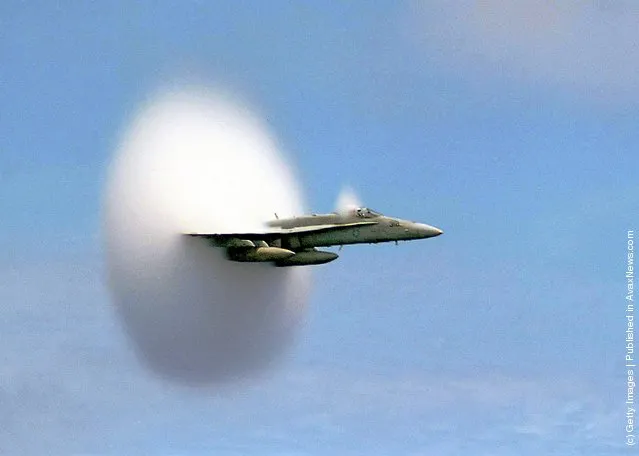
An F/A-18 Hornet assigned to Strike Fighter Squadron One Five One (VFA-151) emerges from a cloud created when it broke the sound barrier in the skies over the Pacific Ocean, July 7, 1999. (Photo by John Gay/US Navy)
Details
25 May 2011 10:33:00


“The Portuguese Water Dog is a breed of working dog as classified by the American Kennel Club. Portuguese Water Dogs are originally from the Portuguese region of the Algarve, from where the breed expanded to all around Portugal's coast, where they were taught to herd fish into fishermen's nets, to retrieve lost tackle or broken nets, and to act as couriers from ship to ship, or ship to shore. Portuguese Water Dogs rode in bobbing fishing trawlers as they worked their way from the warm Atlantic waters of Portugal to the frigid fishing waters off the coast of Iceland where the fleets caught cod to bring home. Portuguese Water Dogs were often taken with sailors during the Portuguese discoveries”. – Wikipedia

Photo: Kix, a Portuguese Water Dog , enjoys a walk around the muddy fields near his home before the grooming and preparation starts for this years Crufts on March 3, 2009 in Telford, England. (Photo by Christopher Furlong/Getty Images)

Details
26 Jul 2011 11:27:00
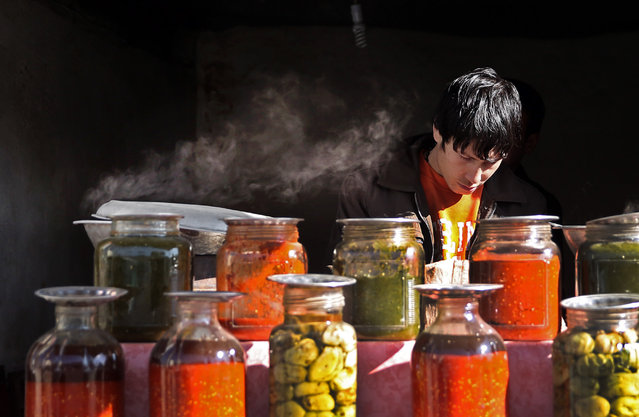
In this Tuesday, December 15, 2015 photo, an Afghan man sells traditional sauces and pickles on a street in Kabul, Afghanistan. (Photo by Massoud Hossaini/AP Photo)

In this Tuesday, December 15, 2015 photo, an Afghan man sells traditional sauces and pickles on a street in Kabul, Afghanistan. (Photo by Massoud Hossaini/AP Photo)
Details
25 Dec 2015 08:03:00
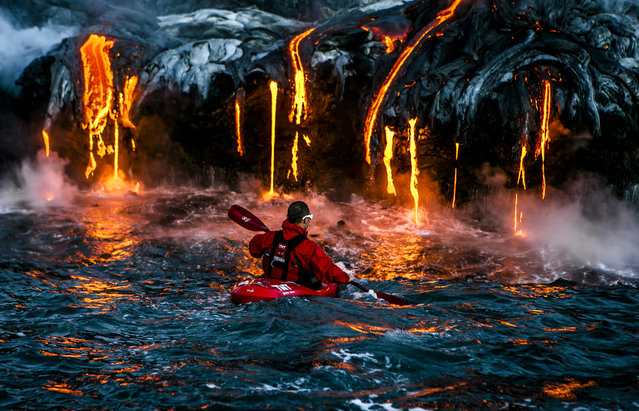
“Kilauea Rules”. The most extreme place we put ours kayakers to paddle till now. Photo location: Big Island, Hawaii. (Photo and caption by Alexandre Socci/National Geographic Photo Contest)

“Kilauea Rules”. The most extreme place we put ours kayakers to paddle till now. Photo location: Big Island, Hawaii. (Photo and caption by Alexandre Socci/National Geographic Photo Contest)
Details
20 Jun 2014 10:47:00
Rescue workers stand near dead bodies washed ashore in Ton Sai Bay in Thailand's Phi Phi island in this December 28, 2004 file photo. (Photo by Luis Enrique Ascui/Reuters)

Rescue workers stand near dead bodies washed ashore in Ton Sai Bay in Thailand's Phi Phi island in this December 28, 2004 file photo. On December 26, 2004, a magnitude 9.15 quake off the coast of Indonesia's Aceh province triggered an Indian Ocean tsunami that killed around 226,000 people in Indonesia, Sri Lanka, India, Thailand and nine other countries. (Photo by Luis Enrique Ascui/Reuters)
Details
03 Dec 2014 14:15:00
Karis, an eleven week old lion cub, plays in fallen leaves brushed up by keepers in her enclosure at Blair Drummond Safari Park, near Stirling, Scotland, on November 20, 2013. (Photo by Andrew Milligan/PA Wire)

Karis, an eleven week old lion cub, plays in fallen leaves brushed up by keepers in her enclosure at Blair Drummond Safari Park, near Stirling, Scotland, on November 20, 2013. (Photo by Andrew Milligan/PA Wire)
Details
23 Nov 2013 11:44:00
Jack, a Lurcher from Dogs Trust Salisbury, walks past a window display of models in a Dogs Trust shop window in Salisbury, as part of a campaign to discourage the impulse buying of dogs ahead of Valentine's Day, on February 10, 2014. (Photo by Matt Alexander/PA Wire)

Jack, a Lurcher from Dogs Trust Salisbury, walks past a window display of models in a Dogs Trust shop window in Salisbury, as part of a campaign to discourage the impulse buying of dogs ahead of Valentine's Day, on February 10, 2014. (Photo by Matt Alexander/PA Wire)
Details
15 Feb 2014 12:30:00
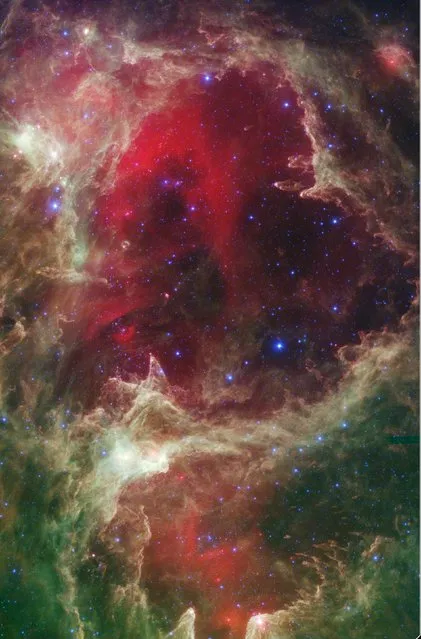
An infrared portrait from NASA's Spitzer Space Telescope which shows generations of stars is seen in this undated NASA handout image released February 14, 2013. In this wispy star-forming region, called W5, the oldest stars can be seen as blue dots in the centers of the two hollow cavities (other blue dots are background and foreground stars not associated with the region). Red shows heated dust that pervades the region's cavities, while green highlights dense clouds. (Photo by NASA/Reuters/JPL-Caltech/Harvard-Smithsonian/Handout)

An infrared portrait from NASA's Spitzer Space Telescope which shows generations of stars is seen in this undated NASA handout image released February 14, 2013. In this wispy star-forming region, called W5, the oldest stars can be seen as blue dots in the centers of the two hollow cavities (other blue dots are background and foreground stars not associated with the region). Red shows heated dust that pervades the region's cavities, while green highlights dense clouds. (Photo by NASA/Reuters/JPL-Caltech/Harvard-Smithsonian/Handout)
Details
03 Mar 2013 08:44:00