Loading...
Done
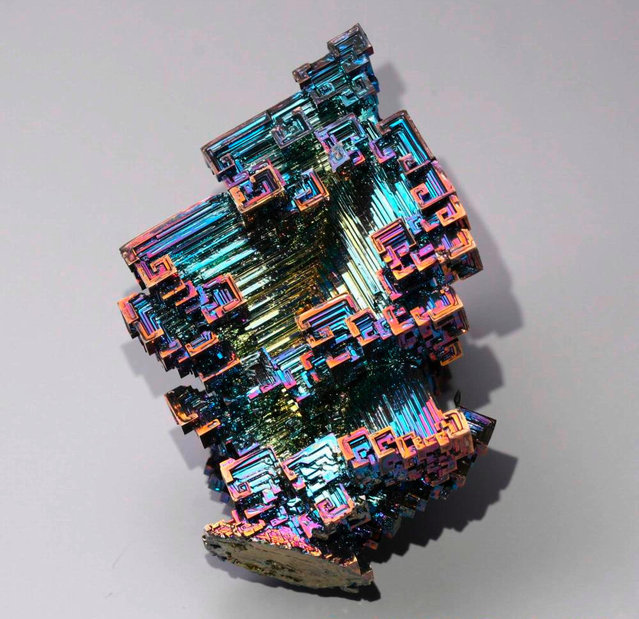
Amazing Bismuth Crystal

Bismuth is a chemical element with symbol Bi and atomic number 83. Bismuth, a pentavalent poor metal, chemically resembles arsenic and antimony. Elemental bismuth may occur naturally, although its sulfide and oxide form important commercial ores. The free element is 86% as dense as lead. It is a brittle metal with a silvery white color when freshly produced, but is often seen in air with a pink tinge owing to surface oxidation. Bismuth is the most naturally diamagnetic and has one of the lowest values of thermal conductivity among metals.
Details
16 Feb 2013 16:56:00
Revelers celebrate during fireworks marking the start of the New Year on Copacabana beach on January 1, 2017 in Rio de Janeiro, Brazil. (Photo by Mario Tama/Getty Images)

Revelers celebrate during fireworks marking the start of the New Year on Copacabana beach on January 1, 2017 in Rio de Janeiro, Brazil. Brazilian revelers traditionally dress in white to honor the New Year's holiday along with the Brazilian Goddess of the Sea- Iemanja. (Photo by Mario Tama/Getty Images)
Details
02 Jan 2017 12:59:00
A bride stretches before the event during the “Running of the Brides” race, in Bangkok, Thailand, December 2, 2017. (Photo by Athit Perawongmetha/Reuters)

A bride stretches before the event during the “Running of the Brides” race, in Bangkok, Thailand, December 2, 2017. Six hundred of to be brides and their grooms compete a run race aimed to win more than two million baht (61,000 US dollars or 51,000 euro) of wedding package prizes including a pair of white gold diamond rings and honeymoon trip to the Maldives. (Photo by Athit Perawongmetha/Reuters)
Details
05 Dec 2017 07:55:00
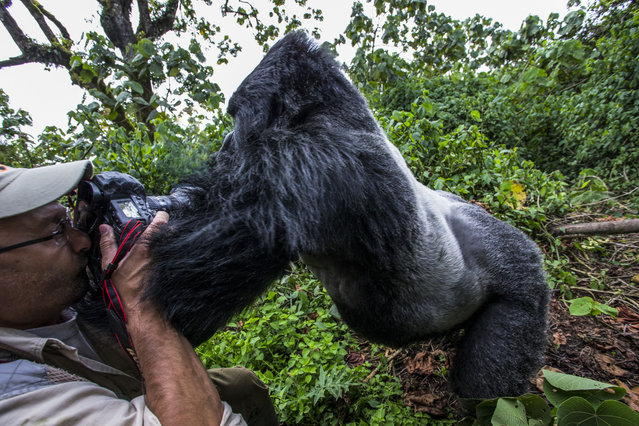
Christophe Vasselin gets pushed over by a gorilla. (Photo by Christophe Vasselin/Caters News Agency)

The snaps show photographers from around the world, who are willing to do just about anything for the perfect picture – whether that be tussling with a seal or withstanding a sharp shove from an angry gorilla. Other brave snappers can be seen getting up close and personal with leopards and great white sharks as they persist in getting the ultimate wildlife shot. Here: Christophe Vasselin gets pushed over by a gorilla. (Photo by Christophe Vasselin/Caters News Agency)
Details
30 Nov 2018 00:03:00
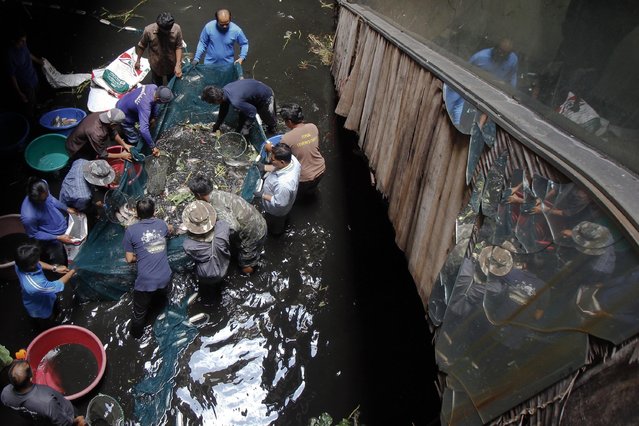
Workers collect fish inside an abandoned department store in Bangkok, Thailand January 13, 2015. Staff from Bangkok Metropolitan Administration (BMA) office were catching fish on Tuesday at the ground floor of the roofless New World department store that was closed down in 1997. (Photo by Chaiwat Subprasom/Reuters)

Workers collect fish inside an abandoned department store in Bangkok, Thailand January 13, 2015. Staff from Bangkok Metropolitan Administration (BMA) office were catching fish on Tuesday at the ground floor of the roofless New World department store that was closed down in 1997. Thousands of fish such as catfishes, fancy carps as well as black and red tilapias were released into the ground floor of the building, flooded with rainwater, as local vendors tried to control mosquitoes in the area, local media reported. BMA recently decided to remove the fish and release the water. (Photo by Chaiwat Subprasom/Reuters)
Details
14 Jan 2015 11:57:00
Shovava Wing Scarves By Roza Khamitova

Roza Khamitova was born into a family of artists in Kazakhstan. After finishing design school in Manhattan, New York, she was working in fashion industry for about 8 years. As a visual artist Roza had always drawn most of her inspiration from the natural world around her in the mountains of Kazakhstan. In 2011 she launched Shovava, her personal line of women’s clothing based on her hand drawn paintings and prints of the animals, plants and patterns found in nature. Roza was enchanted by the beauty of wings, its structure and symbolism. First, she sketches big wide-spread wings on paper with a light pencil, adds black ink to create a three-dimensional feel and fills with stunning watercolors.
Details
06 Dec 2015 10:42:00
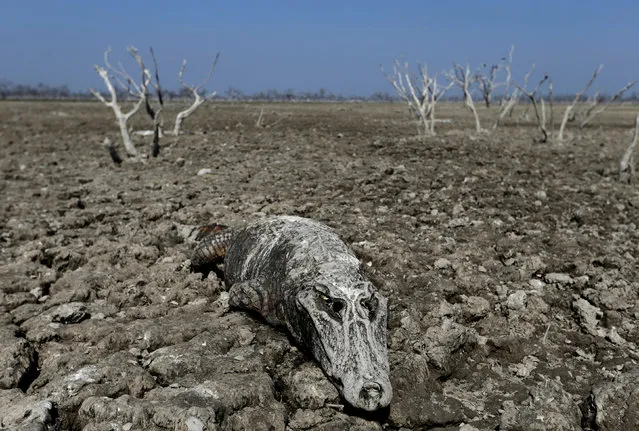
The carcass of a yacare caiman lies in the dried-up river bed of the Pilcomayo river in Boqueron, Paraguay, August 14, 2016. In Paraguay, alongside the Pilcomayo River, black vultures flew over a shrinking pond where a group of crocodilian reptiles known as yacare caimans sought refuge. Water from the river, which divides Paraguay and Argentina in the area of the Gran Chaco, was scarce. This is not an uncommon sight in the region of General Diaz, about 700 kilometres (435 miles) northwest of the country's capital Asuncion, where the Pilcomayo's waters form lakes and streams that give life to capybaras, birds and caimans. “The river's situation is critical. No water is forecast to enter the basin until December, as happens every year”, said Alcides Gonzalez, a resident of the area. (Photo by Jorge Adorno/Reuters)

The carcass of a yacare caiman lies in the dried-up river bed of the Pilcomayo river in Boqueron, Paraguay, August 14, 2016. In Paraguay, alongside the Pilcomayo River, black vultures flew over a shrinking pond where a group of crocodilian reptiles known as yacare caimans sought refuge. Water from the river, which divides Paraguay and Argentina in the area of the Gran Chaco, was scarce. This is not an uncommon sight in the region of General Diaz, about 700 kilometres (435 miles) northwest of the country's capital Asuncion, where the Pilcomayo's waters form lakes and streams that give life to capybaras, birds and caimans. (Photo by Jorge Adorno/Reuters)
Details
03 Nov 2016 12:40:00
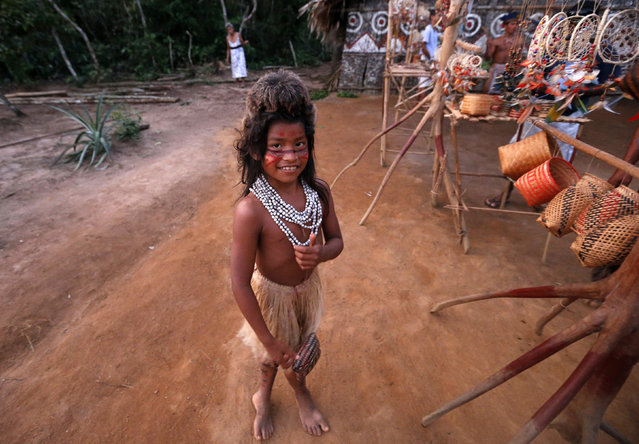
A girl of the Amazonian Tatuyo tribe poses while waiting to sell crafts to tourists in her village in the Rio Negro (Black River) near Manaus city, a World Cup host city, June 23, 2014. Because of their proximity to host city Manaus and their warm welcome, the Tatuyo have enjoyed three weeks of brisk business thanks to the World Cup. Usually, they host between 10 and 30 tourists a day. During the World Cup, this number has rocketed to 250 a day, They have become richer and other communities now come to them to sell them juices and fishes. (Photo by Andres Stapff/Reuters)

A girl of the Amazonian Tatuyo tribe poses while waiting to sell crafts to tourists in her village in the Rio Negro (Black River) near Manaus city, a World Cup host city, June 23, 2014. Because of their proximity to host city Manaus and their warm welcome, the Tatuyo have enjoyed three weeks of brisk business thanks to the World Cup. Usually, they host between 10 and 30 tourists a day. During the World Cup, this number has rocketed to 250 a day, They have become richer and other communities now come to them to sell them juices and fishes. (Photo by Andres Stapff/Reuters)
Details
27 Jun 2014 10:30:00