Loading...
Done
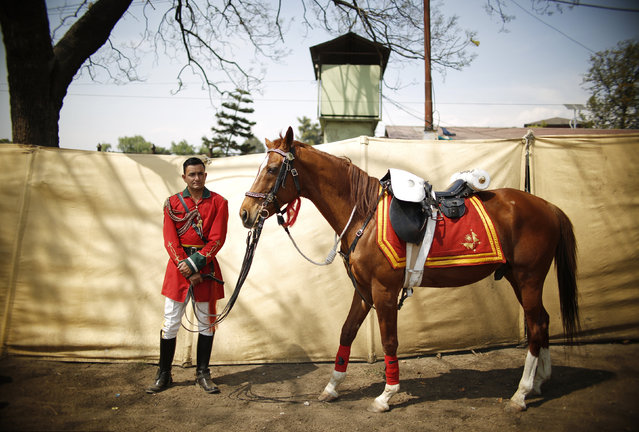
A Nepalese army solder stand next to a horse during the “Ghodejatra” Horse Race festival, which is organised by the Nepal Army, in Kathmandu, Nepal, April 7, 2016. Ghode Jatra, the horse racing festival of Nepal, celebrated on the New Moon day of mid March or early April is among the important celebrations of the Kathmandu Valley. exists a tree in the South-East part of the Tundikhel where Gurumapa supposed to be resides. (Photo by Navesh Chitrakar/Reuters)

A Nepalese army solder stand next to a horse during the “Ghodejatra” Horse Race festival, which is organised by the Nepal Army, in Kathmandu, Nepal, April 7, 2016. Ghode Jatra, the horse racing festival of Nepal, celebrated on the New Moon day of mid March or early April is among the important celebrations of the Kathmandu Valley. Grand horse parade including various acrobatic style of shows are performed by Nepal military at Tundikhel-a fenced parade ground located in the heart of Kathmandu city. (Photo by Navesh Chitrakar/Reuters)
Details
08 Apr 2016 14:33:00
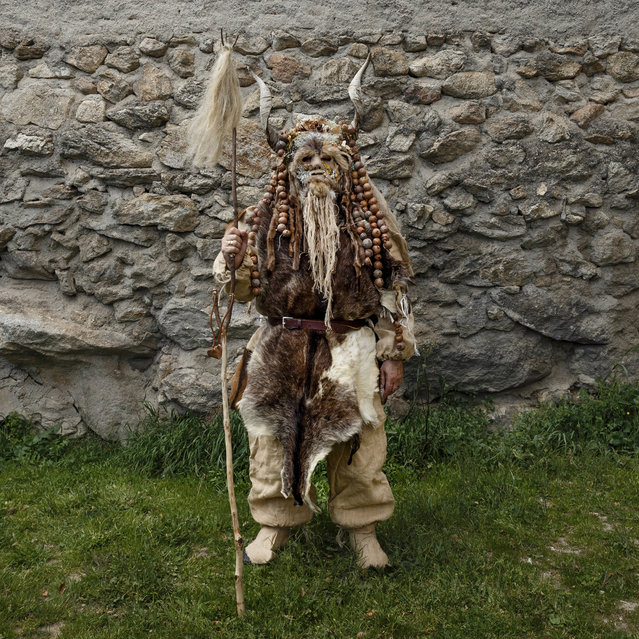
In this April 1, 2017 picture a man dressed as a “Harramacho” a traditional character from the Navalacruz carnival poses for a picture before a traditional Spanish mask gathering in the small village of Casavieja, Spain. (Photo by Daniel Ochoa de Olza/AP Photo)

In this April 1, 2017 picture a man dressed as a “Harramacho” a traditional character from the Navalacruz carnival poses for a picture before a traditional Spanish mask gathering in the small village of Casavieja, Spain. Every spring they come from towns across central and northwestern Spain, clad in elaborate costumes – some as trees, others as bears, still others as monsters who could have emerged from some sort of fever dream. (Photo by Daniel Ochoa de Olza/AP Photo)
Details
10 Apr 2017 08:50:00
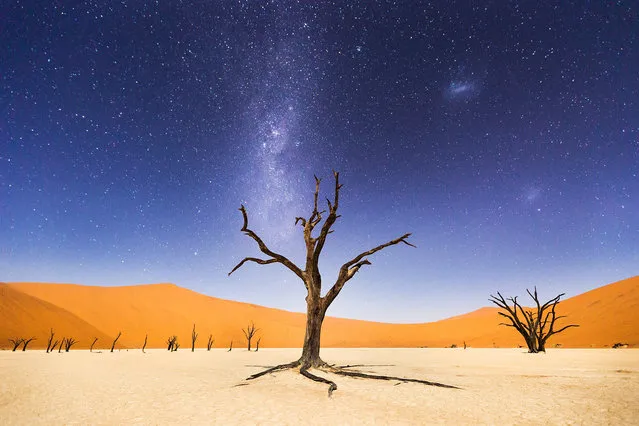
Merit: A Night at Deadvlei. The night before returning to Windhoek, we spent several hours at Deadveli. The moon was bright enough to illuminate the sand dunes in the distance, but the skies were still dark enough to clearly see the milky way and magellanic clouds. Deadveli means “dead marsh. (Photo and caption by Beth McCarley/National Geographic Traveler Photo Contest)

Merit: A Night at Deadvlei. The night before returning to Windhoek, we spent several hours at Deadveli. The moon was bright enough to illuminate the sand dunes in the distance, but the skies were still dark enough to clearly see the milky way and magellanic clouds. Deadveli means “dead marsh. The camelthorn trees are believed to be about 900 years old, but have not decomposed because the environment is so dry. (Photo and caption by Beth McCarley/National Geographic Traveler Photo Contest)
Details
04 Aug 2015 11:50:00
New autopilot features are demonstrated in a Tesla Model S during a Tesla event in Palo Alto, California, 2015. Federal officials say the driver of a Tesla S sports car using the vehicle’s “autopilot” automated driving system has been killed in a collision with a truck, the first U.S. self-driving car fatality. The National Highway Traffic Safety Administration said preliminary reports indicate the crash occurred when a tractor-trailer made a left turn in front of the Tesla at a highway intersection. (Photo by Beck Diefenbach/Reuters)

New autopilot features are demonstrated in a Tesla Model S during a Tesla event in Palo Alto, California, 2015. Federal officials say the driver of a Tesla S sports car using the vehicle’s “autopilot” automated driving system has been killed in a collision with a truck, the first U.S. self-driving car fatality. The National Highway Traffic Safety Administration said preliminary reports indicate the crash occurred when a tractor-trailer made a left turn in front of the Tesla at a highway intersection. Joshua D. Brown, of Canton, Ohio, died in the accident May 7 in Williston, Florida, when his car's cameras failed to distinguish the white side of a turning tractor-trailer from a brightly lit sky and didn't automatically activate its brakes, according to government records obtained Thursday. (Photo by Beck Diefenbach/Reuters)
Details
04 Jul 2016 08:30:00
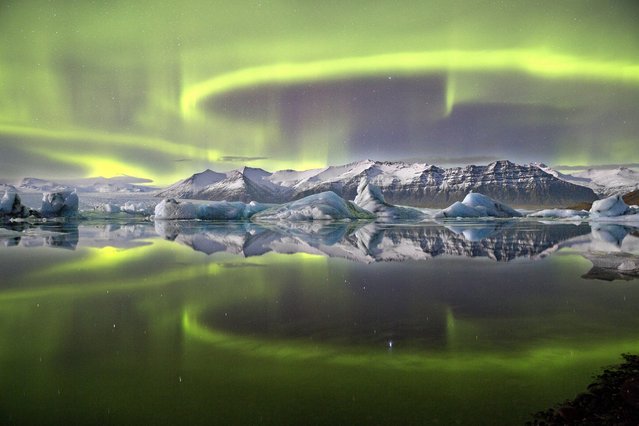
“Aurora over a glacier lagoon”. A vivid green overheaded aurrora pictured in Iceland's Vatnajokull National Park reflected almost symetrically in Jokulsrlon Glacier lagoon. A complete lack of wind and currrent combin in this sheltred lagoon scene to crete an arresting mirror effect giving the image a sensation of utter stillness. Despite theis there is motion on a suprising scale, as the loops and arcs of the aurora are shaped by the shifting forces of the Earth's magnetic field. (Photo by  James Woodend/The Astronomy Photographer of the Year 2014 Contest)

“Aurora over a glacier lagoon”. A vivid green overheaded aurrora pictured in Iceland's Vatnajokull National Park reflected almost symetrically in Jokulsrlon Glacier lagoon. A complete lack of wind and currrent combin in this sheltred lagoon scene to crete an arresting mirror effect giving the image a sensation of utter stillness. Despite theis there is motion on a suprising scale, as the loops and arcs of the aurora are shaped by the shifting forces of the Earth's magnetic field. James Woodend of Great Britain won the grand prize with the image, beating out more than 2,500 other entries. The Astronomy Photographer of the Year 2014 contest is judged by the Royal Observatory Greenwich and BBC Sky at Night magazine. (Photo by James Woodend/The Astronomy Photographer of the Year 2014 Contest)
Details
26 Sep 2014 13:39:00
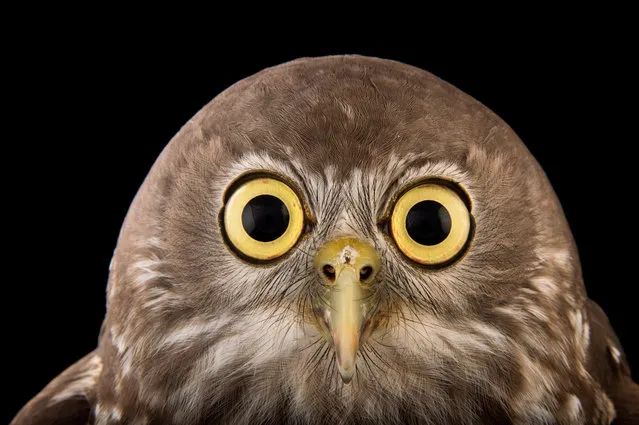
The National Geographic Photo Ark is a travelling exhibition of photographer Joel Sartore’s quest to create a photo archive of biodiversity around the world. So far, Sartore has captured studio portraits of more than 6,000 species – a number that he hopes to double. On 1 July, the ark will open at Melbourne zoo – the first time it has been exhibited in the southern hemisphere. More than 50 portraits will be on display, including many of Australian endangered animals being protected by programs at the zoo itself. These captions have been edited from text supplied by Melbourne zoo. Here: Barking owl. So-named because its call sounds like a barking dog, these birds are native to Australia, Indonesia and Papua New Guinea. In Victoria they are listed as an endangered species, and in 2003 there were estimated to be fewer than 50 breeding pairs. The main threat to the species in Victoria is loss of habitat, especially large trees with hollows in which they can nest and on which many of their prey depend. Apart from a bark, they may utter a chilling scream when they feel threatened. (Photo by Joel Sartore/National Geographic Photo Ark/The Guardian)

The National Geographic Photo Ark is a travelling exhibition of photographer Joel Sartore’s quest to create a photo archive of biodiversity around the world. So far, Sartore has captured studio portraits of more than 6,000 species – a number that he hopes to double. On 1 July, the ark will open at Melbourne zoo – the first time it has been exhibited in the southern hemisphere. More than 50 portraits will be on display, including many of Australian endangered animals being protected by programs at the zoo itself. These captions have been edited from text supplied by Melbourne zoo. Here: Barking owl. (Photo by Joel Sartore/National Geographic Photo Ark/The Guardian)
Details
01 Jul 2017 07:45:00
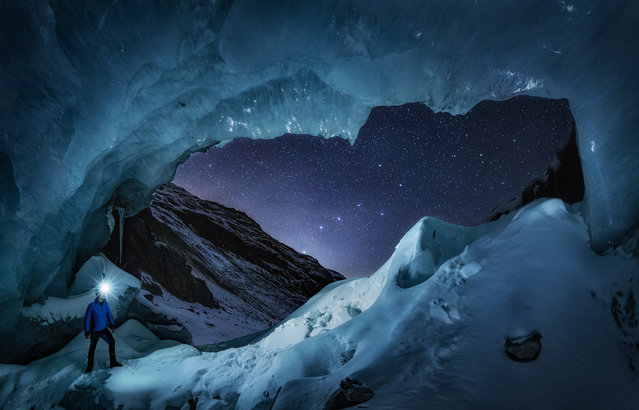
“Mr Big Dipper”, Nicholas Roemmelt (Denmark). A stargazer observes the constellation of the Big Dipper perfectly aligned with the window of the entrance to a large glacier cave in Engadin, Switzerland. This is a panorama of two pictures, and each is a stack of another two pictures: one for the stars and another one for the foreground, but with no composing or time blending. (Photo by Nicholas Roemmelt/National Maritime Museum/The Guardian)

“Mr Big Dipper”, Nicholas Roemmelt (Denmark). A stargazer observes the constellation of the Big Dipper perfectly aligned with the window of the entrance to a large glacier cave in Engadin, Switzerland. This is a panorama of two pictures, and each is a stack of another two pictures: one for the stars and another one for the foreground, but with no composing or time blending. (Photo by Nicholas Roemmelt/National Maritime Museum/The Guardian)
Details
27 Jul 2017 06:50:00
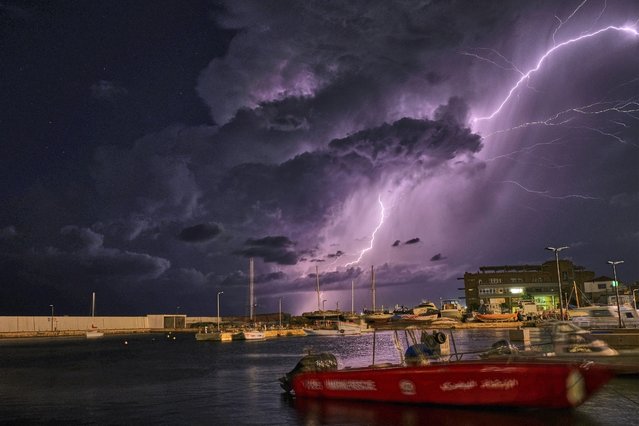
Lightning streaks across the skies over the coastal port city of Batroun, some 43km north of the Lebanese capital Beirut on December 6, 2023. (Photo by Ibrahim Chalhoub/AFP Photo)

Lightning streaks across the skies over the coastal port city of Batroun, some 43km north of the Lebanese capital Beirut on December 6, 2023. (Photo by Ibrahim Chalhoub/AFP Photo)
Details
05 Aug 2024 04:36:00