Couples take part in a Valentine's Day attempt to break the record for the world's largest simultaneous gay kiss on February 14, 2004 in Rome, Italy. (Photo by Franco Origlia/Getty Images)
A Ukrainian woman begs Ukrainian President Petro Poroshenko to stop the bombing in Donetsk after shell hit the residential area where she lives, killing two civilians in Donetsk's Kyibishevsky district, on January 29, 2015. (Photo by Manu Brabo/AFP Photo)
Women look at a collapsed building caused by earthquakes, in Bhaktapur, Nepal, May 18, 2015. Nepal is facing billions in reconstruction costs with almost 745,600 buildings and homes damaged or destroyed, including at least 87,700 in the capital, according to Nepal's emergency authority. (Photo by Ahmad Masood/Reuters)
A picture made available on 09 September 2015 shows traditional mud men dancers from the Asaro District of Goroka in the Eastern Highlands Province of Papua New Guinea perform for the official opening of the Pacific Islands Forum in Port Moresby, Papua New Guinea, 08 September 2015. The Pacific Islands Forum goes from 07 to 11 September and discusses the regions vulnerability to Climate Change. (Photo by Mick Tsikas/EPA)
People take photos as an Ariane 5 space rocket with a payload of four Galileo satellites lifts off from ESA's European Spaceport in Kourou, French Guiana, on November 17, 2016. Ariane 5 successfully launched on November 17 four satellites which will be part of the Galileo global satellite navigation system. (Photo by Jody Amiet/AFP Photo)
The Sphinx breed of cat “Adam vom Feisastern” of the German breeder Sabine Braeuer waits on a jury table during an annual International Pedigree Dog and Cat Show in Erfurt, Germany on June 10, 2012. (Photo by Jens Meyer/Associated Press)
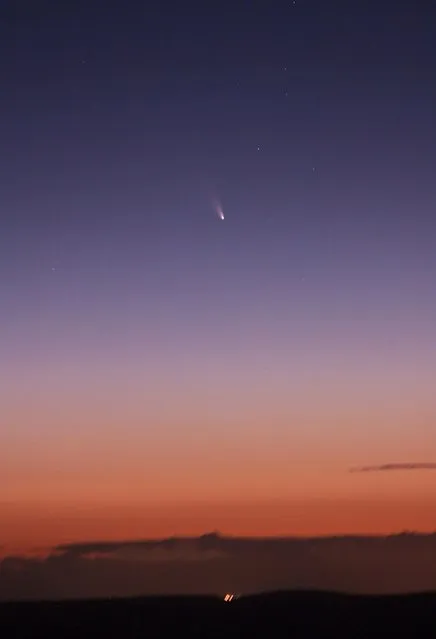
It’s time to start watching for Comet PANSTARRS, one of two comets to get excited about in 2013. Photo: This image provided by NASA shoaws the comet PANSTARRS as seen from Mount Dale, Western Australia on March 5, 2013. According to NASA on March 10, it will make its closest approach to the sun about 28 million miles (45 million kilometers) away. As it continues its nightly trek across the sky, the comet may get lost in the sun's glare but should return and be visible to the naked eye by March 12. (Photo by AP Photo/NASA)