Loading...
Done
A beluga whale sprays water towards visitors during a summer attraction at the Hakkeijima Sea Paradise aquarium in Yokohama, suburban Tokyo on July 20, 2015. Tokyo's temperature climbed over 34 degree Celsius on July 20, one day after the end of the rainy season. (Photo by Toshifumi Kitamura/AFP Photo)

A beluga whale sprays water towards visitors during a summer attraction at the Hakkeijima Sea Paradise aquarium in Yokohama, suburban Tokyo on July 20, 2015. Tokyo's temperature climbed over 34 degree Celsius on July 20, one day after the end of the rainy season. (Photo by Toshifumi Kitamura/AFP Photo)
Details
21 Jul 2015 11:10:00
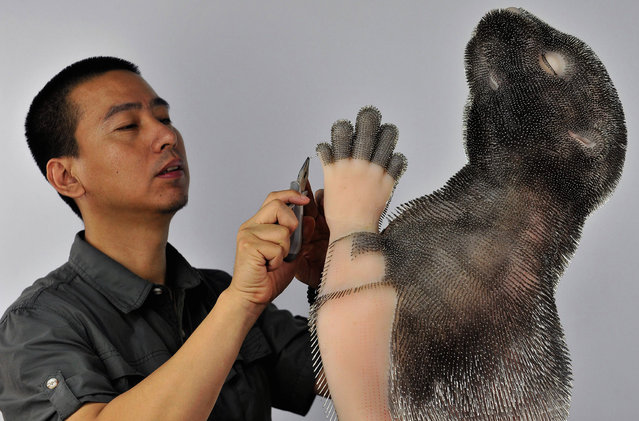
Professor Xie Yong works on an art installation of a beaver, which is made out of plastic and around 300,000 needles, in Shenyang, Liaoning province, July 23, 2013. The needles, according to Xie, represent the pain felt by animals when their fur is taken off to produce clothing. (Photo by Reuters/Stringer)

Professor Xie Yong works on an art installation of a beaver, which is made out of plastic and around 300,000 needles, in Shenyang, Liaoning province, July 23, 2013. The needles, according to Xie, represent the pain felt by animals when their fur is taken off to produce clothing. (Photo by Reuters/Stringer)
Details
27 Jul 2013 09:15:00
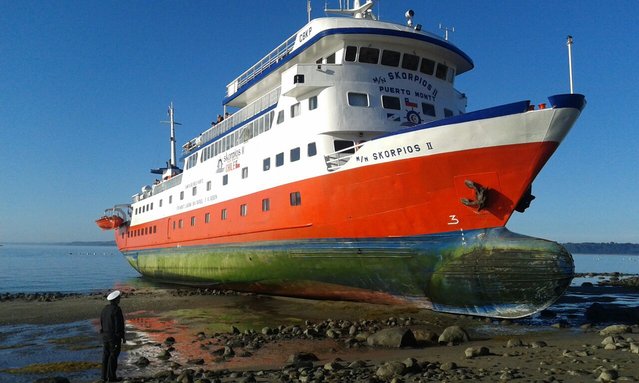
The Chilean ship “Skorpios II” is seen after it ran aground in “Maillen” island, near Puerto Montt, south of Santiago, in this handout picture from the Chilean Navy, February 5, 2015. According to the Chilean Navy, the ship's 89 passengers and 31 crew members were all evacuated and no oil spills or casualties were reported. (Photo by Reuters/Chilean Navy)

The Chilean ship “Skorpios II” is seen after it ran aground in “Maillen” island, near Puerto Montt, south of Santiago, in this handout picture from the Chilean Navy, February 5, 2015. According to the Chilean Navy, the ship's 89 passengers and 31 crew members were all evacuated and no oil spills or casualties were reported. (Photo by Reuters/Chilean Navy)
Details
07 Feb 2015 14:22:00
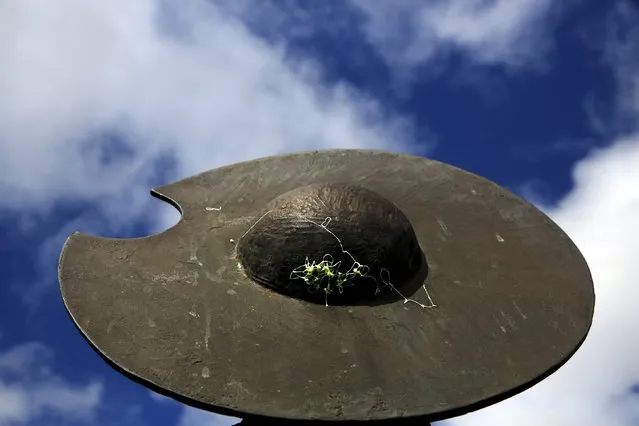
A sculpture of Don Quixote shows him wearing the basin he mistook for the enchanted helmet of the fictional Moorish king Mambrino in Alcazar de San Juan, Spain, April 5, 2016. (Photo by Susana Vera/Reuters)

A sculpture of Don Quixote shows him wearing the basin he mistook for the enchanted helmet of the fictional Moorish king Mambrino in Alcazar de San Juan, Spain, April 5, 2016. The arid central Spanish region of La Mancha is the setting for “Don Quixote”, the seventeenth-century novel by Miguel de Cervantes. Four hundred years after his death, references to the characters of Don Quixote, his loyal squire Sancho Panza and his beautiful lady Dulcinea abound in the surrounding villages from sweet treats to theatre productions involving livestock. Cervantes did not give away the name of the birthplace of Don Quixote, a middle-aged gentleman who becomes obsessed with chivalrous ideals. But many identify the village of Argamasilla de Alba as his hometown. The anniversary of Cervantes’ death is marked on the 23 April. (Photo by Susana Vera/Reuters)
Details
21 Apr 2016 12:32:00
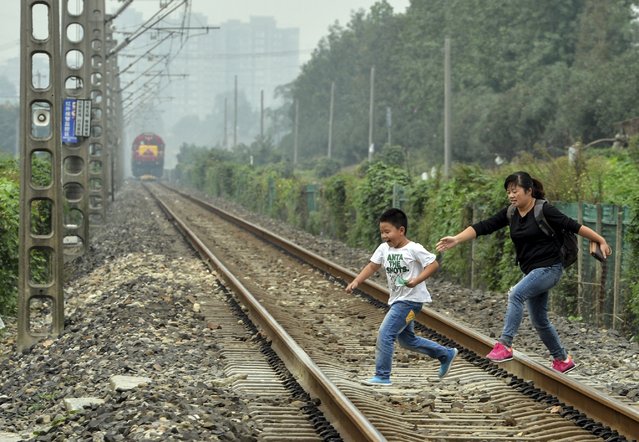
A boy and a woman run across a railway track as a train approaches in Chengdu, Sichuan province, China, October 8, 2015. Many residents disregard sign prohibiting this kind of illegal crossing and choose to do so to save time, local media reported. (Photo by Hao Fei/Reuters/Western China Metropolis Daily)

A boy and a woman run across a railway track as a train approaches in Chengdu, Sichuan province, China, October 8, 2015. Many residents disregard sign prohibiting this kind of illegal crossing and choose to do so to save time, local media reported. (Photo by Hao Fei/Reuters/Western China Metropolis Daily)
Details
18 Oct 2015 08:04:00
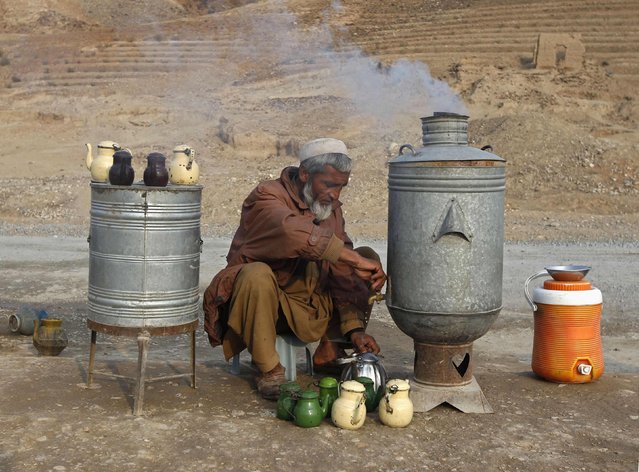
An Afghan man prepares tea for customers at a roadside tea shop on the outskirts of Jalalabad February 2, 2015. (Photo by Reuters/Parwiz)

An Afghan man prepares tea for customers at a roadside tea shop on the outskirts of Jalalabad February 2, 2015. (Photo by Reuters/Parwiz)
Details
25 Feb 2015 08:44:00
U.S. Marine Lt. Ben Reid from 1/2 Charlie Company of Task Force Tarawa waits to be medivaced after being hit with shrapnel and a machine gun round, in the southern Iraqi city of Nasiriyah, on March 23, 2003. The Marines suffered a number of deaths and casualties during gun battles throughout the city. (Photo by Joe Raedle/The Atlantic)

U.S. Marine Lt. Ben Reid from 1/2 Charlie Company of Task Force Tarawa waits to be medivaced after being hit with shrapnel and a machine gun round, in the southern Iraqi city of Nasiriyah, on March 23, 2003. The Marines suffered a number of deaths and casualties during gun battles throughout the city. (Photo by Joe Raedle via The Atlantic)
Details
20 Mar 2013 08:50:00
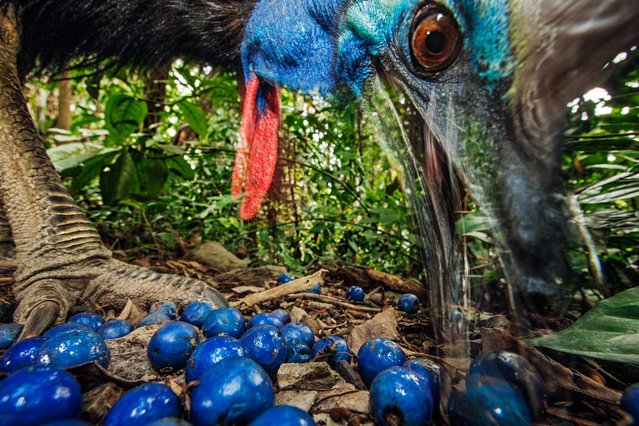
“Cassowaries are large, flightless birds related to emus and (more distantly) to ostriches, rheas, and kiwis”, writes Olivia Judson in the September issue of National Geographic magazine. (Photo by Christian Ziegler/National Geographic)

“Cassowaries are large, flightless birds related to emus and (more distantly) to ostriches, rheas, and kiwis”, writes Olivia Judson in the September issue of National Geographic magazine. How large? People-size: Adult males stand well over five foot five and top 110 pounds. Females are even taller, and can weigh more than 160 pounds. Dangerous when roused, they’re shy and peaceable when left alone. But even birds this big and tough are prey to habitat loss. The dense New Guinea and Australia rain forests where they live have dwindled. Today cassowaries might number 1,500 to 2,000. And because they help shape those same forests – by moving seeds from one place to another – “if they vanish”, Judson writes, “the structure of the forest would gradually change” too. (Photo by Christian Ziegler/National Geographic)

Details
06 Jan 2014 12:21:00