Samba dancers arrive to perform ahead of the athletics competitions of the 2016 Summer Olympics at the Olympic stadium in Rio de Janeiro, Brazil, Sunday, August 14, 2016. (Photo by Jae C. Hong/AP Photo)
Michelle Rodriguez attends the De Grisogono Party during the 71st annual Cannes Film Festival at on May 15, 2018 in Antibes, France. (Photo by INSTARimages.com)
A Muslim woman reads the Quran following noon prayers on the first day of the holy fasting month of Ramadan at Istiqlal Mosque in Jakarta, Indonesia, Monday, June 6, 2016. Devout Muslims began to celebrate Ramadan, the holiest month in the Islamic calendar, refraining from eating, drinking, smoking and sеx from sunrise to sunset. (Photo by Tatan Syuflana/AP Photo)
Britain's biggest dog, 18 month old great Dane, Freddy seen realxing on the sofa with it's owner Claire Stoneman at their home in Southend-on-Sea, Essex, England. (Photo by Matt Writtle/Barcroft Media)
Cars are parked near Place de la Concorde on March 12, 2014 in Paris, France. Inset: World War I, German airplanes at Place de la Concorde in Paris, wrecked by celebrating crowds on the day of the restoration of Alsace-Lorraine, November 18, 1918. (Photo by Peter Macdiarmid/Getty Images)
“The most serious health problem in the U.S. today is obesity.” Sounds familiar, doesn’t it? But that pronouncement about obesity’s primacy in the hierarchy of national health problems is not new. Rather, it’s the opening line to a remarkable article published 60 years ago in LIFE magazine. This photographs made by Martha Holmes to illustrate that March 1954 article, titled “The Plague of Overweight.” Photo: Dorothy Bradley (left), photographed for LIFE magazine article on obesity, 1949. (Photo by Martha Holmes/Time & Life Pictures)
A woman holds her umbrella while walking against strong winds as Typhoon Chan-hom approaches Taiwan, in Taipei, July 10, 2015. (Photo by Pichi Chuang/Reuters)
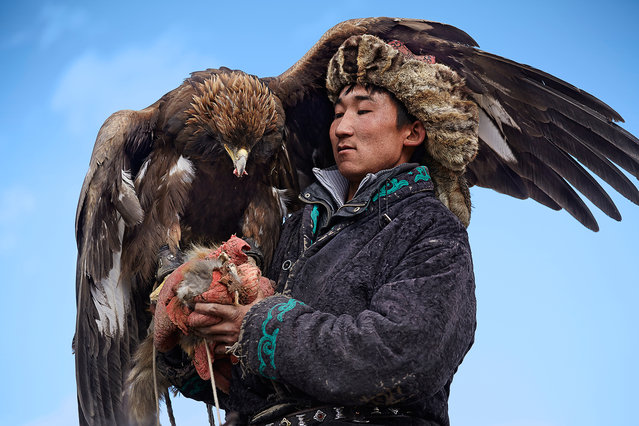
In one of the planet’s most desolate and harsh terrains, the Altai Mountains which run from Siberia in Russia down to Mongolia’s Gobi Desert, hunting with eagles is currently only practiced by a handful of Kyrgyz and Kazakhs. This form of falconry, the practice of hunting with the aid of birds of prey, can be traced back as far as 4,000 years in Central Asia. Here: after a successful hunt, a proud hunter rewards his eagle by feeding it the lungs of the prey, which is considered the most highly prized part of the animal. (Photo by Tariq Zaidi/The Washington Post)