Loading...
Done
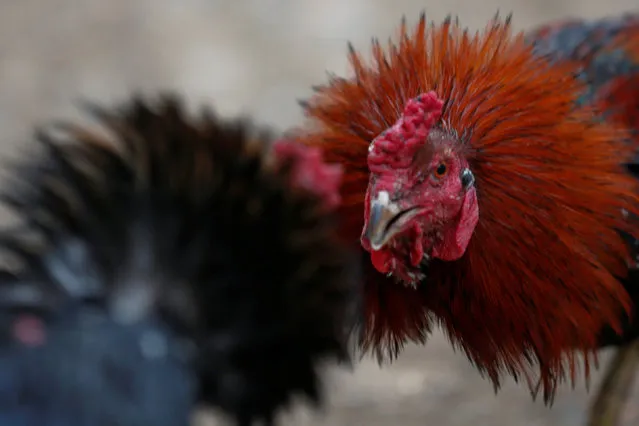
Two cocks are trained for a fight in a village in Nakhon Sawan province, Thailand January 10, 2017. (Photo by Chaiwat Subprasom/Reuters)

Two cocks are trained for a fight in a village in Nakhon Sawan province, Thailand January 10, 2017. (Photo by Chaiwat Subprasom/Reuters)
Details
11 Jan 2017 14:56:00
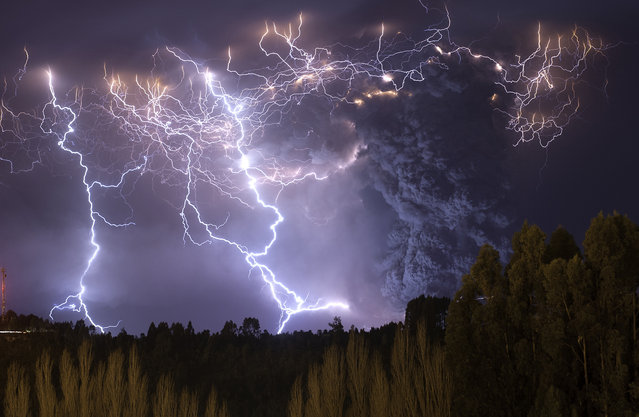
The eruption of Cordon Caulle began on June 4, 2011, located in the Region of Los Rios in Chile. For about 12 months, people and animals became accustomed to living with the daily fall of ash, which also caused problems in the air traffic in South America. The explosions and lightning during first days of the eruption could be seen from hundreds of miles around. This photograph was taken on the second night of eruption from the town of Lago Ranco. (Photo and caption by Francisco Negroni/National Geographic Traveler Photo Contest)

The eruption of Cordon Caulle began on June 4, 2011, located in the Region of Los Rios in Chile. For about 12 months, people and animals became accustomed to living with the daily fall of ash, which also caused problems in the air traffic in South America. The explosions and lightning during first days of the eruption could be seen from hundreds of miles around. This photograph was taken on the second night of eruption from the town of Lago Ranco. (Photo and caption by Francisco Negroni/National Geographic Traveler Photo Contest)

ATTENTION! All pictures are presented in high resolution. To see Hi-Res images – just TWICE click on any picture. In other words, click small picture – opens the BIG picture. Click BIG picture – opens VERY BIG picture.
Details
23 Jun 2013 11:24:00
Nuns react at the arrival of Pope Francis  at the St. Mary's school to attend a meeting of clergy and religious in Nairobi, Kenya, 26 November 2015. Pope Francis is on a six days visit that will take him to Kenya, Uganda and the Repulic of Central Africa from 25 to 30 November. (Photo by Daniel Dal Zennaro/EPA)

Nuns react at the arrival of Pope Francis at the St. Mary's school to attend a meeting of clergy and religious in Nairobi, Kenya, 26 November 2015. Pope Francis is on a six days visit that will take him to Kenya, Uganda and the Repulic of Central Africa from 25 to 30 November. (Photo by Daniel Dal Zennaro/EPA)
Details
27 Nov 2015 09:34:00
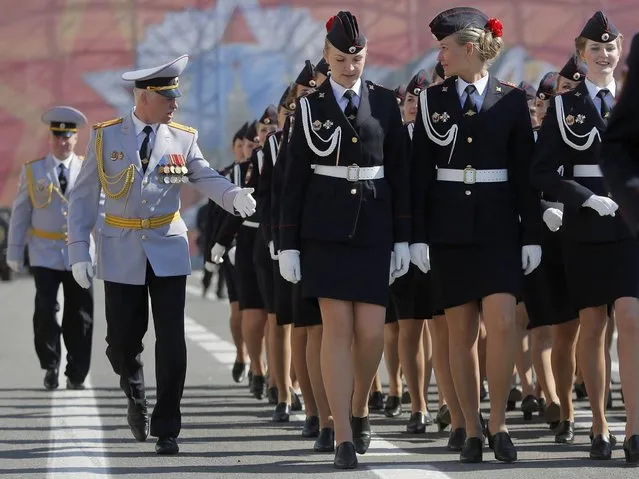
Russian Police academy female cadets march during a rehearsal for the Victory Day military parade at Dvortsovaya (Palace) Square in St Petersburg, Russia, Wednesday, May 7, 2014. Victory Day, marking the defeat of Nazi Germany, is Russia's most important secular holiday celebrated on May 9. (Photo by Dmitry Lovetsky/AP Photo)

Russian Police academy female cadets march during a rehearsal for the Victory Day military parade at Dvortsovaya (Palace) Square in St Petersburg, Russia, Wednesday, May 7, 2014. Victory Day, marking the defeat of Nazi Germany, is Russia's most important secular holiday celebrated on May 9. (Photo by Dmitry Lovetsky/AP Photo)
Details
10 May 2014 14:49:00
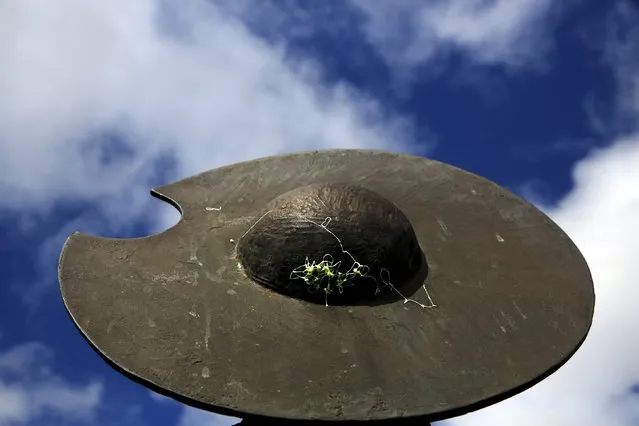
A sculpture of Don Quixote shows him wearing the basin he mistook for the enchanted helmet of the fictional Moorish king Mambrino in Alcazar de San Juan, Spain, April 5, 2016. (Photo by Susana Vera/Reuters)

A sculpture of Don Quixote shows him wearing the basin he mistook for the enchanted helmet of the fictional Moorish king Mambrino in Alcazar de San Juan, Spain, April 5, 2016. The arid central Spanish region of La Mancha is the setting for “Don Quixote”, the seventeenth-century novel by Miguel de Cervantes. Four hundred years after his death, references to the characters of Don Quixote, his loyal squire Sancho Panza and his beautiful lady Dulcinea abound in the surrounding villages from sweet treats to theatre productions involving livestock. Cervantes did not give away the name of the birthplace of Don Quixote, a middle-aged gentleman who becomes obsessed with chivalrous ideals. But many identify the village of Argamasilla de Alba as his hometown. The anniversary of Cervantes’ death is marked on the 23 April. (Photo by Susana Vera/Reuters)
Details
21 Apr 2016 12:32:00
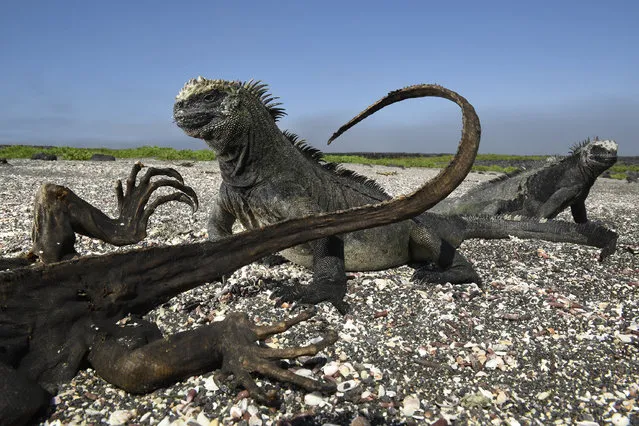
Galapagos – Rocking the Cradle: Four major ocean currents converge along the Galapagos archipelago, creating the conditions for an extraordinary diversity of animal life, April 25, 2016. The islands are home to at least 7,000 flora and fauna species, of which 97 percent of the reptiles, 80 percent of the land birds, 50 percent of the insects and 30 percent of the plants are endemic. The local ecosystem is highly sensitive to the changes in temperature, rainfall and ocean currents that characterize the climatic events known as El Niño and La Niña. These changes cause marked fluctuations in weather and food availability. Many scientists expect the frequency of El Niño and La Niña to increase as a result of climate change, making the Galapagos a possible early-warning location for its effects. (Photo by Thomas P. Peschak for National Geographic/World Press Photo)

Galapagos – Rocking the Cradle: Four major ocean currents converge along the Galapagos archipelago, creating the conditions for an extraordinary diversity of animal life, April 25, 2016. The islands are home to at least 7,000 flora and fauna species, of which 97 percent of the reptiles, 80 percent of the land birds, 50 percent of the insects and 30 percent of the plants are endemic. (Photo by Thomas P. Peschak for National Geographic/World Press Photo)
Details
16 Apr 2018 00:01:00


“Snowflake (c. 1964 – November 24, 2003) was an albino gorilla. He was the only known albino gorilla so far, and the most popular resident of the Barcelona Zoo in Catalonia, Spain. Originally named Nfumu Ngui in Fang language ("white gorilla") by his captor, he was then nicknamed Floquet de Neu (Catalan for little snowflake) by his keeper Jordi Sabater Pi. On his arrival to Barcelona where he was given an official reception by the then Mayor of Barcelona, Josep Maria de Porcioles, in November 1966, he was called Blancanieves (“Snow White”) in the newspaper Tele/Exprés. But he became famous with the name given to him by Sabater when National Geographic Magazine featured him on the main page in March 1967, with the English name Snowflake. This name spread among the press (Stern, Life, Paris-Match) and was later translated to Spanish as Copito de Nieve. Sabater himself called the gorilla Floquet or Copi, and in the later years Nfumu. The asteroid 95962 Copito, discovered by Catalan astronomer J. Manteca, is named in his honour”.
Details
07 Mar 2011 15:50:00


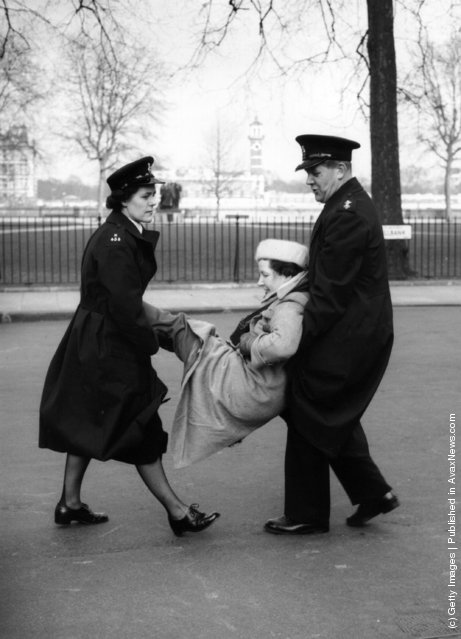
A British policewoman chasing after a group of naked street boys by the Serpentine in Hyde Park, London. (Photo by Reg Speller/Getty Images). 1926
Details
23 Jul 2011 12:43:00