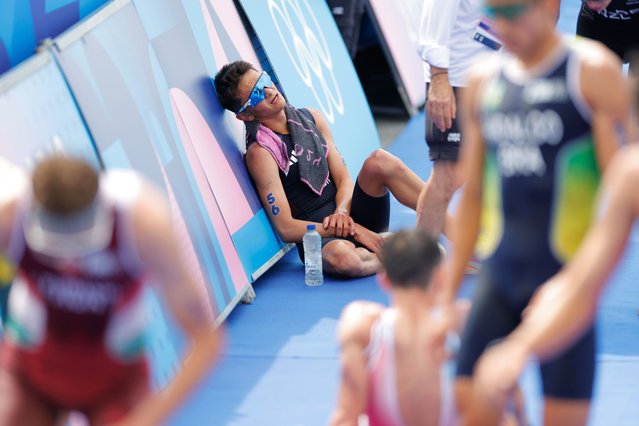
British Alex Yee looks exhausted after the men's individual triathlon race at the Paris 2024 Olympic Games, on Wednesday 31 July 2024 in Paris, France. (Photo by Tom Jenkins/The Guardian)
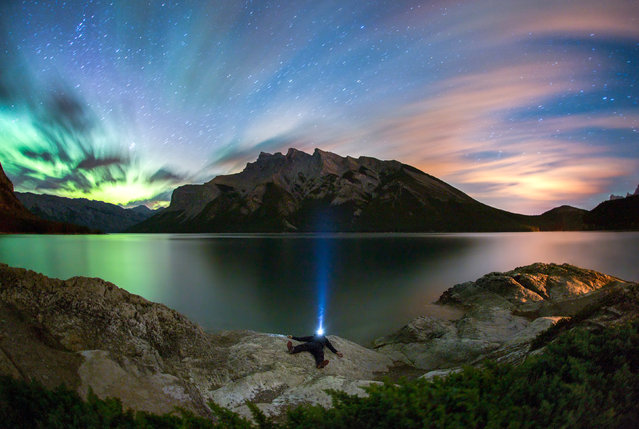
A landscape photographer turned the camera on himself to take a set of incredible selfie while visiting some of the world's most beautiful destinations. Paul Zizka, 39, from Alberta, Canada, has been a photographer for nine years, and thought that featuring in his own pictures would emphasize the nature surrounding him and create a more unique shot. Here: Lake Minnewanka, Banff National Park, Alberta, Canada. (Photo by Paul Zizka/Caters News Agency)
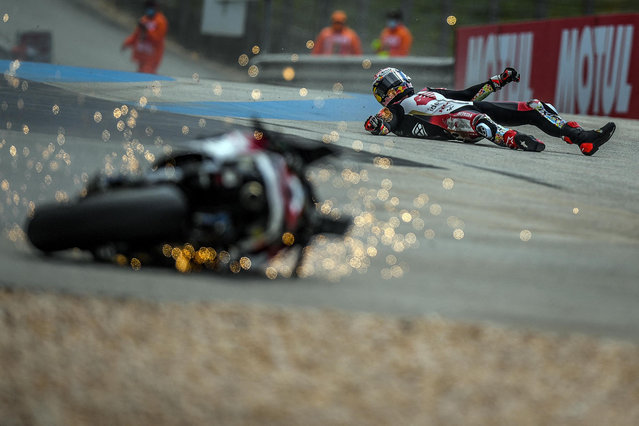
LCR Honda IDEMITSU's Japanese rider Takaaki Nakagami crashes in the second MotoGP free practice session of the Portuguese Grand Prix at the Algarve International Circuit in Portimao, on April 16, 2021. (Photo by Patricia de Melo Moreira/AFP Photo)
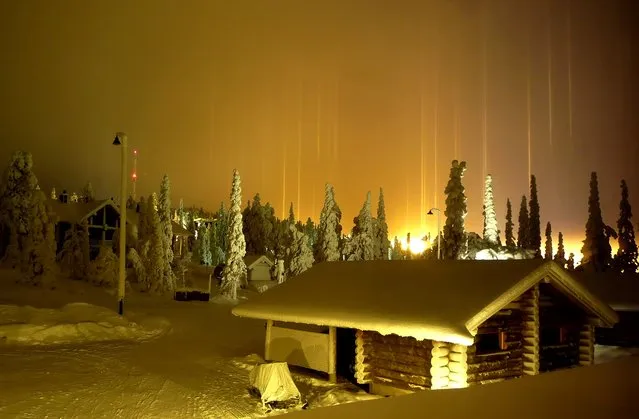
A light pillar is a visual phenomenon created by the reflection of light from ice crystals with near horizontal parallel planar surfaces. The light can come from the Sun (usually at or low to the horizon) in which case the phenomenon is called a sun pillar or solar pillar. It can also come from the Moon or from terrestrial sources such as streetlights.
China's Yanni Wu looks on as she stands with officials following a false start during the women's 100m hurdles final at Olympic Sports Centre Stadium in Hangzhou, China on October 1, 2023. (Photo by Dylan Martinez/Reuters)
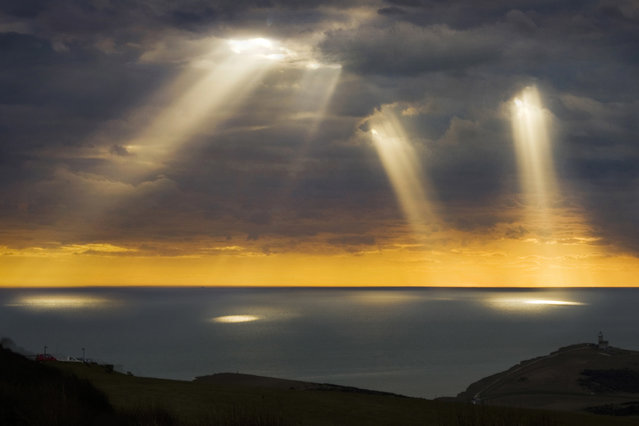
This breathtaking natural light show illuminating waters off the British coast looks like something out of hit film “Close Encounters of the Third Kind”. Photographer Adrian Campfield was out having dinner at a restaurant at Beachy Head, East Sussex, when the rays suddenly appeared. The 59-year-old and his wife Louise rushed outside onto the 535ft high cliffs to watch the spectacle. Mr Campfield, a former graphic designer, from Bexley, Kent, said the light was “changing all the time” for more than 15 minutes. (Photo by Adrian Campfield/Solent/Visual Press Agency)
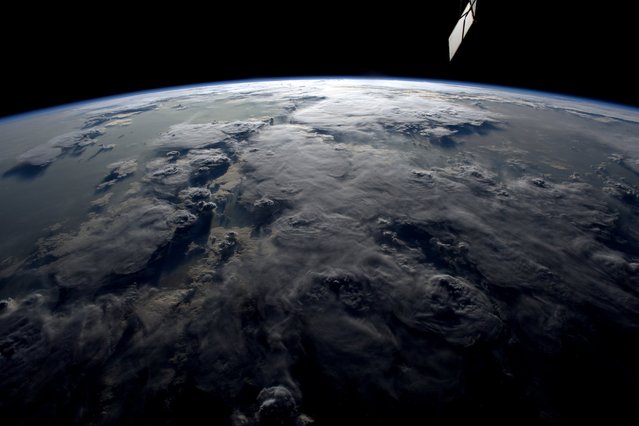
European Space Agency astronaut Tim Peake will return home after a six-month long mission on the International Space Station,on June 18, 2016. Peake was the first British ESA astronaut to visit the ISS and captured hundreds of photographs of the Earth during his mission. Here: “Lots of sun-glint right now during our whole orbit – we haven't seen a sunset for over 3 days”, he wrote. (Photo by Tim Peake/ESA/NASA)
Underwater photographer of the year – winner. Dancing Octopus by Gabriel Barathieu (France). Location: Island of Mayotte, off the coast of south-east Africa. “Balletic and malevolent”, one judge said of this octopus, hunting in a lagoon. Barathieu waited until spring tides when there was just 30cm of water on the flats and plenty of light in the shallows. (Photo by Gabriel Barathieu/UPY2017)