Maya Nakanishi of Japan competes en route to winning the women's T64 long jump at the World Para Athletics Championships in Dubai on November 11, 2019. (Photo by Christopher Pike/Reuters)
A competitor wearing a onesie with Brussels sprouts battles gale force winds during the Dutch Headwind Cycling Championships on the storm barrier Oosterscheldekering near Neeltje Jans, south-western Netherlands, Sunday, February 9, 2020. (Photo by Peter Dejong/AP Photo)
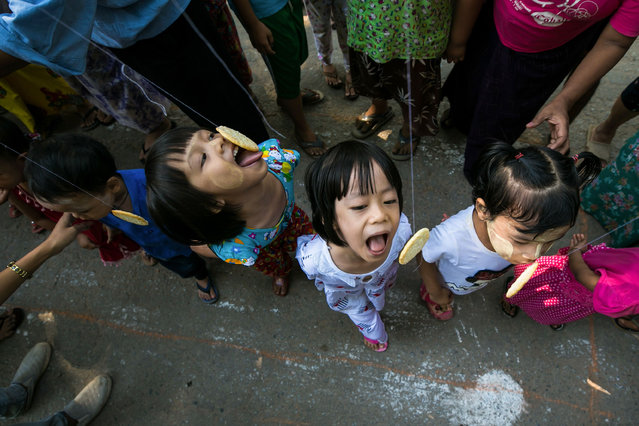
Children play a game as Myanmar celebrates its 72nd Independence Day in Yangon on January 4, 2020. The country is celebrating the 72nd anniversary of its declaration of independence from British colonial rule. (Photo by Sai Aung Main/AFP Photo)
Visitors take photos of the fluorescent sea in the waters of Paishi Village, Dalian City, Liaoning Province, China, May 24, 2020, from the night of May 24 to the early morning of May 25, 2020. The fluorescent sea in dalian is caused by noctilucent algae in the sea water. (Photo by Costfoto/Barcroft Media via Getty Images)
Russia' s President Vladimir Putin (L) congratulates prizewinners at the 2018 Youth Judo Tournament dedicated to Soviet and Russian judo coach Anatoly Rakhlin, and held at St Petersburg' s Yubileyny Palace of Sports in St Petersburg, Russia on May 23, 2018. (Photo by Mikhail Metzel/TASS)
A mother takes a selfie while breastfeeding her baby at the “Hakab Na 2018”, an event held in celebration of National Breastfeeding Awareness Month at the SMX Convention Center in Pasay City, Philippines on Sunday, August 5, 2018. Now on its sixth year, the event is a gathering of families, lactation experts, peer counselors and breastfeeding advocacy supporters and was aimed at promoting the importance of providing support to breastfeeding mothers. (Photo by Avito C. Dalan/PNA Photo)
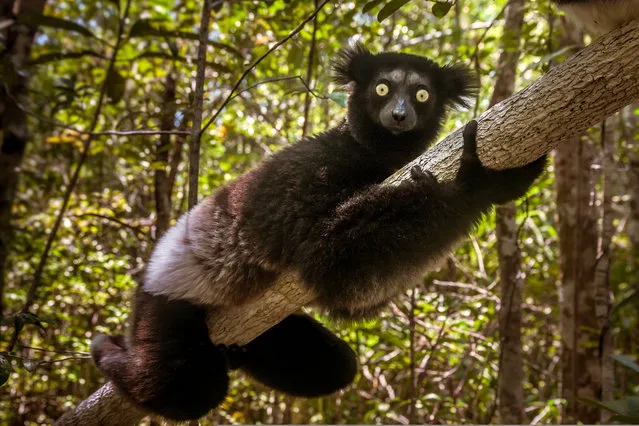
The secretive indri (Indri indri) of Madagascar, the largest living lemur. It is also critically endangered and highly evolutionarily distinct with no close relatives, which makes its branch one of most precarious on the mammal evolutionary tree. In the likely event that the indri goes extinct, we will lose 19m years of unique evolutionary history from the mammal tree of life. (Photo by Pierre-Yves Babelon/Aarhus University)