Loading...
Done
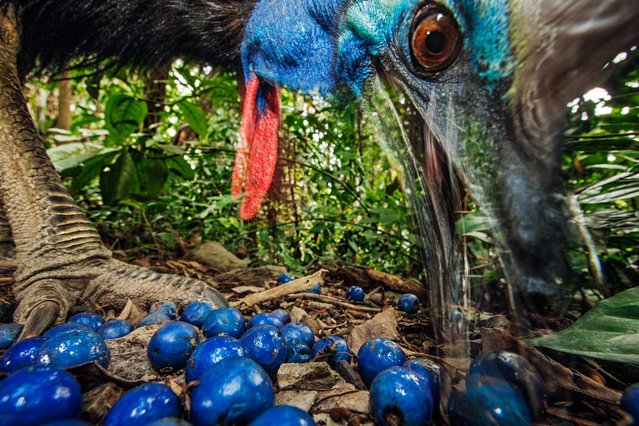
“Cassowaries are large, flightless birds related to emus and (more distantly) to ostriches, rheas, and kiwis”, writes Olivia Judson in the September issue of National Geographic magazine. (Photo by Christian Ziegler/National Geographic)

“Cassowaries are large, flightless birds related to emus and (more distantly) to ostriches, rheas, and kiwis”, writes Olivia Judson in the September issue of National Geographic magazine. How large? People-size: Adult males stand well over five foot five and top 110 pounds. Females are even taller, and can weigh more than 160 pounds. Dangerous when roused, they’re shy and peaceable when left alone. But even birds this big and tough are prey to habitat loss. The dense New Guinea and Australia rain forests where they live have dwindled. Today cassowaries might number 1,500 to 2,000. And because they help shape those same forests – by moving seeds from one place to another – “if they vanish”, Judson writes, “the structure of the forest would gradually change” too. (Photo by Christian Ziegler/National Geographic)
Details
06 Jan 2014 12:21:00
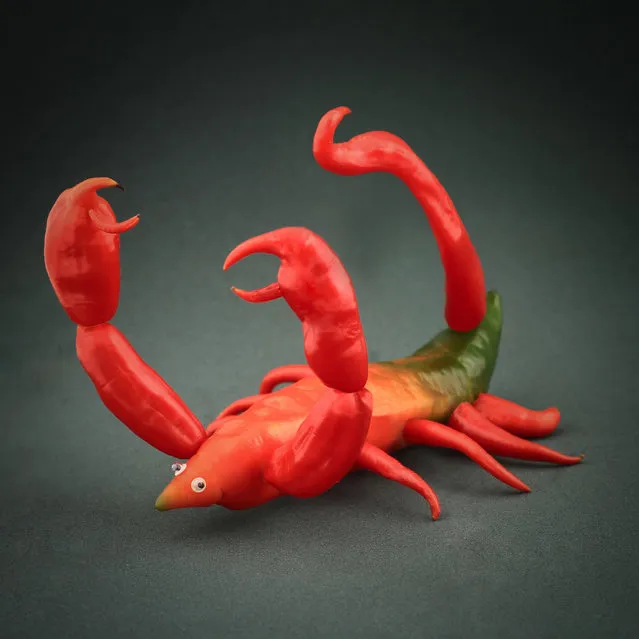
“Red Pepperpion. (Photo by Vanessa Dualib)

“Red Pepperpion. Red Pepperpions are secretive, nocturnal arachilli which can be spotted in kitchens of arid climates all around the world.

Red Pepperpions are equipped with a delicious (and depending on the quantity...deadly!) stinger at the end of its tail. If you happen to get bitten (or if you bite him!) it will produce a burning sensation on your taste nerves.

However, there is no need to worry, since the fact is that his potent stinger is usually only used when hunting or whenever the Pepperpion feels like he might become part of someones meal...

At daylight or when encountering a larger foe, such as a Saucier Chef, they retreat into burrows inside the fridge or hide beneath the oven”. (Photo and comment by Vanessa Dualib)


Details
08 Feb 2013 09:24:00
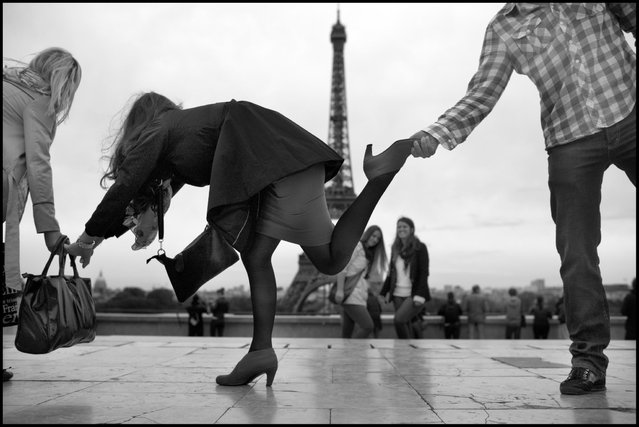
The Eiffel Tour-the body language of balance. I came across this group of young adults from Sarajevo, Bosnia, having fun testing their balance two nights ago in on the Esplanade de Trocadero. (Photo and comment by Peter Turnley)

The Eiffel Tour-the body language of balance. I came across this group of young adults from Sarajevo, Bosnia, having fun testing their balance two nights ago in on the Esplanade de Trocadero. (Photo and comment by Peter Turnley)
Details
23 Feb 2013 08:09:00
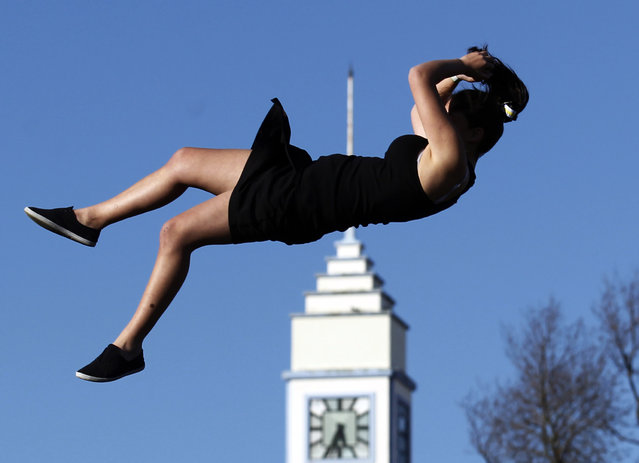
8. NEW ZEALAND: A woman dives from a platform into a giant air bed at a park in Palmerston North September 29, 2011. (Photo by Marcos Brindicci/Reuters)

The report, prepared by the Sustainable Development Solutions Network (SDSN) and the Earth Institute at Columbia University, showed Syria, Afghanistan and eight sub-Saharan countries as the 10 least happy places on earth to live. The top 10 this year were Denmark, Switzerland, Iceland, Norway, Finland, Canada, Netherlands, New Zealand, Australia, and Sweden. Denmark was in third place last year, behind Switzerland and Iceland. The bottom 10 were Madagascar, Tanzania, Liberia, Guinea, Rwanda, Benin, Afghanistan, Togo, Syria and Burundi. The United States came in at 13, the United Kingdom at 23, France at 32, and Italy at 50. Here: #8. NEW ZEALAND: A woman dives from a platform into a giant air bed at a park in Palmerston North September 29, 2011. (Photo by Marcos Brindicci/Reuters)
Details
26 Mar 2016 13:19:00
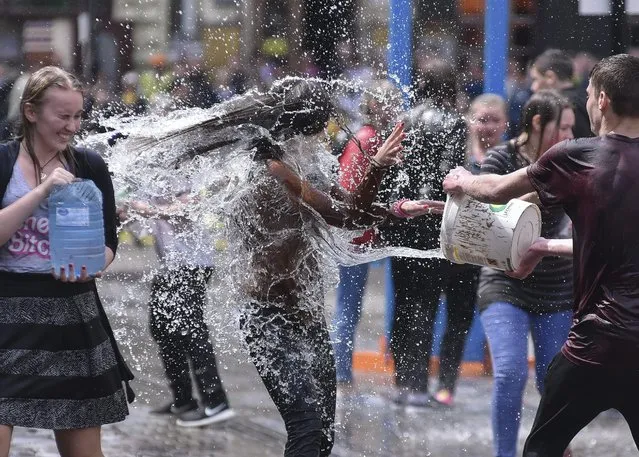
Ukrainians pour water on each other on a street in Lviv, Ukraine, 02 May 2016. The tradition of pouring water was an ancient spring ritual of cleansing on first Monday after Orthodox Easter. (Photo by Mykola Tys/EPA)

Ukrainians pour water on each other on a street in Lviv, Ukraine, 02 May 2016. The tradition of pouring water was an ancient spring ritual of cleansing on first Monday after Orthodox Easter. (Photo by Mykola Tys/EPA)
Details
03 May 2016 13:38:00
Pedestrians look at “doll” model Lulu Hashimoto standing on the street during a photo opportunity for Reuters in Tokyo, Japan August 23, 2017. (Photo by Kim Kyung-Hoon/Reuters)

Pedestrians look at “doll” model Lulu Hashimoto standing on the street during a photo opportunity for Reuters in Tokyo, Japan August 23, 2017. (Photo by Kim Kyung-Hoon/Reuters)
Details
25 Aug 2017 08:27:00
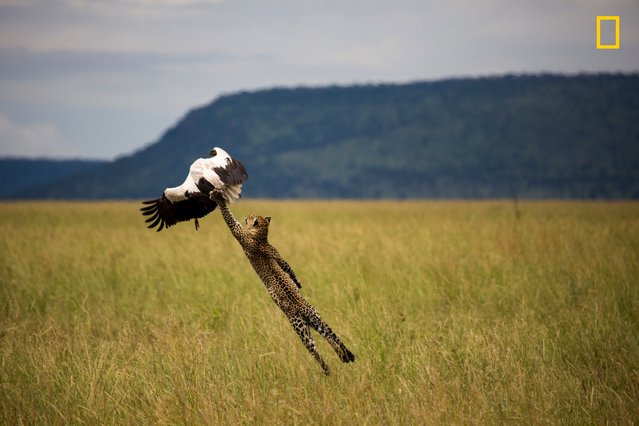
“Leopard Hunting a Stork”. “One-shot capture. I watched the leopard stalking the stork, I only had time to focus at 400mm, no time to change to high speed, I watched the stork, and as soon as it flapped its wings, I shot one shot”. (Photo by Paul Rifkin/National Geographic Travel Photographer of the Year Contest)

“Leopard Hunting a Stork”. “One-shot capture. I watched the leopard stalking the stork, I only had time to focus at 400mm, no time to change to high speed, I watched the stork, and as soon as it flapped its wings, I shot one shot”. (Photo by Paul Rifkin/National Geographic Travel Photographer of the Year Contest)
Details
04 Jun 2018 00:03:00
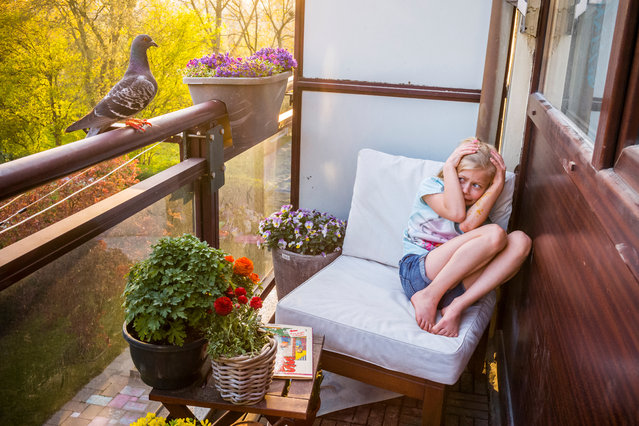
Nature – first prize, stories. Pandemic Pigeons – A Love Story. The photographer’s daughter, Merel, cowers after Dollie flies past and perches on the balcony before entering the house in Vlaardingen in the Netherlands on 6 April 2020. “She’s still frightened when Dollie suddenly lands on the balcony railing. I hide my smile behind the camera, as I try to comfort her by saying they won’t hurt you. “I thought he was going to attack me”, she replies. As the nesting pigeons keep coming back to our place, slowly my girls have started to appreciate them – perhaps not as much as I do, but it’s a start”. (Photo by Jasper Doest/World Press Photo 2021)

Nature – first prize, stories. Pandemic Pigeons – A Love Story. The photographer’s daughter, Merel, cowers after Dollie flies past and perches on the balcony before entering the house in Vlaardingen in the Netherlands on 6 April 2020. “She’s still frightened when Dollie suddenly lands on the balcony railing. I hide my smile behind the camera, as I try to comfort her by saying they won’t hurt you. “I thought he was going to attack me”, she replies. As the nesting pigeons keep coming back to our place, slowly my girls have started to appreciate them – perhaps not as much as I do, but it’s a start”. (Photo by Jasper Doest/World Press Photo 2021)
Details
17 Apr 2021 09:30:00