Loading...
Done
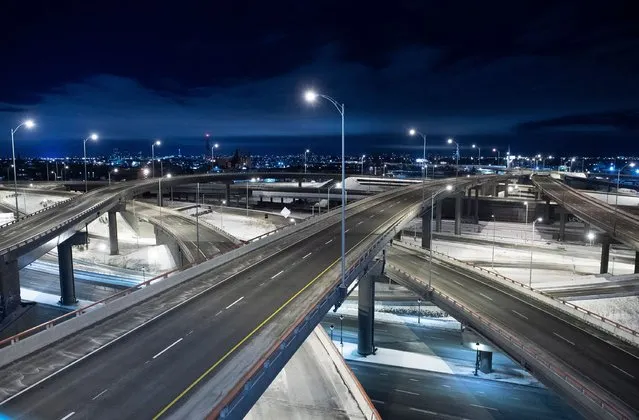
An empty Turcot Interchange is shown in Montreal, Saturday, January 9, 2021, as the Quebec government imposed a curfew to help stop the spread of COVID-19 starting at 8 p.m until 5 a.m and lasting until Feb. 8. (Photo by Graham Hughes/The Canadian Press via AP Photo)

An empty Turcot Interchange is shown in Montreal, Saturday, January 9, 2021, as the Quebec government imposed a curfew to help stop the spread of COVID-19 starting at 8 p.m until 5 a.m and lasting until Feb. 8. (Photo by Graham Hughes/The Canadian Press via AP Photo)
Details
18 Jun 2021 14:56:00
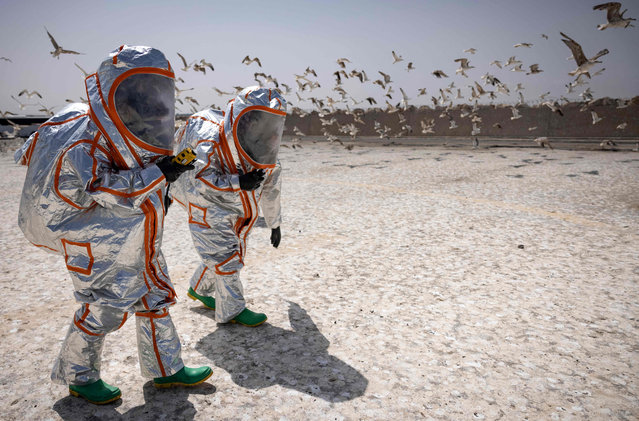
Members of the Moroccan Royal Armed Forces Rescue and Relief Unit take part in a biochemical simulation organized by the US Defense Threat Reduction Agency (DTRA) as part of the “African Lion” military exercise, in the port of Agadir, on June 15, 2021. (Photo by Fadel Senna/AFP Photo)

Members of the Moroccan Royal Armed Forces Rescue and Relief Unit take part in a biochemical simulation organized by the US Defense Threat Reduction Agency (DTRA) as part of the “African Lion” military exercise, in the port of Agadir, on June 15, 2021. (Photo by Fadel Senna/AFP Photo)
Details
26 Jun 2021 09:42:00
Kang Na-ra, a North Korean defector who is now a beauty YouTuber, points at her lips after putting on a lipstick made by North Korea, in Seoul, South Korea, June 11, 2019. (Photo by Kim Hong-Ji/Reuters)

Kang Na-ra, a North Korean defector who is now a beauty YouTuber, points at her lips after putting on a lipstick made by North Korea, in Seoul, South Korea, June 11, 2019. (Photo by Kim Hong-Ji/Reuters)
Details
06 Dec 2019 00:05:00
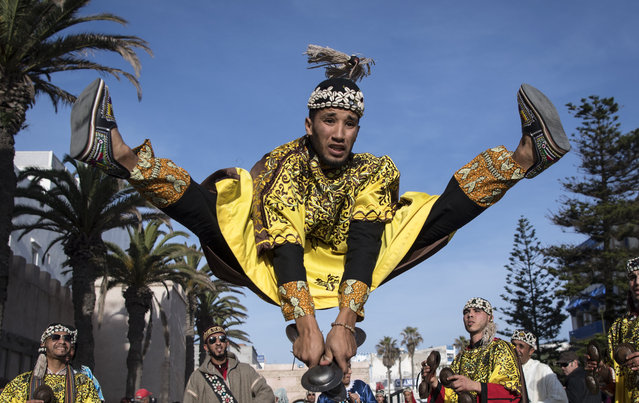
A Gnawa traditional group performs in the city of Essaouira on December 14, 2019, to celebrate the decision of adding the Gnawa culture to UNESCO's list of Intangible Cultural Heritage of Humanity. Gnawa culture, a centuries-old Moroccan practice rooted in music, African rituals and Sufi traditions, was added to UNESCO's list of Intangible Cultural Heritage of Humanity earlier in the week. Gnawa refers to a “set of musical productions, fraternal practices and therapeutic rituals where the secular mixes with the sacred”, according to the nomination submitted by Morocco. Often dressed in colourful outfits, Gnawa musicians play the guenbri, a type of lute with three strings, accompanied by steel castanets called krakebs. (Photo by Fadel Senna/AFP Photo)

A Gnawa traditional group performs in the city of Essaouira on December 14, 2019, to celebrate the decision of adding the Gnawa culture to UNESCO's list of Intangible Cultural Heritage of Humanity. Gnawa culture, a centuries-old Moroccan practice rooted in music, African rituals and Sufi traditions, was added to UNESCO's list of Intangible Cultural Heritage of Humanity earlier in the week. Gnawa refers to a “set of musical productions, fraternal practices and therapeutic rituals where the secular mixes with the sacred”, according to the nomination submitted by Morocco. Often dressed in colourful outfits, Gnawa musicians play the guenbri, a type of lute with three strings, accompanied by steel castanets called krakebs. (Photo by Fadel Senna/AFP Photo)
Details
18 Dec 2019 00:05:00
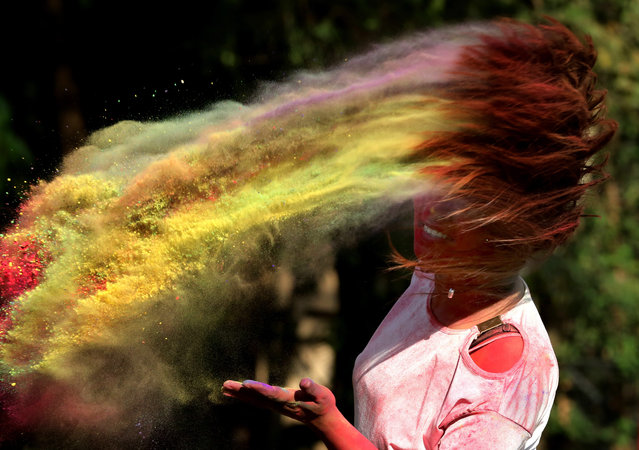
A college girl takes part in the Holi festival celebrations in Bhopal, India, 19 March 2019. Holi is celebrated on the full moon day and marks the beginning of the spring season. Holi will be celebrated as the Hindu spring festival of colors across the country on 21 March. (Photo by Sanjeev Gupta/EPA/EFE)

A college girl takes part in the Holi festival celebrations in Bhopal, India, 19 March 2019. Holi is celebrated on the full moon day and marks the beginning of the spring season. Holi will be celebrated as the Hindu spring festival of colors across the country on 21 March. (Photo by Sanjeev Gupta/EPA/EFE)
Details
26 Dec 2019 00:03:00
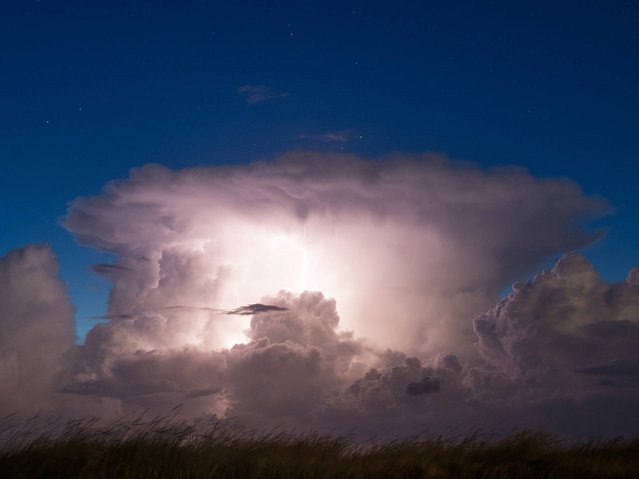
Lightning illuminates a thundercloud as a storm front hits the North Sea region near Westerhever, northern Germany, on August 11, 2014. (Photo by Daniel Reinhardt/AFP Photo/DPA)

Lightning illuminates a thundercloud as a storm front hits the North Sea region near Westerhever, northern Germany, on August 11, 2014. (Photo by Daniel Reinhardt/AFP Photo/DPA)
Details
15 Sep 2014 10:58:00
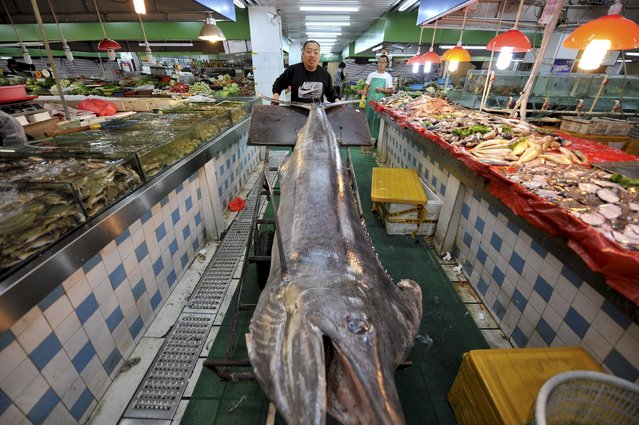
A seafood vendor moves a giant swordfish to his stall at a market in Qingdao, Shandong province, China, September 12, 2015. (Photo by Reuters/Stringer)

A seafood vendor moves a giant swordfish to his stall at a market in Qingdao, Shandong province, China, September 12, 2015. The 4.1-metre-long (13.5 feet) swordfish, weighed about 309.5 kilograms (682 lbs), was caught by local fishermen on Friday, local media reported. (Photo by Reuters/Stringer)
Details
13 Sep 2015 13:44:00
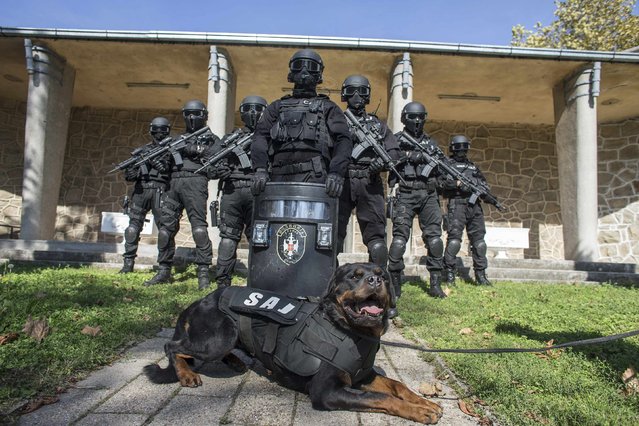
Serbian police officers of the Special Anti-Terrorist Unit pose for a picture in their base outside Belgrade October 8, 2014. (Photo by Marko Djurica/Reuters)

Serbian police officers of the Special Anti-Terrorist Unit pose for a picture in their base outside Belgrade October 8, 2014. When the killing of an unarmed black teenager by a white policeman in Ferguson, Missouri, in August sparked sometimes violent protests, the response of police in camouflage gear and armoured vehicles wielding stun grenades and assault rifles seemed more like a combat operation than a public order measure. Some U.S. police departments have recently acquired U.S. military-surplus hardware from wars abroad, but there are many law enforcers around the world whose rules of engagement also allow the use of lethal force with relatively few restrictions. But for every regulation that gives police wide scope to use firearms, there is another code that sharply limits their use. In Serbia, police may use measures ranging from batons to special vehicles, water cannon and tear gas on groups of people who have gathered illegally and are behaving in a way that is violent or could cause violence, but they may use firearms only when life is endangered. (Photo by Marko Djurica/Reuters)
Details
27 Nov 2014 14:53:00