Loading...
Done
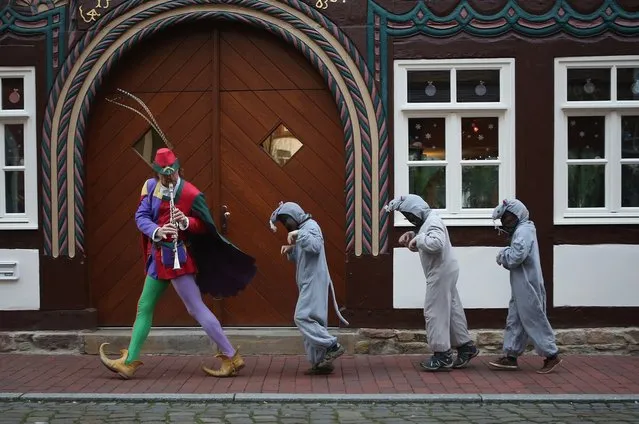
The Pied Piper of Hamelin, actually city tourism employee Michael Boyer, leads local children dressed as rats through a quiet street on November 19, 2012 in Hameln, Germany. The Pied Piper (in German: Der Rattenfaenger), is one of the many stories featured in the collection of fairy tales collected by the Grimm brothers, and the 200th anniversary of the first publication of the stories will take place this coming December 20th. Boyer, a U.S. citizen who has lived in Hameln for 15 years, and city children regularly perform a reenactment of the Pied Piper tale throughout the summer months. The Grimm brothers collected their stories from oral traditions in the region between Frankfurt and Bremen in the early 19th century, and the works include such global classics as Sleeping Beauty, Little Red Riding Hood, Rapunzel, Cinderella and Hansel and Gretel.  (Photo by Sean Gallup)

The Pied Piper of Hamelin, actually city tourism employee Michael Boyer, leads local children dressed as rats through a quiet street on November 19, 2012 in Hameln, Germany. The Pied Piper (in German: Der Rattenfaenger), is one of the many stories featured in the collection of fairy tales collected by the Grimm brothers, and the 200th anniversary of the first publication of the stories will take place this coming December 20th. Boyer, a U.S. citizen who has lived in Hameln for 15 years, and city children regularly perform a reenactment of the Pied Piper tale throughout the summer months. The Grimm brothers collected their stories from oral traditions in the region between Frankfurt and Bremen in the early 19th century, and the works include such global classics as Sleeping Beauty, Little Red Riding Hood, Rapunzel, Cinderella and Hansel and Gretel. (Photo by Sean Gallup)
Details
23 Nov 2012 11:48:00
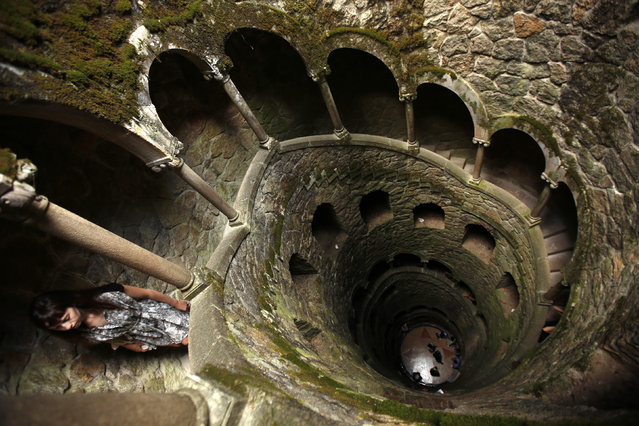
A visitor walks inside the initiation well at Quinta da Regaleira in Sintra October 6, 2014. (Photo by Rafael Marchante/Reuters)

A visitor walks inside the initiation well at Quinta da Regaleira in Sintra October 6, 2014. Sintra became the first centre of European Romantic architecture in the 19th century, which influenced the development of landscape architecture throughout Europe. It was classified as a World Heritage Site by UNESCO in 1995. Its monuments are visited by more than 1.5 million of tourists every year, according to local media. (Photo by Rafael Marchante/Reuters)
Details
28 Oct 2014 12:35:00
Mikhail Baburin, 66, talks to his cat Marquis at his house in the remote Siberian village of Mikhailovka, Krasnoyarsk region, Russia, December 5, 2016. (Photo by Ilya Naymushin/Reuters)

Mikhail Baburin, 66, talks to his cat Marquis at his house in the remote Siberian village of Mikhailovka, Krasnoyarsk region, Russia, December 5, 2016. Baburin, a former Navy man, barge worker and employee of a military plant in Krasnoyarsk, is the last inhabitant of Mikhailovka, which was founded in the 19th century by migrants from Russia's Mordovia region. He moved in 2000 to Mikhailovka where he was born and has lived there all alone for the last 10 years with only domestic animals. (Photo by Ilya Naymushin/Reuters)
Details
07 Dec 2016 12:22:00
5-year-old Rina Kumari rubs her eye while cracking stones on the banks of Mahananda river in Siliguri, northeast India, March 5, 2005. Over 400 million people in India live below the internationally agreed poverty line (living on less than US $1 per day). According to estimates, several hundred thousand children work as labourers and beg on the streets in India. Photo taken on March 5, 2005. (Photo by Desmond Boylan/Reuters)

5-year-old Rina Kumari rubs her eye while cracking stones on the banks of Mahananda river in Siliguri, northeast India, March 5, 2005. Over 400 million people in India live below the internationally agreed poverty line (living on less than US $1 per day). According to estimates, several hundred thousand children work as labourers and beg on the streets in India. (Photo by Desmond Boylan/Reuters)
Details
13 Jun 2014 12:07:00
A mudlark uses a torch to look for items on the bank of the River Thames in London, Britain June 06, 2016. Mudlarking is believed to trace its origins to the 18th and 19th century, when scavengers searched the Thames' shores for items to sell. These days, history and archaeology fans are the ones hoping to find old relics such as coins, ceramics, artifacts or everyday items from across centuries. They wait for the low tide and then scour specific areas of exposed shores. "If you're in a field you could be out all day long, with the river you're restricted to about two or three hours," mudlark Nick Stevens said. While many just use the naked eye for their searches, others rely on metal detectors for which a permit from the Port of London Authority is needed. Digging also requires consent. (Photo by Neil Hall/Reuters)

A mudlark uses a torch to look for items on the bank of the River Thames in London, Britain June 06, 2016. Mudlarking is believed to trace its origins to the 18th and 19th century, when scavengers searched the Thames' shores for items to sell. These days, history and archaeology fans are the ones hoping to find old relics such as coins, ceramics, artifacts or everyday items from across centuries. their finds with the Portable Antiquities Scheme. Any item over 300 years old must be recorded. (Photo by Neil Hall/Reuters)
Details
27 Aug 2016 10:43:00
An Iranian Shiite Muslim prays in Laylat al-Qadr, or the night of destiny, during holy fasting month of Ramadan after midnight, in central Tehran, Iran, early Sunday, June 18, 2017. Laylat al-Qadr is the night when Muslims believe the Quran was first revealed to prophet Muhammad. Worshipers gather in religious ceremonies to pray, ask forgiveness and make wishes on one of the most important nights of the Islamic calendar. Shiite Muslims, the vast majority of Iranians, believe the night happens either on 19th, 21st or 23rd of the holy month of Ramadan. (Photo by Ebrahim Noroozi/AP Photo)

An Iranian Shiite Muslim prays in Laylat al-Qadr, or the night of destiny, during holy fasting month of Ramadan after midnight, in central Tehran, Iran, early Sunday, June 18, 2017. Laylat al-Qadr is the night when Muslims believe the Quran was first revealed to prophet Muhammad. Worshipers gather in religious ceremonies to pray, ask forgiveness and make wishes on one of the most important nights of the Islamic calendar. Shiite Muslims, the vast majority of Iranians, believe the night happens either on 19th, 21st or 23rd of the holy month of Ramadan. (Photo by Ebrahim Noroozi/AP Photo)
Details
18 Jun 2017 03:43:00
An Indian girl dressed in traditional attire reacts to camera as she watches a cultural performance during Lohri festival in Jammu, India, Monday, January 13, 2014. Lohri is a celebration of the winter solstice observed by Hindus and Sikhs in northern India. (Photo by Channi Anand/AP Photo)

An Indian girl dressed in traditional attire reacts to camera as she watches a cultural performance during Lohri festival in Jammu, India, Monday, January 13, 2014. Lohri is a celebration of the winter solstice observed by Hindus and Sikhs in northern India. (Photo by Channi Anand/AP Photo)
Details
18 Jan 2014 13:28:00
A policeman wields his baton at an autorickshaw rider as punishment for breaking the lockdown rules, after India ordered a 21-day nationwide lockdown to limit the spreading of coronavirus disease (COVID-19) in Mumbai, India on March 25, 2020. (Photo by Francis Mascarenhas/Reuters)

A policeman wields his baton at an autorickshaw rider as punishment for breaking the lockdown rules, after India ordered a 21-day nationwide lockdown to limit the spreading of coronavirus disease (COVID-19) in Mumbai, India on March 25, 2020. (Photo by Francis Mascarenhas/Reuters)
Details
26 Mar 2020 00:07:00