Loading...
Done
Developed for the British American Ambulance Corps, this new motorcycle ambulance is capable of speeding wounded soldiers 90 miles an hour from the front lines to field hospitals. Its springs are synchronized with the patient?s heartbeat to avoid increasing fever when traveling over various Terrain. Viewing it in New York  August 27, 1941, are left to right: constable Herbert Scott of England, driver; William E. Detlor, whose firm developed the vehicle; M. W. Stand, inspector-general of Civilian Defense, and Maj. Edward Riekert, also. (Photo by AP Photo)

Developed for the British American Ambulance Corps, this new motorcycle ambulance is capable of speeding wounded soldiers 90 miles an hour from the front lines to field hospitals. Its springs are synchronized with the patient's heartbeat to avoid increasing fever when traveling over various Terrain. Viewing it in New York August 27, 1941, are left to right: constable Herbert Scott of England, driver; William E. Detlor, whose firm developed the vehicle; M. W. Stand, inspector-general of Civilian Defense, and Maj. Edward Riekert, also. (Photo by AP Photo)
Details
28 Aug 2015 11:51:00
Barrier tape is tied around 15-month-old Shivani's ankle to prevent her from running away, while her mother Sarta Kalara works at a construction site nearby, in Ahmedabad, India, April 19, 2016. Kalara says she has no option but to tether her daughter Shivani to a stone despite her crying, while she and her husband work for 250 rupees ($3.8) each a shift digging holes for electricity cables in the city of Ahmedabad. (Photo by Amit Dave/Reuters)

Barrier tape is tied around 15-month-old Shivani's ankle to prevent her from running away, while her mother Sarta Kalara works at a construction site nearby, in Ahmedabad, India, April 19, 2016. Kalara says she has no option but to tether her daughter Shivani to a stone despite her crying, while she and her husband work for 250 rupees ($3.8) each a shift digging holes for electricity cables in the city of Ahmedabad. (Photo by Amit Dave/Reuters)
Details
23 May 2016 09:15:00
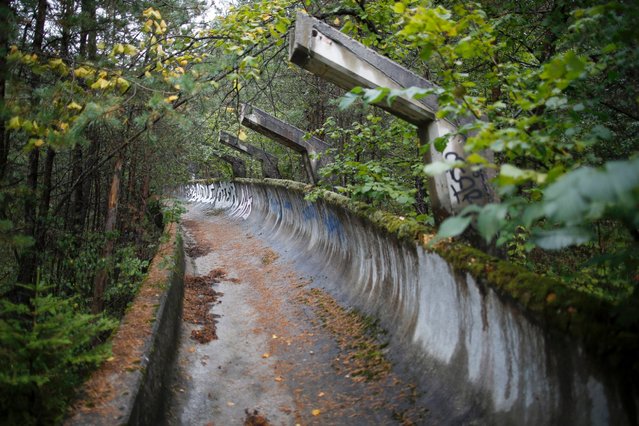
The disused bobsled track from the Sarajevo 1984 Winter Olympics is seen on Mount Trebevic, near Sarajevo, September 19, 2013. Abandoned and left to crumble into oblivion, most of the 1984 Winter Olympic venues in Bosnia's capital Sarajevo have been reduced to rubble by neglect as much as the 1990s conflict that tore apart the former Yugoslavia. (Photo by Dado Ruvic/Reuters)

The disused bobsled track from the Sarajevo 1984 Winter Olympics is seen on Mount Trebevic, near Sarajevo, September 19, 2013. Abandoned and left to crumble into oblivion, most of the 1984 Winter Olympic venues in Bosnia's capital Sarajevo have been reduced to rubble by neglect as much as the 1990s conflict that tore apart the former Yugoslavia. (Photo by Dado Ruvic/Reuters)
Details
05 Aug 2016 13:16:00
Tamberly Conway, bottom left, takes part in a large snowball fight in Dupont Circle on Sunday January 24, 2016 in Washington, DC. (Photo by Matt McClain/The Washington Post)

Tamberly Conway, bottom left, takes part in a large snowball fight in Dupont Circle on Sunday January 24, 2016 in Washington, DC. The Washington, DC area was blanketed by a large snow event. (Photo by Matt McClain/The Washington Post)
Details
25 Jan 2016 11:59:00
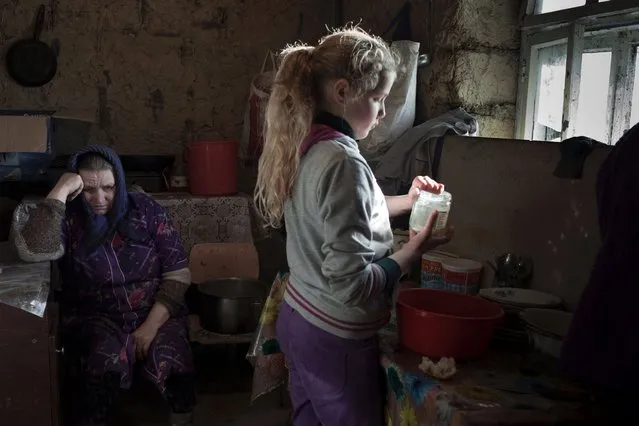
According to the U.S. government, Moldova, one of the poorest countries in Europe, depends on about $1.6 billion annually sent back from the roughly one million Moldovans who left for work in in Europe, Russia, and other former Soviet Bloc countries. Photographer Myriam Meloni went to Moldova to document what she refers to as “social orphans” – children whose parents have emigrated to another country in search of a job and a better future for their families. Here: Lulia is seen washing dishes in her grandmother's house, where she lives. (Photo by Myriam Meloni)

According to the U.S. government, Moldova, one of the poorest countries in Europe, depends on about $1.6 billion annually sent back from the roughly one million Moldovans who left for work in in Europe, Russia, and other former Soviet Bloc countries. Photographer Myriam Meloni went to Moldova to document what she refers to as “social orphans” – children whose parents have emigrated to another country in search of a job and a better future for their families. Here: Lulia is seen washing dishes in her grandmother's house, where she lives. (Photo by Myriam Meloni)
Details
12 Mar 2016 14:57:00
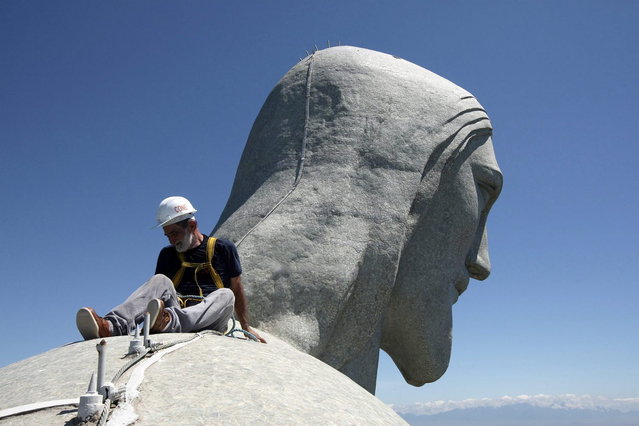
A worker inspects the Christ the Redeemer statue which was damaged during lightning storms in Rio de Janeiro January 21, 2014. (Photo by Severino Silva/Reuters/Agência o Dia)

A worker inspects the Christ the Redeemer statue which was damaged during lightning storms in Rio de Janeiro January 21, 2014. (Photo by Severino Silva/Reuters/Agência o Dia)
Details
22 Jan 2014 13:19:00
A file photograph dated 07 January 2006 and released by Greenpeace, showing the Yushin Maru, a factory ship in a Japanese whaling fleet, injuring a whale with it's first harpoon attempt. A UN court in The Hague on 31 March 2014 halted Japan's much-criticized whaling programme, ruling that it contravenes a 1986 moratorium on whale hunting. Japan must end its 'research whaling' programme, the International Court of Justice (ICJ) said. (Photo by Kate Davison/EPA)

A file photograph dated 07 January 2006 and released by Greenpeace, showing the Yushin Maru, a factory ship in a Japanese whaling fleet, injuring a whale with it's first harpoon attempt. A UN court in The Hague on 31 March 2014 halted Japan's much-criticized whaling programme, ruling that it contravenes a 1986 moratorium on whale hunting. Japan must end its 'research whaling' programme, the International Court of Justice (ICJ) said. Japan said the programme was for scientific research and permitted under international conventions. Australia had brought the case to the ICJ in 2010, charging that Japan was breaching international law by killing hundreds of whales every year for commercial purposes. Japan was “deeply disappointed” by the ruling, an unnamed government official was quoted by the Kyodo News agency as saying. But the official said Japan would stand by the ruling. (Photo by Kate Davison/EPA)
Details
01 Apr 2014 08:38:00
Library, 2007. Photographer Lori Nix says this is the most popular image she has made for this project that she calls “The City”. (Photo by Lori Nix)

Photographer Lori Nix hand-crafted dioramas are fictional scenes of a post-apocalyptic world in which plants and decay reclaim both grand and mundane structures. Each structure is built in Nix's living room and can take over half a year to build. Photo: Library, 2007. Photographer Lori Nix says this is the most popular image she has made for this project that she calls “The City”. (Photo by Lori Nix)
Details
18 Apr 2014 10:02:00