Loading...
Done
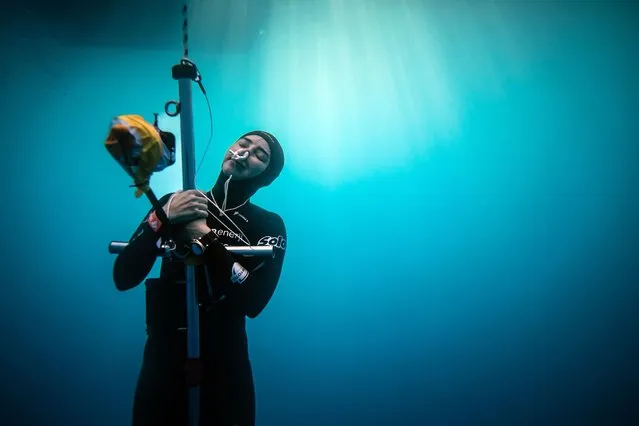
Turkish National athlete Sahika Ercumen persists in her preparations for the dive along the shores of Karamagara Bay as she will dive to break the 105-meter world record in the variable weight category without fins on the 100th anniversary of the Turkish Republic in Hatay, Turkiye on October 15, 2023. The national athlete is determined to exceed the 105-meter world record currently held by Serbian diver Lena Balta in the variable weight category without fins. (Photo by Sebnem Coskun/Anadolu via Getty Images)

Turkish National athlete Sahika Ercumen persists in her preparations for the dive along the shores of Karamagara Bay as she will dive to break the 105-meter world record in the variable weight category without fins on the 100th anniversary of the Turkish Republic in Hatay, Turkiye on October 15, 2023. The national athlete is determined to exceed the 105-meter world record currently held by Serbian diver Lena Balta in the variable weight category without fins. (Photo by Sebnem Coskun/Anadolu via Getty Images)
Details
28 Oct 2023 06:04:00


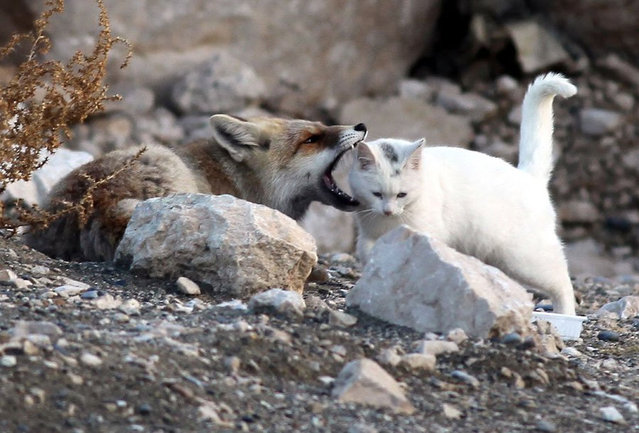
Near the shores in the city of Van, a cat and a fox are often seen playing together. A local said he first saw them together when they shared some left over fish from a fisherman. The pair soon began to play together and it has now been over a year since they began this unlikely alliance.
Details
25 Nov 2012 10:21:00
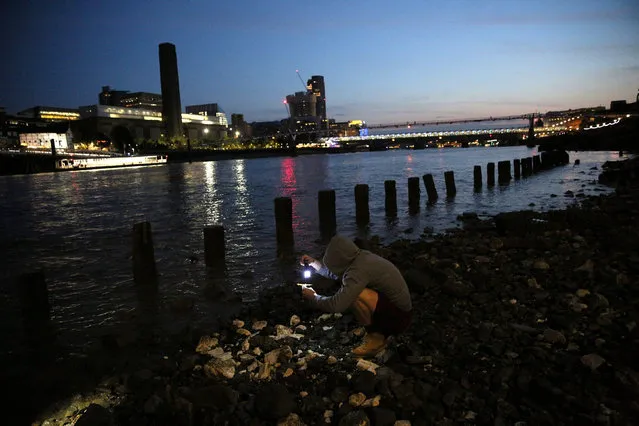
A mudlark uses a torch to look for items on the bank of the River Thames in London, Britain June 06, 2016. Mudlarking is believed to trace its origins to the 18th and 19th century, when scavengers searched the Thames' shores for items to sell. These days, history and archaeology fans are the ones hoping to find old relics such as coins, ceramics, artifacts or everyday items from across centuries. They wait for the low tide and then scour specific areas of exposed shores. "If you're in a field you could be out all day long, with the river you're restricted to about two or three hours," mudlark Nick Stevens said. While many just use the naked eye for their searches, others rely on metal detectors for which a permit from the Port of London Authority is needed. Digging also requires consent. (Photo by Neil Hall/Reuters)

A mudlark uses a torch to look for items on the bank of the River Thames in London, Britain June 06, 2016. Mudlarking is believed to trace its origins to the 18th and 19th century, when scavengers searched the Thames' shores for items to sell. These days, history and archaeology fans are the ones hoping to find old relics such as coins, ceramics, artifacts or everyday items from across centuries. their finds with the Portable Antiquities Scheme. Any item over 300 years old must be recorded. (Photo by Neil Hall/Reuters)
Details
27 Aug 2016 10:43:00
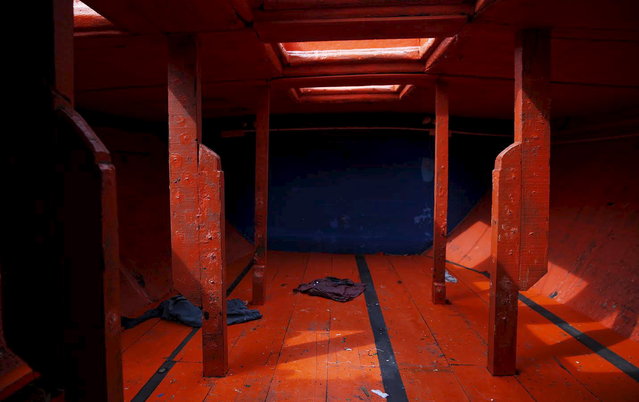
The hull on a boat that carried Rohingya migrants for three months is seen at Langkawi island, in the Malaysia's northern state of Kedah, Malaysia, May 12, 2015. Thailand and Malaysia may set up camps and detention centers to shelter hundreds of refugees arriving on their shores, officials said on Tuesday, as a leading inter-governmental agency said about 7,000 boat people were still adrift in the Bay of Bengal. (Photo by Olivia Harris/Reuters)

The hull on a boat that carried Rohingya migrants for three months is seen at Langkawi island, in the Malaysia's northern state of Kedah, Malaysia, May 12, 2015. Thailand and Malaysia may set up camps and detention centers to shelter hundreds of refugees arriving on their shores, officials said on Tuesday, as a leading inter-governmental agency said about 7,000 boat people were still adrift in the Bay of Bengal. (Photo by Olivia Harris/Reuters)
Details
13 May 2015 11:25:00
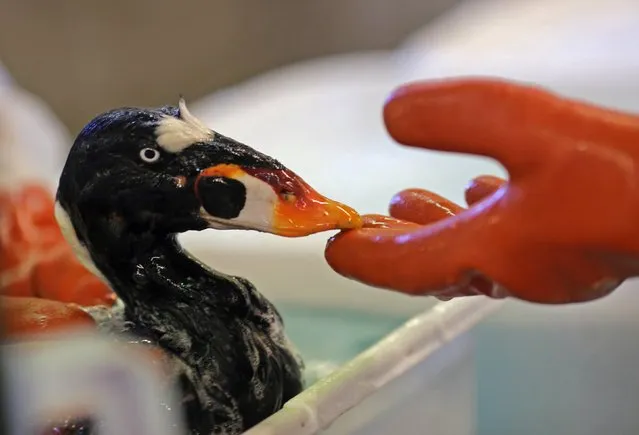
A bird is cleaned at the International Bird Rescue in Fairfield, California January 20, 2015. A gooey, unknown material discovered on the eastern shores of San Francisco Bay is clinging to the feathers of birds, and more than 100 birds, mostly species of oceangoing, diving ducks, have died after their feathers were fouled by the viscous substance now undergoing testing at state labs in Sacramento. (Photo by Robert Galbraith/Reuters)

A bird is cleaned at the International Bird Rescue in Fairfield, California January 20, 2015. A gooey, unknown material discovered on the eastern shores of San Francisco Bay is clinging to the feathers of birds, and more than 100 birds, mostly species of oceangoing, diving ducks, have died after their feathers were fouled by the viscous substance now undergoing testing at state labs in Sacramento. (Photo by Robert Galbraith/Reuters)
Details
22 Jan 2015 14:03:00
Brazilian tattoo artist Michel Praddo, also known as Diabao or Human Satan, and his wife Carol Praddo, known as Mulher Demonia or Demon Woman, take a picture with a fan at the beach shore in Praia Grande, Brazil on August 18, 2021. Despite his frightening image, Prado says he has a good heart. His wife Carol Prado, 36, who is known as Demon Woman, also altered her body to fit the image. The Sao Paulo-based couple have undergone their most extreme modifications during the last five years. (Photo by Carla Carniel/Reuters)

Brazilian tattoo artist Michel Praddo, also known as Diabao or Human Satan, and his wife Carol Praddo, known as Mulher Demonia or Demon Woman, take a picture with a fan at the beach shore in Praia Grande, Brazil on August 18, 2021. (Photo by Carla Carniel/Reuters)
Details
24 Aug 2021 08:10:00
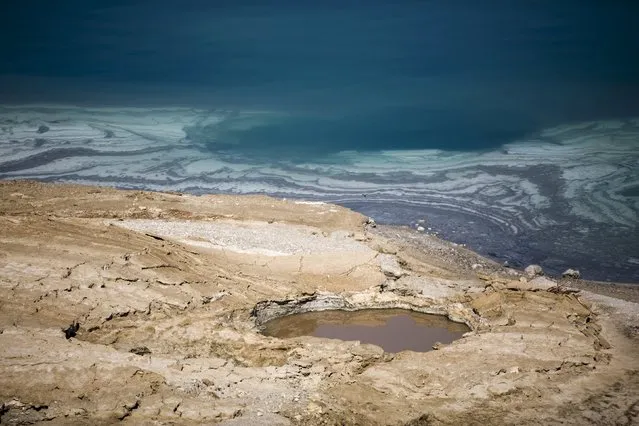
A sinkhole is seen on the shore of the Dead Sea near Kibbutz Ein Gedi, Israel July 27, 2015. The Dead Sea is shrinking, and as its waters vanish at a rate of more than one meter a year, hundreds of sinkholes, some the size of a basketball court, some two storeys deep, are devouring land where the shoreline once stood. (Photo by Amir Cohen/Reuters)

A sinkhole is seen on the shore of the Dead Sea near Kibbutz Ein Gedi, Israel July 27, 2015. The Dead Sea is shrinking, and as its waters vanish at a rate of more than one meter a year, hundreds of sinkholes, some the size of a basketball court, some two storeys deep, are devouring land where the shoreline once stood. (Photo by Amir Cohen/Reuters)
Details
30 Jul 2015 12:06:00
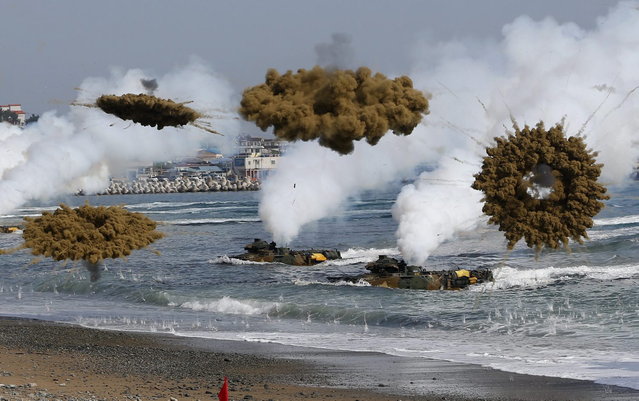
Amphibious assault vehicles of the South Korean Marine Corps throw smoke bombs as they move to land on shore during a U.S.-South Korea joint landing operation drill in Pohang March 31, 2014. The drill is part of the two countries' annual military training called Foal Eagle, which began on February 24 and runs until April 18. (Photo by Kim Hong-Ji/Reuters)

Amphibious assault vehicles of the South Korean Marine Corps throw smoke bombs as they move to land on shore during a U.S.-South Korea joint landing operation drill in Pohang March 31, 2014. The drill is part of the two countries' annual military training called Foal Eagle, which began on February 24 and runs until April 18. (Photo by Kim Hong-Ji/Reuters)
Details
31 Mar 2014 12:36:00