Loading...
Done
A man talks on his mobile phone in the village of Devmali in the desert state of Rajasthan, India June 14, 2016. (Photo by Himanshu Sharma/Reuters)

A man talks on his mobile phone in the village of Devmali in the desert state of Rajasthan, India June 14, 2016. (Photo by Himanshu Sharma/Reuters)
Details
16 Jun 2016 12:27:00
A cat is presented during “the "3rd International Pursaklar Cat Beauty Fest”, on October 14, 2018 in Ankara. (Photo by Adem Altan/AFP Photo)

A cat is presented during “The "3rd International Pursaklar Cat Beauty Fest”, on October 14, 2018 in Ankara. (Photo by Adem Altan/AFP Photo)
Details
21 Oct 2018 00:03:00
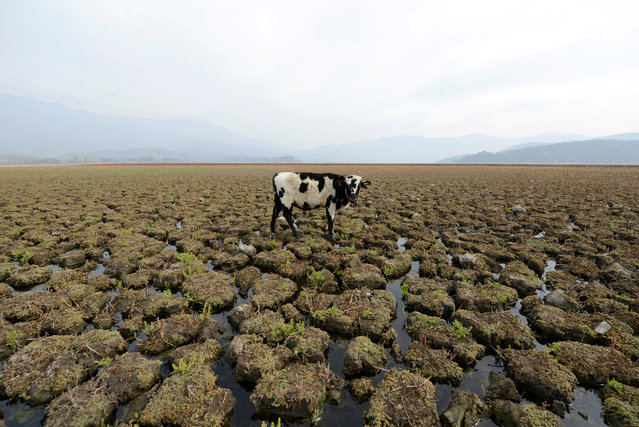
A cow is seen on land that used to be under water, at the Aculeo Lagoon in Paine, Chile, May 14, 2018. (Photo by Matias Delacroix/Reuters)

A cow is seen on land that used to be under water, at the Aculeo Lagoon in Paine, Chile, May 14, 2018. (Photo by Matias Delacroix/Reuters)
Details
04 Jan 2019 00:01:00
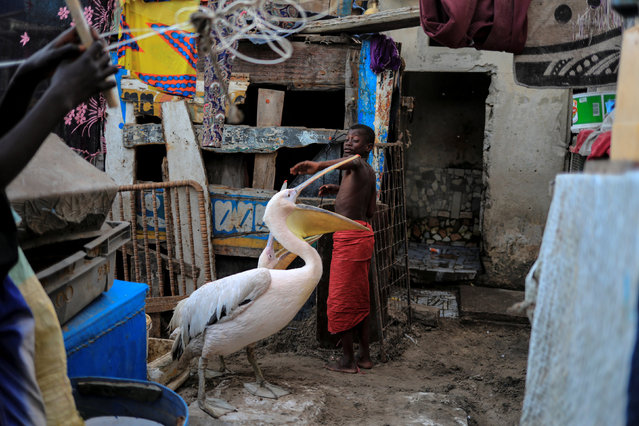
A boy plays with pelicans in Yoff, commune of Dakar, Senegal March 14, 2018. (Photo by Zohra Bensemra/Reuters)

A boy plays with pelicans in Yoff, commune of Dakar, Senegal March 14, 2018. (Photo by Zohra Bensemra/Reuters)
Details
28 Mar 2018 00:01:00
A demonstrator uses a slingshot during a protest against Chile's government in Santiago, Chile, November 14, 2019. (Photo by Jorge Silva/Reuters)

A demonstrator uses a slingshot during a protest against Chile's government in Santiago, Chile, November 14, 2019. (Photo by Jorge Silva/Reuters)
Details
16 Nov 2019 00:05:00


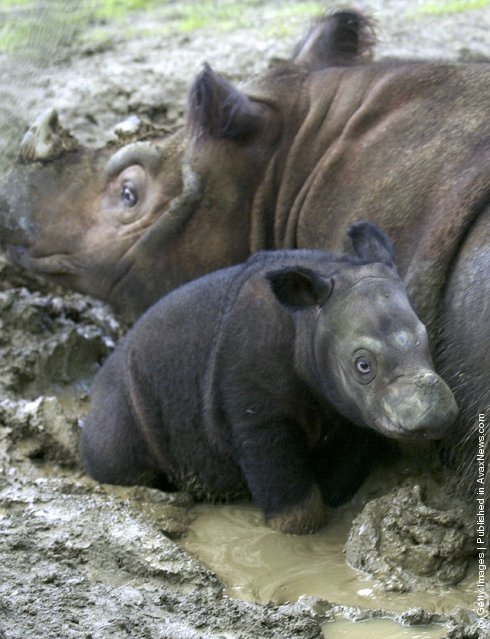
“The Sumatran Rhinoceros (Dicerorhinus sumatrensis) is a member of the family Rhinocerotidae and one of five extant rhinoceroses. It is the only extant species of the genus Dicerorhinus. It is the smallest rhinoceros, standing about 120–145 centimetres (3.9–4.76 ft) high at the shoulder, with a body length of 250 centimetres (8.2 ft) and weight of 500–800 kilograms (1,100–1,800 lb). Like the African species, it has two horns; the larger is the nasal horn, typically 15–25 centimetres (5.9–9.8 in), while the other horn is typically a stub. A coat of reddish-brown hair covers most of the Sumatran Rhino's body”. – Wikipedia

Photo: Emi, a Sumatran rhinoceros lies in the mud with her three-week-old female calf at the Cincinnati Zoo and Botanical Garden August 19, 2004 in Cincinnati, Ohio. Emi made history by becoming the first Sumatran rhino to produce two calves in captivity. (Photo by Mike Simons/Getty Images)

Details
22 Jun 2011 12:37:00
Dunnottar Castle In Scottish

Dunnottar Castleis a ruined medieval fortress located upon a rocky headland on the north-east coast of Scotland, about 3 kilometres (1.9 mi) south of Stonehaven. The surviving buildings are largely of the 15th and 16th centuries, but the site is believed to have been fortified in the Early Middle Ages. Dunnottar has played a prominent role in the history of Scotland through to the 18th-century Jacobite risings because of its strategic location and the strength of its situation. Dunnottar is best known as the place where the Honours of Scotland, the Scottish crown jewels, were hidden from Oliver Cromwell's invading army in the 17th century. The property of the Keiths from the 14th century, and the seat of the Earl Marischal, Dunnottar declined after the last Earl forfeited his titles by taking part in the Jacobite rebellion of 1715. The castle was restored in the 20th century and is now open to the public.
Details
13 Jan 2014 11:31:00
Ophiocordyceps Sinensis A.K.A. Caterpillar Fungus

“There are over 680 documented species of the sac fungus genus Ophiocordyceps, and one of the best known of these is Ophiocordyceps sinensis, colloquially known as caterpillar fungus. The fungus is known in Tibetan as yartsa gunbu or yatsa gunbu. O. sinensis is known in the West as a medicinal mushroom and its use has a long history in Traditional Chinese medicine as well as Traditional Tibetan medicine. The highly valuable fungus-caterpillar combination is hand-collected and is used as an aphrodisiac and as a treatment for a variety of ailments from fatigue to cancer”. – Wikipedia

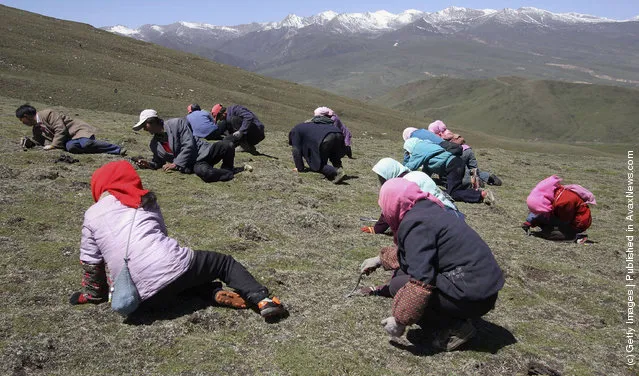
Photo: Nomads dig for Chinese caterpillar fungus from a mountain May 25, 2007 in Guide County, Hainan Prefecture, Qinghai Province, China. Nomads can earn about 2,000 yuan to 5,000 yuan (about U.S. $260 to $653 ) through their work during the fifty-day Chinese caterpillar fungus gathering season. (Photo by China Photos/Getty Images)
Details
26 Sep 2011 10:47:00