Loading...
Done
Britain's Mo Farah reacts as he wins the men's 5000m final at the London 2012 Olympic Games at the Olympic Stadium in Britain August 11, 2012. Lucy Nicholson: “When Mo Farah was rounding the final corner for the 5000m the huge stadium was electric, everybody was on their feet and he knew he was going to win as he came into that final stretch. All the photographers were excited because we knew he was going to react in a very dramatic way so it was a lovely sequence of photos as he crossed the finish line – he put his hands over his head, he wrapped himself in the British flag, it was a very long celebration sequence, which is all you can really wish for as a photographer”. (Photo by Lucy Nicholson/Reuters)

The Rio de Janeiro Olympics kick off on August 5 for some two weeks of competitive games drawing athletes as well as audiences from around the world. As they prepare to cover the event, Reuters photographers look back on their favourite pictures from past Olympics where they captured the action on the ground as well as the participants' tears and joy that followed. (Photo by Lucy Nicholson/Reuters)
Details
03 Aug 2016 11:19:00
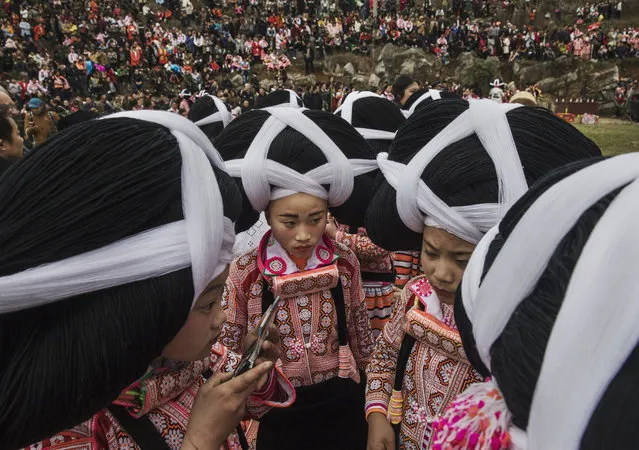
Girls of the Long Horn Miao ethnic minority group wear headdresses as they prepare gather for Tiaohua or Flower Festival as part of the Lunar New Year on February 6, 2017 in Longga village, Guizhou province, southern China. The Long Horn Miao are recognized for their declining practice of wrapping a blend of linen, wool, and the hair of their ancestors around animal horns or a wooden clip to make headdresses. Many young women say they now wear the headdresses only for special occasions and festivals, as the ornaments, which are attached by the horns to their real hair, have proved impractical for modern daily life in a fast changing world. China officially recognizes 56 different ethnic minorities, and statistics show over 7 million Chinese identifying themselves as Miao. But the small Long Horn Miao community counts only around 5000 people living in 12 villages, whose age-old traditions, language, and culture are fading. It is increasingly difficult in a modernizing China, as young people are drawn from remote rural villages to opportunities in bigger cities amongst wide-scale urbanization. Farming and labour remain the mainstays of life for the Long Horn Miao, leaving the area relatively poor in comparison with many parts of China. The government has invested significant amounts into local infrastructure and the tourism industry to try to bolster the local economy. (Photo by Kevin Frayer/Getty Images)

Girls of the Long Horn Miao ethnic minority group wear headdresses as they prepare gather for Tiaohua or Flower Festival as part of the Lunar New Year on February 6, 2017 in Longga village, Guizhou province, southern China. (Photo by Kevin Frayer/Getty Images)
Details
13 Feb 2017 00:01:00
A daredevil photographer is determined to capture London in a whole new light – by scaling the city’s many rooftops. Jacob Riglin, from Richmond Upon Thames, photographs the nation's capital from above – hanging from scaffolding, dangling his legs over the edge of buildings and looking down from perilous heights. Such images have gained the photographer, 20, an incredible fan base on Instagram, which has seen his follower count rise to more than 150,000. (Photo by Jacob Riglin/Caters News)

A daredevil photographer is determined to capture London in a whole new light – by scaling the city’s many rooftops. Jacob Riglin, from Richmond Upon Thames, photographs the nation's capital from above – hanging from scaffolding, dangling his legs over the edge of buildings and looking down from perilous heights. Such images have gained the photographer, 20, an incredible fan base on Instagram, which has seen his follower count rise to more than 150,000. He said, “I had always been interested climbing and getting that adrenaline rush from feeling on top of the world”. Here: Jacob looking out to the London skyline. (Photo by Jacob Riglin/Caters News)
Details
17 Oct 2015 08:05:00
Second Place Winner: “Thunderstorm at False Kiva”. I hiked out to these ruins at night hoping to photograph them with the Milky Way, but instead a thunderstorm rolled through, creating this dramatic image. – Max Seigal. (Photo and caption by Max Seigal/National Geographic Traveler Photo Contest)

Second Place Winner: “Thunderstorm at False Kiva”. I hiked out to these ruins at night hoping to photograph them with the Milky Way, but instead a thunderstorm rolled through, creating this dramatic image. – Max Seigal. National Geographic Traveler Director of Photography Dan Westergren, one of this year's judges, shares his thoughts on the second place winner: “This photo combines two different scenes into one: the small kiva in a cliff dwelling and the grand vista of Canyonlands National Park across the valley. I really like the two different color palettes – warm inside and purple outside. This two-for-one scene was caused by the lightning storm outside the dwelling, which lit up the landscape like it was a huge electronic flash. Looking at this picture I can imagine what a wonderful sight it must have been for the ancient people who lived here. It doesn't seem too amazing now in our modern world, but might have been mind-blowing for the prehistoric residents”. Location: Utah. (Photo and caption by Max Seigal/National Geographic Traveler Photo Contest)
Details
02 Aug 2013 06:16:00
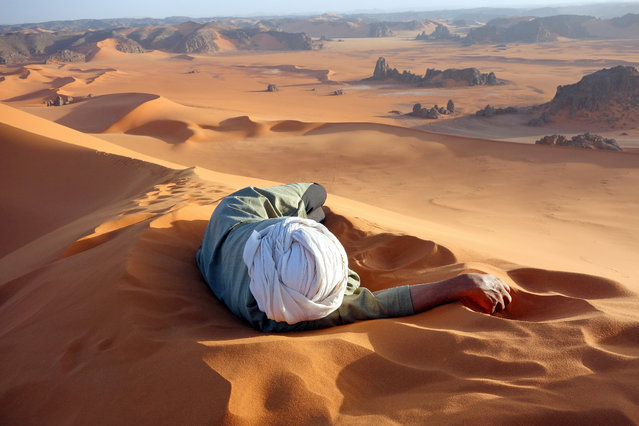
“A Well Earned Rest in the Sahara”. This photo of Moussa Macher, our Tuareg guide, was taken at the summit of Tin-Merzouga, the largest dune (or erg) in the Tadrat region of the Sahara desert in southern Algeria. Moussa rested while waiting for us to finish our 45-minute struggle to the top. Photo location: Summit of Tin-Merzouga, Tadrat, Tassili N'Ajjer National Park, Algeria. (Photo and caption by Evan Cole/National Geographic Photo Contest)

Merit Prize Winner: “A Well Earned Rest in the Sahara”. This photo of Moussa Macher, our Tuareg guide, was taken at the summit of Tin-Merzouga, the largest dune (or erg) in the Tadrat region of the Sahara desert in southern Algeria. Moussa rested while waiting for us to finish our 45-minute struggle to the top. It only took ten minutes of rolling, running, and jumping to get back down. The Tadrat is part of the Tassili N'Ajjer National Park World Heritage area, famous for its red sand and engravings and rock paintings of cattle, elephants, giraffes, and rhinos that lived there when the climate was milder. Photo location: Summit of Tin-Merzouga, Tadrat, Tassili N'Ajjer National Park, Algeria. (Photo and caption by Evan Cole/National Geographic Photo Contest)
Details
01 Aug 2014 11:38:00
A girl stands with arms outstretched at North Narrabeen on January 27, 2024 in Sydney, Australia. Around 30 indigenous children from Brewarrina, Weilmoringle, and Goodooga in the far North West NSW travelled to Sydney to participate in the program. The initiative is part of the Bush to Beach programme, which now in its 19th year, gives indigenous children a unique opportunity to learn and explore Sydney's beach culture. The efforts are made possible entirely by volunteers, donations and sponsorship. Bush to Beach is a charity dedicated to inspiring hope, confidence, and self-esteem and promoting education for Aussie bush kids, a release by the charity said. This trip is a reward for school attendance and an opportunity for the kids to see that there is another world outside their community and help develop confidence and self-esteem, according to Bush to Beach co-founder Jack Cannons. (Photo by Jenny Evans/Getty Images)

A girl stands with arms outstretched at North Narrabeen on January 27, 2024 in Sydney, Australia. Around 30 indigenous children from Brewarrina, Weilmoringle, and Goodooga in the far North West NSW travelled to Sydney to participate in the program. The initiative is part of the Bush to Beach programme, which now in its 19th year, gives indigenous children a unique opportunity to learn and explore Sydney's beach culture. (Photo by Jenny Evans/Getty Images)
Details
10 Feb 2024 09:26:00
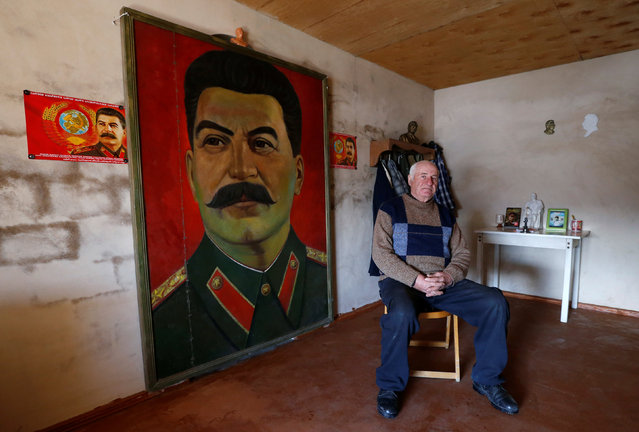
Retired builder Vasili Sidamonidze, 70, poses for a portrait at his home in Gori, Georgia, December 6, 2016. “Unfortunately, Stalin is not popular nowadays. Our people don't respect him. Only we, members of the (Communist) Party, respect him”, Sidamonidze said. “I always try to attend Stalin's birthday anniversaries in Gori. Unfortunately many people don't want to join us even if they live nearby. They look at us from their windows”. Stalin, who was born in Gori in 1878 and died in 1953, is largely reviled today in Georgia, which regained its independence during the 1991 collapse of the Soviet Union. Over the years, his memorials have been dismantled, most recently in 2010 when authorities removed a statue of the dictator from Gori's central square. But Stalin is still revered by a small group of mainly elderly supporters who stress his role in the industrialisation of the Soviet Union and in defeating Nazi Germany in World War Two. Each Dec. 21, a few dozen people mark his birthday by gathering outside a Gori museum dedicated to Stalin, where they make speeches and walk to the square where a 6-meter-high bronze statue of him once stood, calling for it to be reinstated. Opponents say it was a symbol of Moscow's still lingering shadow. In 2008, Russia fought a brief war with Georgia and recognised its breakaway regions of Abkhazia and South Ossetia as independent states. (Photo by David Mdzinarishvili/Reuters)

Retired builder Vasili Sidamonidze, 70, poses for a portrait at his home in Gori, Georgia, December 6, 2016. “Unfortunately, Stalin is not popular nowadays. Our people don't respect him. Only we, members of the (Communist) Party, respect him”, Sidamonidze said. “I always try to attend Stalin's birthday anniversaries in Gori. Unfortunately many people don't want to join us even if they live nearby. They look at us from their windows”. (Photo by David Mdzinarishvili/Reuters)
Details
17 Dec 2016 07:59:00
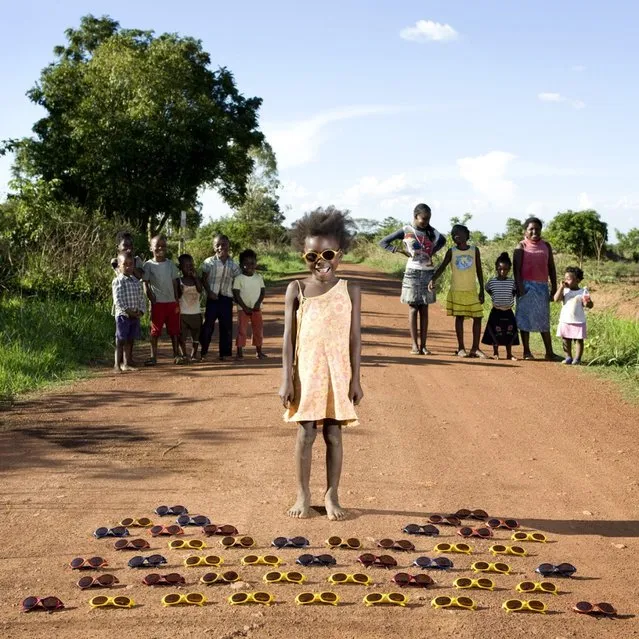
Maudy – Kalulushi, Zambia. Maudy was born in a hut in a small village close to Kalulushi, in Zambia. She grew up playing in the street with the other children in the village, who all attend the same school, where students ages 3 to 10 years old are in the same class. The village has no shops, restaurants or hotels, and just a few children are lucky enough to have toys. Maudy and her friends found a box full of sunglasses on the street, which quickly became their favorite toys. “Toy Stories” project. (Gabriele Galimberti)

Maudy – Kalulushi, Zambia. Maudy was born in a hut in a small village close to Kalulushi, in Zambia. She grew up playing in the street with the other children in the village, who all attend the same school, where students ages 3 to 10 years old are in the same class. The village has no shops, restaurants or hotels, and just a few children are lucky enough to have toys. Maudy and her friends found a box full of sunglasses on the street, which quickly became their favorite toys. “Toy Stories” project. (Photo and caption by Gabriele Galimberti)
Details
05 Dec 2013 07:54:00