Loading...
Done
Photo by Shikhei Goh

About Me

My Name Is Shikhei Goh. I was born in Dabo Singkep (Riau Islands) and now I live in Batam Island, an industrial island about 45 minutes by boat from singapore. I started taking pictures using a DSLR in March 2011. I had tried taking pictures of many things but I really have a great passion for Macro photography and I can say I am a macro addict.
I have always said to myself that I must and I can make great photos. After countless of trials and errors, explorations, and criticisms I can say that I am happy enough for what I have achieved now. However, I will keep on exploring as there are always new things in macro photography.
Written by Shikheigoh

Details
28 Nov 2012 09:38:00


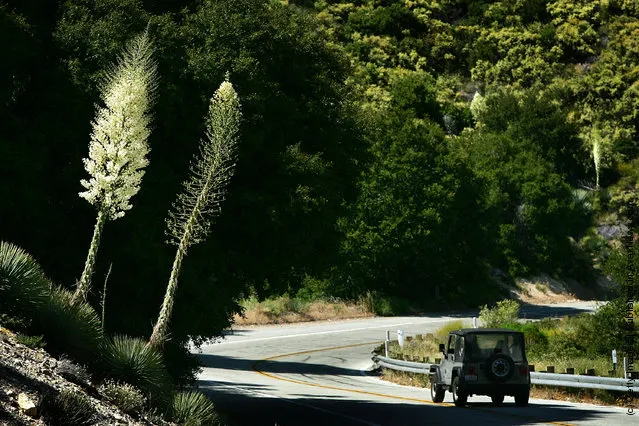
“Yucca is a genus of perennial shrubs and trees in the agave family, Agavaceae. Its 40-50 species are notable for their rosettes of evergreen, tough, sword-shaped leaves and large terminal panicles of white or whitish flowers. They are native to the hot and dry (arid) parts of North America, Central America, South America, and the Caribbean. Early reports of the species were confused with the cassava (Manihot esculenta). Consequently, Linnaeus mistakenly derived the generic name from the Carib word for the latter, yuca. It is also colloquially known in the midwest United States as “Ghosts in the graveyard”, as it is commonly found growing in rural graveyards and when in bloom the flowers appear as an apparition floating.” – Wikipedia

Photo: A yucca standing among flowers bursts forth a very large stalk of flowers as a heavy wildflower bloom on June 21, 2005 in the Angeles National Forest northwest of La Canada, California. (Photo by David McNew/Getty Images)
Details
29 Mar 2011 07:31:00


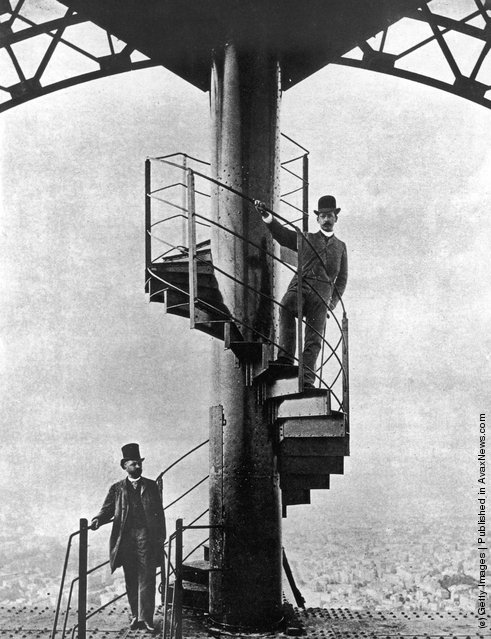
“The Eiffel Tower (French: La Tour Eiffel, nickname La dame de fer, the iron lady) is a puddle iron lattice tower located on the Champ de Mars in Paris. Built in 1889, it has become both a global icon of France and one of the most recognizable structures in the world. The tower is the tallest building in Paris and the most-visited paid monument in the world. Named for its designer, engineer Gustave Eiffel, the tower was built as the entrance arch to the 1889 World's Fair. The tower stands 324 metres (1,063 ft) tall, about the same height as an 81-storey building”. – Wikipedia

Photo: French engineer Alexandre Gustave Eiffel (1832–1923), left, poses high on the steps of the completed Eiffel Tower, which he designed for the 1889 Paris Exposition. (Photo by General Photographic Agency/Getty Images)
Details
08 May 2011 09:56:00


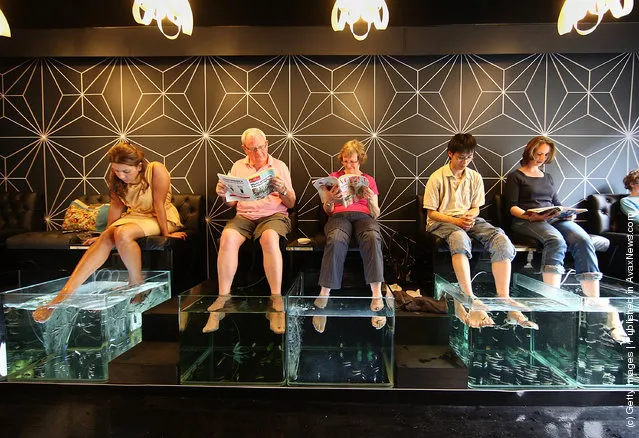
“Doctor fish is the name given to two species of fish: Garra rufa and Cyprinion macrostomus. Other nicknames include nibble fish, kangal fish, physio fish and doctorfishen; in non-medical contexts, Garra rufa is called the reddish log sucker. They live and breed in the outdoor pools of some Turkish spas, where they feed on the skin of patients with psoriasis. The fish are like combfishes in that they only consume the affected and dead areas of the skin, leaving the healthy skin to grow, with the outdoor location of the treatment bringing beneficial effects. The spas are not meant as a curative treatment option, only as a temporary alleviation of symptoms, and patients usually revisit the spas every few months”. – Wikipedia

Photo: Visitors to the Aqua Sheko fish therapy spa have their feet exfoliated on June 24, 2010 in London, England. Customers sit with their feet in a tank filled with 100-150 Garra Rufa fish which remove any dead skin by nibbling and sucking. A half hour session is then followed by a foot massage. (Photo by Peter Macdiarmid/Getty Images)
Details
22 Jun 2011 10:44:00
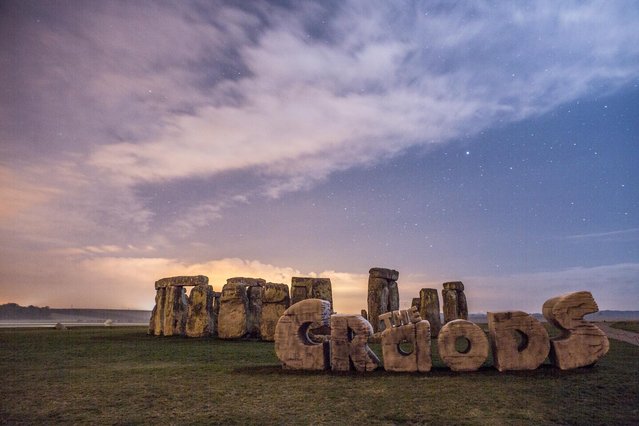
19th March 2013: In celebration of the Spring Solstice 2013 and in conjunction with the release of Twentieth Century Fox's 3D animation ‘THE CROODS’ - a family animation centered around the first ever pre historic road trip - a giant monument was erected at Stonehenge at sunrise today, Tuesday 19th March.  This marks the first time a modern structure has EVER been allowed on this historic site. The Spring Solstice or ‘Vernal Equinox’ recognises the first day of spring and each year sees druids and pagans gather at Stonehenge early in the morning to watch the sun rise above the prehistoric stones.  This year an additional monument, in the shape of ‘THE CROODS’, will become part of these special celebrations at daybreak. ‘Meet the first modern family, THE CROODS, whose world is rocked by generational clashes and seismic shifts that come to a head on a wild road trip filled with dazzling adventures, amazing firsts (like fire…and shoes), never before seen creatures and the epic discovery that they’ll have to stay one step ahead of the ever-changing world or get left in the prehistoric dust.’ DreamWorks Animation SKG presents THE CROODS. The film is directed by Chris Sanders & Kirk DeMicco, and produced by Kristine Belson and Jane Hartwell.  The screenplay is by Kirk DeMicco & Chris Sanders, with a story by John Cleese, Kirk DeMicco and Chris Sanders. The music is by Alan Silvestri. The film stars Nicolas Cage as Grug, Ryan Reynolds as Guy, Emma Stone as Eep, Catherine Keener as Ugga, Clark Duke as Thunk, and Cloris Leachman as Gran. THE CROODS presents an age known as the Croodaceous Period, which, says DeMicco, “fell between the Jurassic Age and the ‘Katzenzoic Era’– at least according to DreamWorks archaeologists.” It is a world of visual splendor and grandeur that holds innumerable challenges for the beleaguered clan

In celebration of the Spring Solstice 2013 and in conjunction with the release of Dreamworks’ 3D animation The Croods – a family animation centered around the first ever pre historic road trip – a giant monument was built at Stonehenge at sunrise on Tuesday March 19, 2013. This marks the first time a modern structure has Ever been allowed on this historic site. (Photo by Flashforwardpublicity.com)
Details
21 Mar 2013 10:21:00
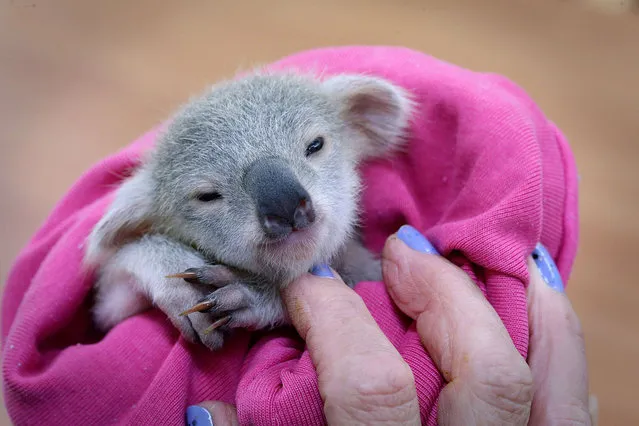
An adorable baby koala is seen enjoying a snooze after a traumatic start to life. The baby koala, nicknamed “Blondie Bumstead”, is being cared for by a volunteer from the Ipswich Koala protection society in Queensland after her mother was killed by a dog. (Photo by Jamie Hanson/Newspix/REX Features)

An adorable baby koala is seen enjoying a snooze after a traumatic start to life. The baby koala, nicknamed “Blondie Bumstead”, is being cared for by a volunteer from the Ipswich Koala protection society in Queensland after her mother was killed by a dog. Blondie, who was named for her light fur, was given just a 50-50 chance of pulling through after the attack. But after a course of antibiotics and some tender loving car from volunteer Marilyn Spletter she has now been given a clean bill of health. According to Marilyn she has hand-reared around 40 baby koalas but says that Blondie, who will be released back into the wild after 15 months, is one of her favourites. She said: “She's got a little character all of her own and she knows what she wants and what she doesn't. When she's stressed I kiss her on the nose or I rub my nose on hers and it relaxes her”. (Photo by Jamie Hanson/Newspix/REX Features)
Details
07 Aug 2014 10:26:00
These black-and-white photos are taken from the new book “Armoured Warfare in the First World War 1916 – 1918” by Anthony Tucker-Jones and published by Pen & Sword Military. “Interestingly the British, French and Germans took completely different approaches with varying results”. The British military produced “Little Willie” in Autumn 1915 weighing 18 tonnes, which had a crew of two plus four gunners. “Inspired by a tracked artillery tractor “Little Willie” was referred to as a water tank – hence the name tank – to ensure secrecy”, said Anthony. “This led to the strange looking Mark I with its peculiar rhomboid shape, designed to cross trenches with guns in sponsons on either side. The Germans saw the tank as unchivalrous and were slow to grasp its utility. They favoured the Stormtrooper (specialist soldiers used to infiltrate enemy trenches) and artillery, not the tank”, said Anthony. “However, they didn’t hesitate to make use of captured British tanks. Although the tank helped secure victory and German soldiers dubbed it “Germany’s Downfall” the country was ultimately brought to its knees by the Allies blockade”. Here: British troops hitch a ride on a Mark IV after the massed tank fleet spearheading attack at Cambrai on November 20, 1917. (Photo by Anthony Tucker-Jones/Mediadrumworld.com)

These black-and-white photos are taken from the new book “Armoured Warfare in the First World War 1916 – 1918” by Anthony Tucker-Jones and published by Pen & Sword Military. Here: British troops hitch a ride on a Mark IV after the massed tank fleet spearheading attack at Cambrai on November 20, 1917. (Photo by Anthony Tucker-Jones/Mediadrumworld.com)
Details
23 Feb 2017 00:02:00
The National Geographic Photo Ark is a travelling exhibition of photographer Joel Sartore’s quest to create a photo archive of biodiversity around the world. So far, Sartore has captured studio portraits of more than 6,000 species – a number that he hopes to double. On 1 July, the ark will open at Melbourne zoo – the first time it has been exhibited in the southern hemisphere. More than 50 portraits will be on display, including many of Australian endangered animals being protected by programs at the zoo itself. These captions have been edited from text supplied by Melbourne zoo. Here: Barking owl. So-named because its call sounds like a barking dog, these birds are native to Australia, Indonesia and Papua New Guinea. In Victoria they are listed as an endangered species, and in 2003 there were estimated to be fewer than 50 breeding pairs. The main threat to the species in Victoria is loss of habitat, especially large trees with hollows in which they can nest and on which many of their prey depend. Apart from a bark, they may utter a chilling scream when they feel threatened. (Photo by Joel Sartore/National Geographic Photo Ark/The Guardian)

The National Geographic Photo Ark is a travelling exhibition of photographer Joel Sartore’s quest to create a photo archive of biodiversity around the world. So far, Sartore has captured studio portraits of more than 6,000 species – a number that he hopes to double. On 1 July, the ark will open at Melbourne zoo – the first time it has been exhibited in the southern hemisphere. More than 50 portraits will be on display, including many of Australian endangered animals being protected by programs at the zoo itself. These captions have been edited from text supplied by Melbourne zoo. Here: Barking owl. (Photo by Joel Sartore/National Geographic Photo Ark/The Guardian)
Details
01 Jul 2017 07:45:00