Loading...
Done
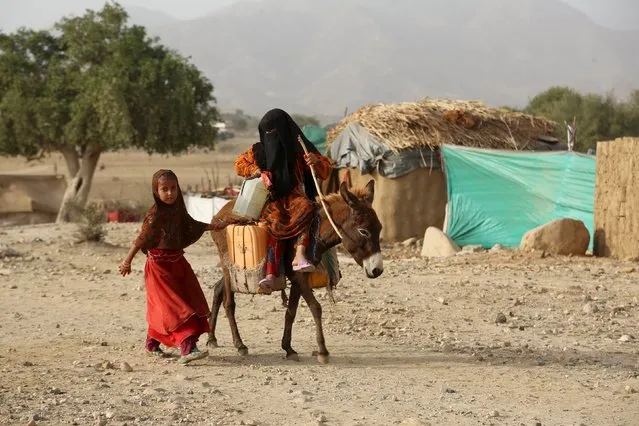
A girl rides a donkey as another walks by at the Shawqaba camp for internally displaced people who were forced to leave their villages by the war in Yemen's northwestern province of Hajjah March 12, 2016. In northwest Yemen, one of the poorest countries in the Middle East, about 400 families uprooted by the war have been stuck in the Shawqaba camp in Hajjah province for the past year. Residents live in poorly built huts that protect them neither from summer heat nor winter cold in a camp that lacks the most basic services. (Photo by Abduljabbar Zeyad/Reuters)

A girl rides a donkey as another walks by at the Shawqaba camp for internally displaced people who were forced to leave their villages by the war in Yemen's northwestern province of Hajjah March 12, 2016. In northwest Yemen, one of the poorest countries in the Middle East, about 400 families uprooted by the war have been stuck in the Shawqaba camp in Hajjah province for the past year. Residents live in poorly built huts that protect them neither from summer heat nor winter cold in a camp that lacks the most basic services. (Photo by Abduljabbar Zeyad/Reuters)
Details
09 Apr 2016 13:16:00
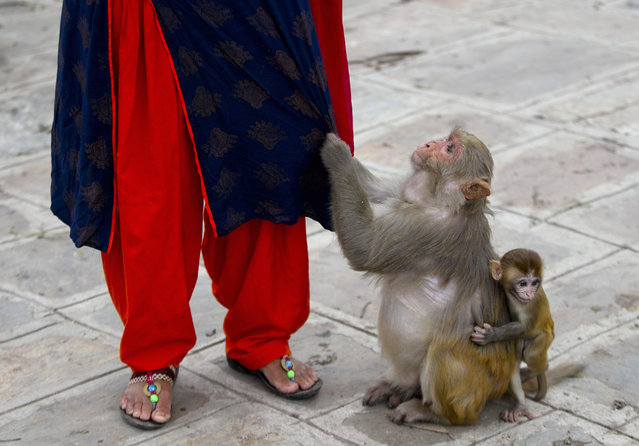
In this July 8, 2019, photo, a monkey pulls on the clothes of Saraswati Dangol as she arrives to feed monkeys in the forest near Pashupatinath temple in Kathmandu, Nepal. For the past four years, Dangol has been bringing the bread every day to feed the monkeys. As soon as they see her with her white sack, they gather around her, some patiently waiting for their turn while others less patiently snatching the bread from her hands. Many of Dangol's regulars are elderly, or are mother or baby monkeys who are unable to fight for their share of food in the wild. (Photo by Niranjan Shrestha/AP Photo)

In this July 8, 2019, photo, a monkey pulls on the clothes of Saraswati Dangol as she arrives to feed monkeys in the forest near Pashupatinath temple in Kathmandu, Nepal. For the past four years, Dangol has been bringing the bread every day to feed the monkeys. As soon as they see her with her white sack, they gather around her, some patiently waiting for their turn while others less patiently snatching the bread from her hands. Many of Dangol's regulars are elderly, or are mother or baby monkeys who are unable to fight for their share of food in the wild. (Photo by Niranjan Shrestha/AP Photo)
Details
26 Jul 2019 00:03:00
Ocean voyage

Do you think that history is a science? Well, not exactly. First, and foremost, history is the state's “legend of wars”, it’s official regalia. Of course, public historians are not interested in scientific truth – quite the opposite. In this respect, any attempt to present a state’s history as altruistic and benevolent as possible is welcomed and encouraged – as opposed to any revisionism attempts that may be more accurate. In this matter, Chinese have surpassed us all – they revised in highly creative manner (but rather shamelessly) the technology already invented by Europeans, a process that resulted in oldest state on the planet. Here is an interesting paradox: ask any sinologist about the Middle Kingdom during second century B.C., and he will describe it to you in such a vivid manner as if he has been living there all his life – but as soon as you will ask him to describe Chinese history in the 19-20th centuries… let's say, his eagerness will be greatly diminished. However, we will discuss China in a different article, and in the meantime we will try to understand how exactly historic “legend of wars” is formed and functions – based on a specific and well-known example. A great example is Ferdinand Magellan's first voyage around the world.

Details
14 Nov 2011 09:11:00
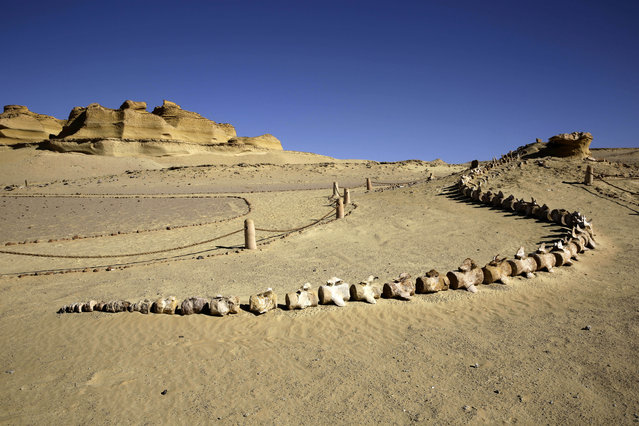
Fossilized whale bones are on display  outside the Wati El Hitan Fossils and Climate Change Museum, a UNESCO natural World Heritage site, on the opening day, in the Fayoum oasis, Egypt, Thursday, January 14, 2016. Egypt has cut the ribbon on the Middle East's first fossil museum housing the world's largest intact skeleton of a "walking whale" in an attempt to attract much-needed tourists driven off by recent militant attacks. The construction of the much-hyped Fossils and Climate Change Museum was covered a 2 billion euros (2. 17 billion dollars) grant from Italy, according to Italian Ambassador Maurizio Massari. (Photo by Thomas Hartwell/AP Photo)

Fossilized whale bones are on display outside the Wati El Hitan Fossils and Climate Change Museum, a UNESCO natural World Heritage site, on the opening day, in the Fayoum oasis, Egypt, Thursday, January 14, 2016. Egypt has cut the ribbon on the Middle East's first fossil museum housing the world's largest intact skeleton of a "walking whale" in an attempt to attract much-needed tourists driven off by recent militant attacks. The construction of the much-hyped Fossils and Climate Change Museum was covered a 2 billion euros (2. 17 billion dollars) grant from Italy, according to Italian Ambassador Maurizio Massari. Its centerpiece is an intact, 37-million-year-old and 20-meter-long skeleton of a legged form of whale that testifies to how modern-day whales evolved from land mammals. The sand-colored, dome-shaped museum is barely discernible in the breathtaking desert landscape that stretches all around. (Photo by Thomas Hartwell/AP Photo)
Details
16 Jan 2016 08:06:00
A participant of  “Bread Procession of the Saint”, takes part in the ceremony in honor of Domingo de La Calzada Saint (1019-1109) who helped poor people and pilgrimage, in Santo Domingo de La Calzada, northern Spain, Wednesday, May 11, 2016. (Photo by Alvaro Barrientos/AP Photo)

A participant of “Bread Procession of the Saint”, takes part in the ceremony in honor of Domingo de La Calzada Saint (1019-1109) who helped poor people and pilgrimage, in Santo Domingo de La Calzada, northern Spain, Wednesday, May 11, 2016. Every year during spring season, “Las Doncellas” (White Virgins), hold on their head a basket cover with white cloth while they walk past along of this old village in honor of the saint. (Photo by Alvaro Barrientos/AP Photo)
Details
12 May 2016 14:59:00
Todd Bretl specializes in underwater photography, and is able to capture striking photos of aquatic life big and small. His photos of sharks are particularly striking; though he rarely faces hostility from the animals, he tries not to spend too much time looking through his viewfinder and many shots are framed by educated guesses and impeccable timing. (Photo by Todd Bretl)

Todd Bretl specializes in underwater photography, and is able to capture striking photos of aquatic life big and small. His photos of sharks are particularly striking; though he rarely faces hostility from the animals, he tries not to spend too much time looking through his viewfinder and many shots are framed by educated guesses and impeccable timing. What follows are photographs taken over the past several years on trips to the Bahamas and Isla Guadalupe, an island off the coast of the Baja California peninsula in Mexico. (Photo by Todd Bretl)
Details
01 Aug 2014 12:35:00
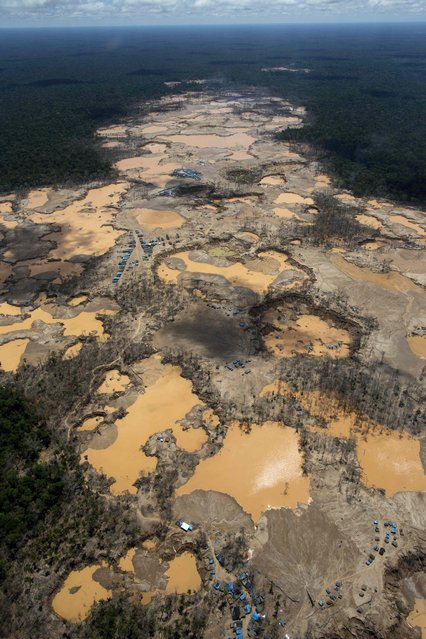
This November 11, 2014 aerial photo, shows a deforested area dotted with blue tarps, marking the area where miners reside, and craters filled with water, caused by illegal gold mining activities, in La Pampa, in Peru's Madre de Dios region. (Photo by Rodrigo Abd/AP Photo)

This November 11, 2014 aerial photo, shows a deforested area dotted with blue tarps, marking the area where miners reside, and craters filled with water, caused by illegal gold mining activities, in La Pampa, in Peru's Madre de Dios region. Less than a month before Peru plays host to global climate talks, the government sent a battalion of police into southeastern jungles to dismantle illegal gold-mining mining camps. Peru's anti-illegal mining czar, retired army Gen. Augusto Soto, marched the men to the wasteland known as La Pampa, where 50,000 hectares of rainforest have been obliterated in the past six years. (Photo by Rodrigo Abd/AP Photo)
Details
21 Nov 2014 12:35:00
Bicycle Cafe In Zurich, Switzerland

In the past, having a car was synonymous to success. Now, however, having a bicycle in the new trend. Riding a bicycle is all pros and no cons. It makes you slimmer and healthier, it allows you to enjoy the fresh air, traffic jams are no longer a problem, and of course you don’t waste money on gas. However, there was always a problem of leaving your bike unattended. With thieves lurking behind every corner, there is always a risk of someone stealing your bicycle. Thus, the authorities of Zurich have decided to do something for cyclists. They’ve created the first café for cyclists where the person can sit on his bike while enjoying a cup of coffee. This is a great idea since the visitors will not have to worry about their bikes being stolen. Though to visit such a café, you might want to bring a cushion with you, since sitting on small, hard plastic seat is not very relaxing.
Details
22 Dec 2014 11:49:00