Loading...
Done
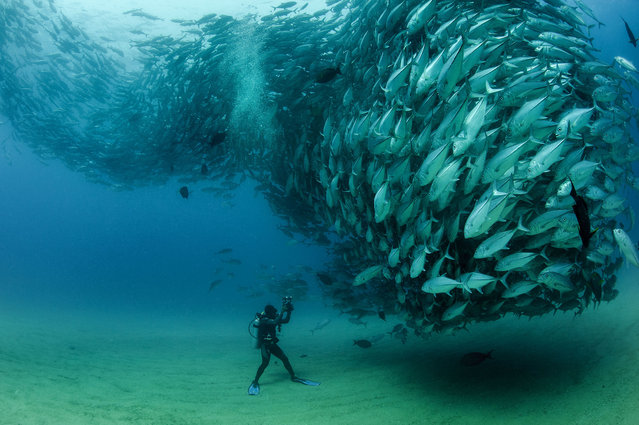
The school of fish gather in front of diver David Castro with his camera

Californian photographer and conservationist Octavio Aburto had spent years photographing the school in Cabo Pulmo National Park, Mexico – and had been trying to capture this exact shot for three years. “Together with my friend David Castro, we were diving with a large group of Bigeye travellies at Cabo Pulmo National Park, Mexico. Thousands of fish forming a ball during the reproduction courtship. In the afternoon, these fish congregate to form a large spawning aggregation around the reefs of the National Park”. (Photo and caption by Octavio Aburto)
Details
10 Feb 2014 08:34:00
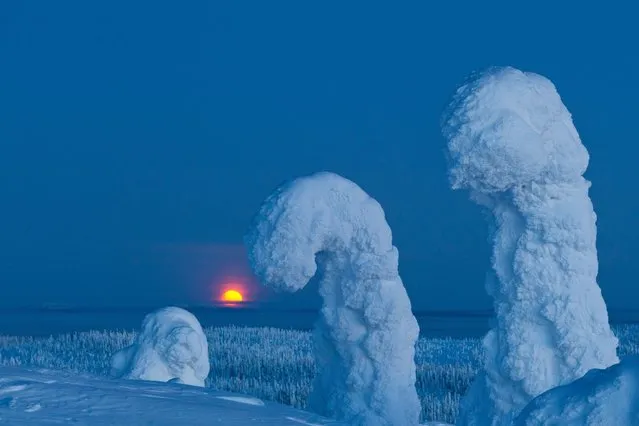
The Northern Lights glow green in a spectacular light show above a field of trees frozen solid with snow. (Photo by Jaak Sarv/Solent News & Photo Agency)

The Northern Lights glow green in a spectacular light show above a field of trees frozen solid with snow. (Photo by Jaak Sarv/Solent News & Photo Agency)
Details
09 Feb 2014 12:36:00
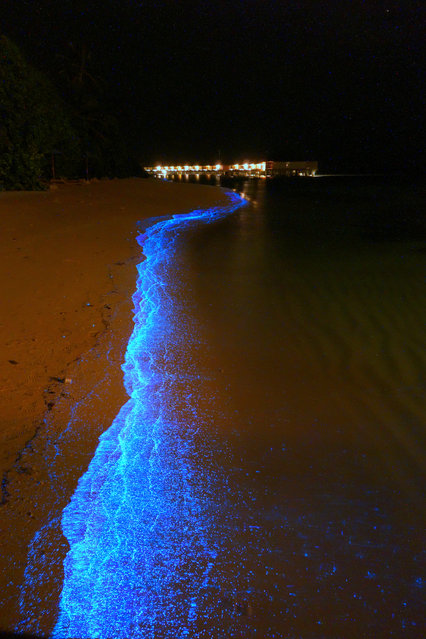
Bioluminescent phytoplankton washes up on Maldives beach. (Photo by Will Ho)

While vacationing on the Maldives Islands, Taiwanese amateur photographer Will Ho stumbled onto an incredible stretch of beach covered in millions of bioluminescent phytoplankton. These tiny organisms glow similarly to fireflies and tend to emit light when stressed, such as when waves crash or when they are otherwise agitated. While the phenomenon and its chemical mechanisms have been known for some time, biologists have only recently began to understand the reasons behind it. Photo: Bioluminescent phytoplankton washes up on Maldives beach. (Photo by Will Ho)
Details
07 Feb 2014 10:03:00
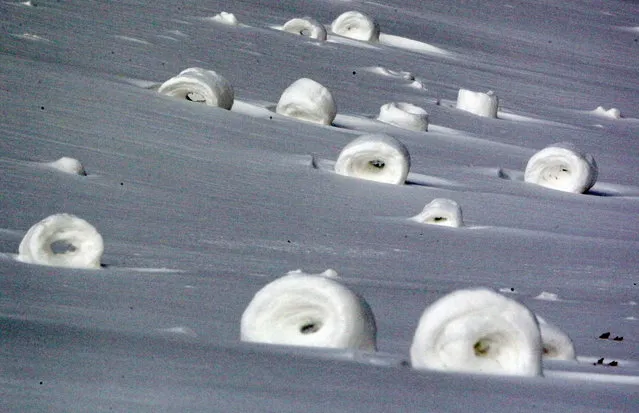
In this January 27, 2014 photo, snow rollers dot a lot at the northwest corner of Olive and North Main streets in Akron, Ohio. The snow balls are formed naturally when high winds push snow across a hill. (Photo by Michael Chritton/AP Photo/Akron Beacon Journal)

In this January 27, 2014 photo, snow rollers dot a lot at the northwest corner of Olive and North Main streets in Akron, Ohio. The snow balls are formed naturally when high winds push snow across a hill. (Photo by Michael Chritton/AP Photo/Akron Beacon Journal)
Details
02 Feb 2014 09:43:00
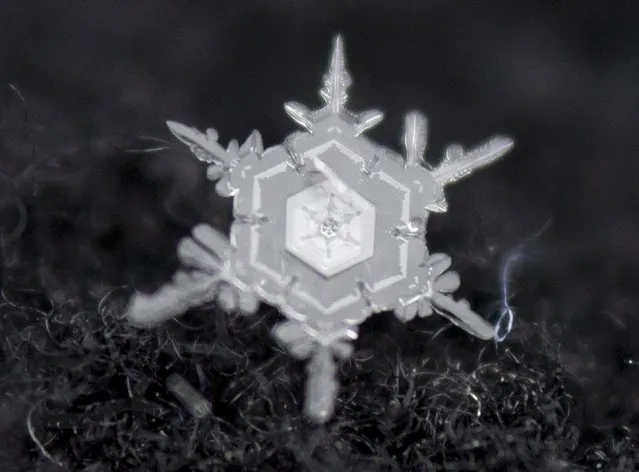
A snowflake rests on black velvet after a snowfall in Knoxville on Tuesday, January 28, 2014. (Photo by Adam Lau/News Sentinel)

A snowflake rests on black velvet after a snowfall in Knoxville on Tuesday, January 28, 2014. (Photo by Adam Lau/News Sentinel)
Details
31 Jan 2014 10:03:00
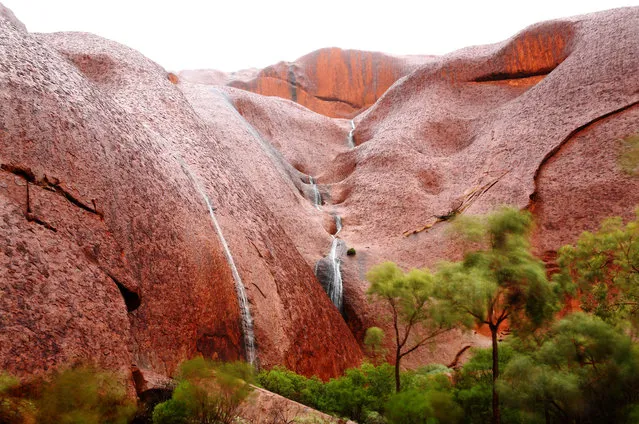
A general view of Uluru is seen as it rains on November 28, 2013 in Uluru-Kata Tjuta National Park, Australia. Uluru/ Ayers Rock is a large sandstone formation situated in central Australia approximately 335km from Alice Springs. The site and its surrounding area is scared to the Anangu people, the Indigenous people of this area and is visited by over 250,000 people each year.  (Photo by Mark Kolbe/Getty Images)

A general view of Uluru is seen as it rains on November 28, 2013 in Uluru-Kata Tjuta National Park, Australia. Uluru/ Ayers Rock is a large sandstone formation situated in central Australia approximately 335km from Alice Springs. The site and its surrounding area is scared to the Anangu people, the Indigenous people of this area and is visited by over 250,000 people each year. (Photo by Mark Kolbe/Getty Images)
Details
30 Jan 2014 13:27:00
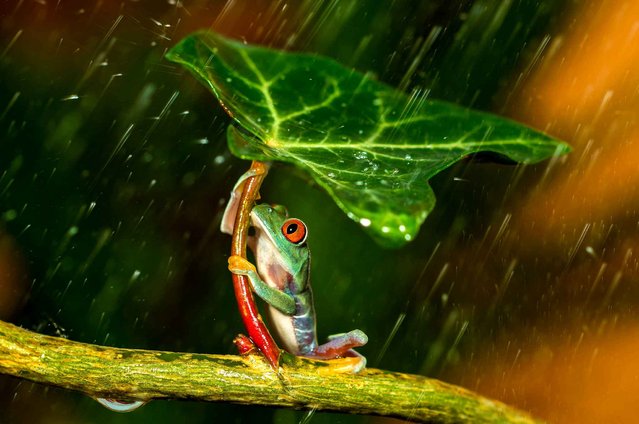
“Ohh no :( Raining”. (Photo by Kutub Uddin)

This photo was caught on camera by amateur photographer Kutub Uddin, 27, and was taken in his back garden in Bognor Regis, West Sussex. The red-eyed tree frogs have been Mr Uddin's pets for four months and he often lets them out to roam around his garden. Photo: “Ohh no :( Raining”. (Photo by Kutub Uddin)
Details
30 Jan 2014 08:42:00
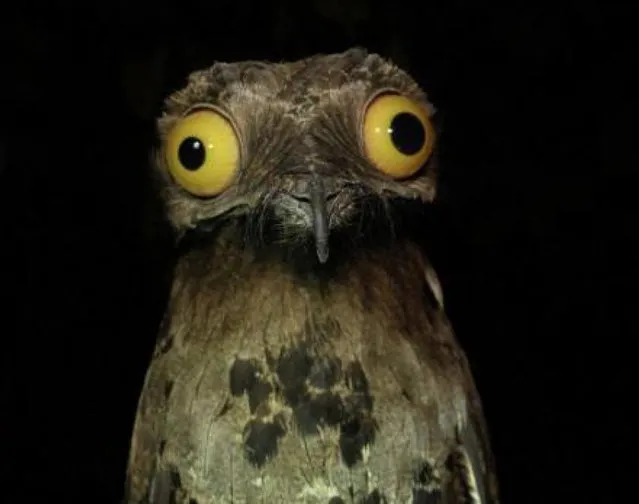
Nightjars And Pooto Bird

Potoos (family Nyctibiidae) are a group of near passerine birds related to the nightjars and frogmouths. They are sometimes called Poor-me-ones, after their haunting calls. There are seven species in one genus, Nyctibius, in tropical Central and South America.
These are nocturnal insectivores which lack the bristles around the mouth found in the true nightjars. They hunt from a perch like a shrike or flycatcher. During the day they perch upright on tree stumps, camouflaged to look like part of the stump. The single spotted egg is laid directly on the top of a stump.
Details
20 Jan 2014 14:34:00