A model poses backstage during the Speedo show as part of Mercedes Benz Fashion Festival Sydney 2011 at Sydney Town Hall on August 24, 2011 in Sydney, Australia. (Photo by Stefan Gosatti/Getty Images)
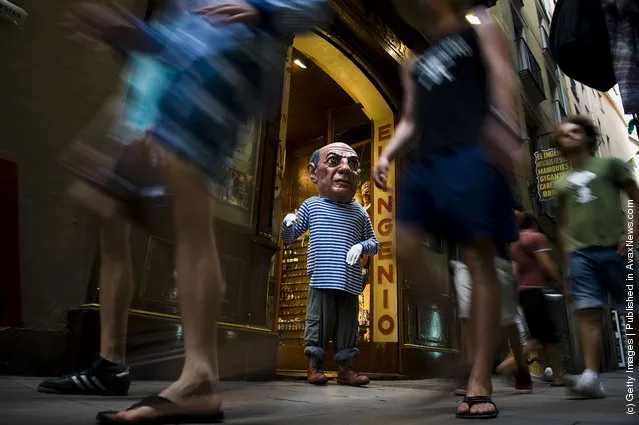
A Pablo Picasso papier mache “huge head” mask, known as “Capgros” in Catalan, is displayed at the entrance of the “El Ingenio” shop on August 23, 2011 in Barcelona, Spain. “El Ingenio” (The Ingenuity) has been making and selling papier mache giant masks and huge heads for Catalan popular festivals since 1838. The “La Merce” festival will be held on September 24 to observe the feast day of Our Lady of Mercy, patron saint of Barcelona. (Photo by David Ramos/Getty Images)
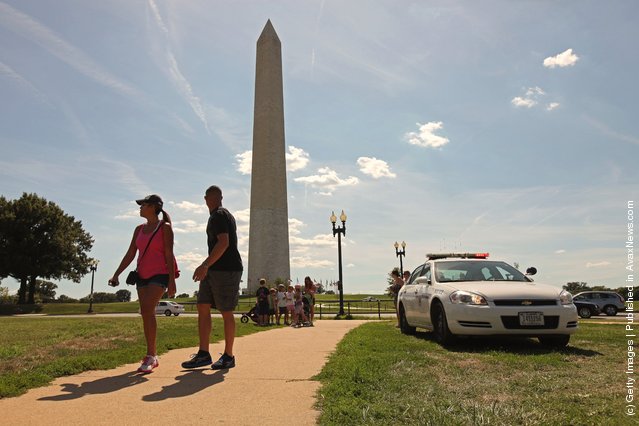
U.S. Park Police work to keep people away from the area surrounding the Washington Monument after a 5.8 magnitude earthquake struck the east coast August 23, 2011 in Washington, DC. Police officers said that unidentified material had fallen off the Washington Monument as a result of the earthquake. All the monuments and buildings along the National Mall have been evacuated and closed. (Photo by Chip Somodevilla/Getty Images)
People pray inside a temple at the Janmashtami Hindu Festival at Bhaktivedanta Manor on August 22, 2011 in Watford, England. Up to 72,000 were expected to take part in the two day festival celebrating the birth of Krishna, in what is believed to be the largest Hindu festival gathering outside of India. (Photo by Dan Kitwood/Getty Images)
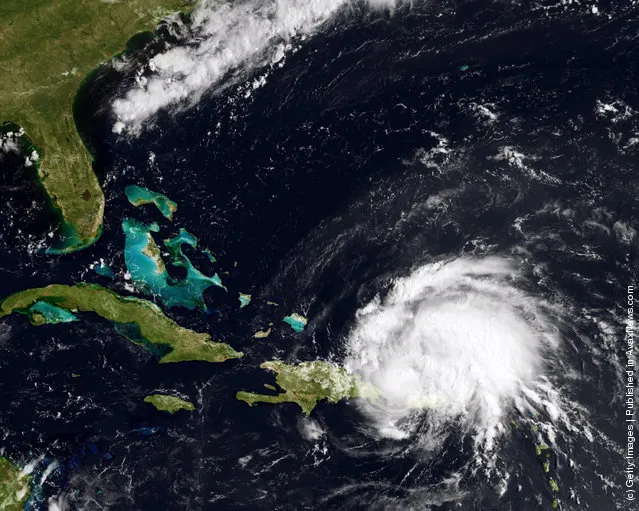
In this handout GOES satellite image provided by the National Oceanic and Atmospheric Administration (NOAA), Irene reaches hurricane strength as it moves across Puerto Rico towards Hispaniola August 22, 2011 in the Caribbean Sea. Irene, the first hurricane of the Atlantic storm season, brought torrential rains and winds to Puerto Rico, downing trees and powerlines and flooding streets. The expected path will bring Irene through the Bahamas and is likely to hit Florida and up the east coast of the U.S. (Photo by NOAA via Getty Images)
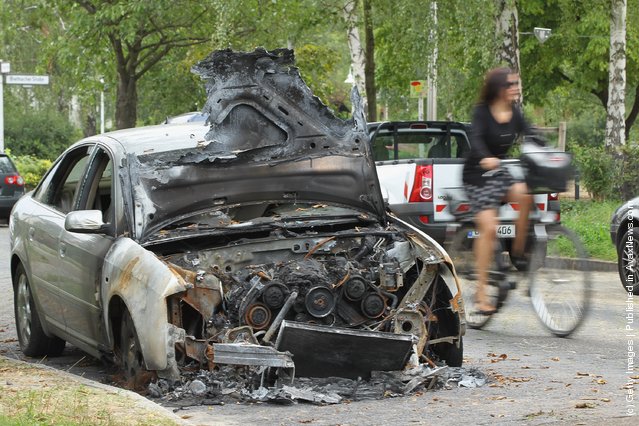
A woman on a bicycle rides past the remains of an Audi sedan set afire by an arsonist recently in Zehlendorf district in a street where two more cars were torched on August 23, 2011 in Berlin, Germany. Police have so far made no arrests in a series of arson attacks that have destroyed at least 70 cars within the last week and show no signs of abating. In recent years several hundred cars have been torched annually and police suspect left-wing radicals. The recent series of attacks, averaging about 10 a day, has been particularly severe. (Photo by Sean Gallup/Getty Images)
Commuters walk up the redesigned subway stairs at the Tanjong Pagar subway station on August 23, 2011 in Singapore. The subway stairs have been repainted in bright colours and slogans encouraging people to take the stairs, by way of promoting fitness in the city. (Photo by Chris McGrath/Getty Images)
Catherine, Duchess of Cambridge speaks to soldiers as she arrives at Calgary Airport on July 7, 2011 in Calgary, Canada. (Photo by Chris Jackson/Getty Images)