Loading...
Done
A truck transporting 20 tons of fish lost its load after crashing on a road near Liepen, eastern Germany on April 20, 2018. (Photo by Stefan Sauer/AFP Photo/DPA)

A truck transporting 20 tons of fish lost its load after crashing on a road near Liepen, eastern Germany on April 20, 2018. (Photo by Stefan Sauer/AFP Photo/DPA)
Details
22 Apr 2018 05:26:00
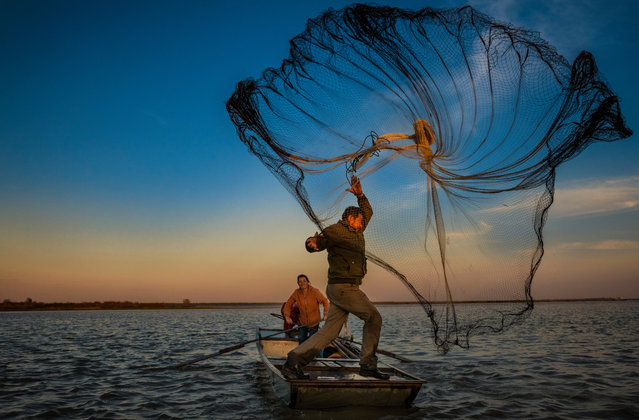
A fisherman throws a net for catching fish with his wife in Yanhu fisherman village near Yangzhou, Jiangsu province, China, 18 October 2018. (Photo by Aleksandar Plavevski/EPA/EFE)

A fisherman throws a net for catching fish with his wife in Yanhu fisherman village near Yangzhou, Jiangsu province, China, 18 October 2018. (Photo by Aleksandar Plavevski/EPA/EFE)
Details
05 Nov 2018 00:01:00
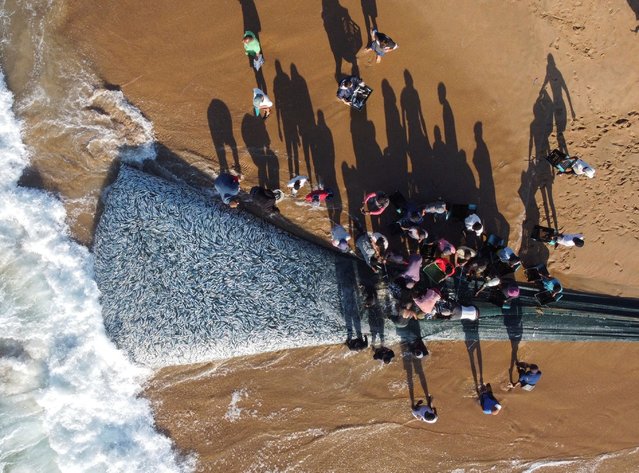
A drone view of fishermen unloading fish caught in a net during the sardine run in Scottburgh, South Africa, on June 12, 2024. (Photo by Rogan Ward/Reuters)

A drone view of fishermen unloading fish caught in a net during the sardine run in Scottburgh, South Africa, on June 12, 2024. (Photo by Rogan Ward/Reuters)
Details
18 Jun 2024 02:51:00
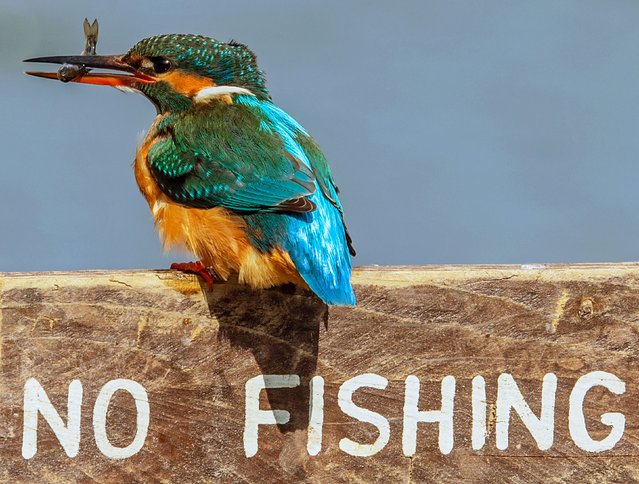
A kingfisher ignores the “no fishing” sign after catching food at Teddesley Park in Staffordshire, England, on Saturday, April 5, 2025. (Photo by Stuart Brock/Anadolu/Getty Images)

A kingfisher ignores the “no fishing” sign after catching food at Teddesley Park in Staffordshire, England, on Saturday, April 5, 2025. (Photo by Stuart Brock/Anadolu/Getty Images)
Details
27 Apr 2025 03:43:00
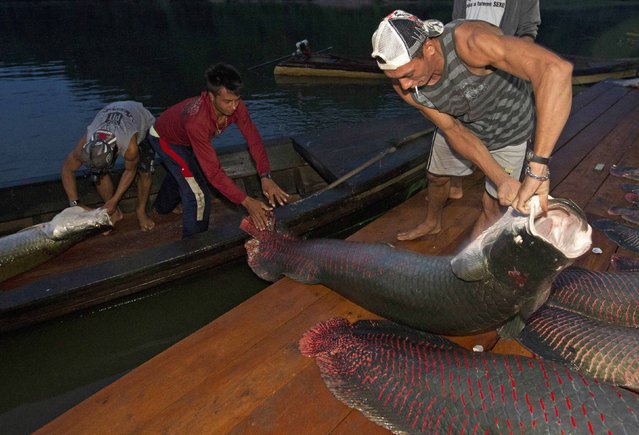
Villagers from the Medio Jurua nature reserve of Brazil's Amazon rainforest arrive with their catch of pirarucus, the largest freshwater fish in South America, after a night of fishing in Manaria Lake, Carauari municipality, September 3, 2012. Catching the pirarucu, a fish that is sought after for its meat and is considered by biologists to be a living fossil, is only allowed once a year by Brazil's environmental protection agency. (Photo by Bruno Kelly/Reuters)

Villagers from the Medio Jurua nature reserve of Brazil's Amazon rainforest arrive with their catch of pirarucus, the largest freshwater fish in South America, after a night of fishing in Manaria Lake, Carauari municipality, September 3, 2012. Catching the pirarucu, a fish that is sought after for its meat and is considered by biologists to be a living fossil, is only allowed once a year by Brazil's environmental protection agency. (Photo by Bruno Kelly/Reuters)
Details
19 Jul 2013 08:53:00
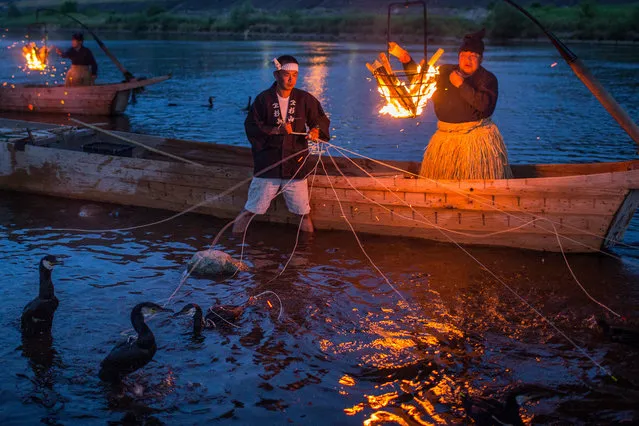
Cormorant masters and boatmen prepare sea cormorants for the nights “Ukai” on July 2, 2014 in Gifu, Japan. In this traditional fishing art “ukai”, a cormorant master called “usho” manages cormorants to capture ayu or sweetfish. The ushos of River Nagara have been the official staff of the Imperial Household Agency of Japan since 1890. Currently six imperial fishermen of Nagara River conduct special fishing to contribute to the Imperial family eight times a year, on top of daily fishing from mid-May to mid-October. (Photo by Chris McGrath/Getty Images)

Cormorant masters and boatmen prepare sea cormorants for the nights “Ukai” on July 2, 2014 in Gifu, Japan. In this traditional fishing art “ukai”, a cormorant master called “usho” manages cormorants to capture ayu or sweetfish. The ushos of River Nagara have been the official staff of the Imperial Household Agency of Japan since 1890. Currently six imperial fishermen of Nagara River conduct special fishing to contribute to the Imperial family eight times a year, on top of daily fishing from mid-May to mid-October. (Photo by Chris McGrath/Getty Images)
Details
04 Jul 2014 09:41:00
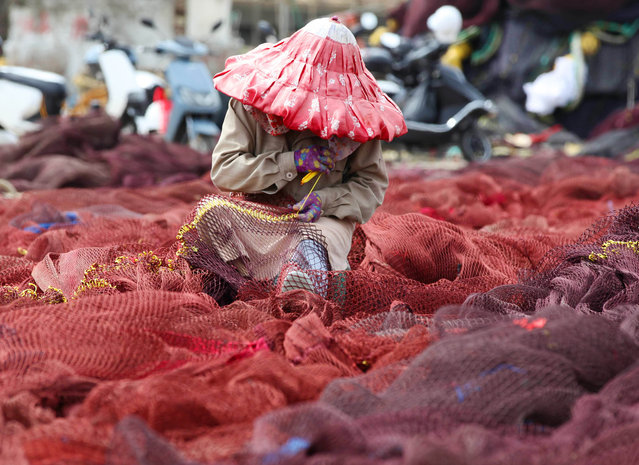
A fisherwoman repairs the fishing nets at a fishing port during the annual summer fishing ban, which covers the Bohai Sea, the Yellow Sea, the East China Sea, and the waters north of 12 degrees north latitude in the South China Sea, on June 8, 2022 in Wenling, Taizhou City, Zhejiang Province of China. (Photo by Liu Zhenqing/VCG via Getty Images)

A fisherwoman repairs the fishing nets at a fishing port during the annual summer fishing ban, which covers the Bohai Sea, the Yellow Sea, the East China Sea, and the waters north of 12 degrees north latitude in the South China Sea, on June 8, 2022 in Wenling, Taizhou City, Zhejiang Province of China. (Photo by Liu Zhenqing/VCG via Getty Images)
Details
15 Jun 2022 04:09:00
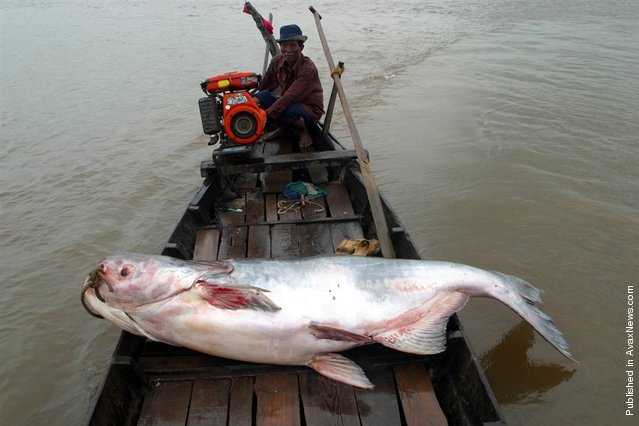
Among the fish populations that could be harmed by the Xayaburi dam in Laos is the critically endangered Mekong giant catfish, considered by the Guinness Book of World Records to be the world’s largest freshwater fish. The fish, which grows to 650 pounds and about 10 feet long, is only found in the Mekong River. It is migratory, moving between downstream habitats in Cambodia upstream to northern Thailand and Laos each year to spawn. Some experts fear the Xayaburi dam could block the migration and drive the giant catfish to extinction

Among the fish populations that could be harmed by the Xayaburi dam in Laos is the critically endangered Mekong giant catfish, considered by the Guinness Book of World Records to be the world’s largest freshwater fish. The fish, which grows to 650 pounds and about 10 feet long, is only found in the Mekong River. It is migratory, moving between downstream habitats in Cambodia upstream to northern Thailand and Laos each year to spawn. Some experts fear the Xayaburi dam could block the migration and drive the giant catfish to extinction. (Photo by Courtesy of Zeb Hogan/University of Nevada, Reno)
Details
20 Apr 2012 13:10:00