Loading...
Done
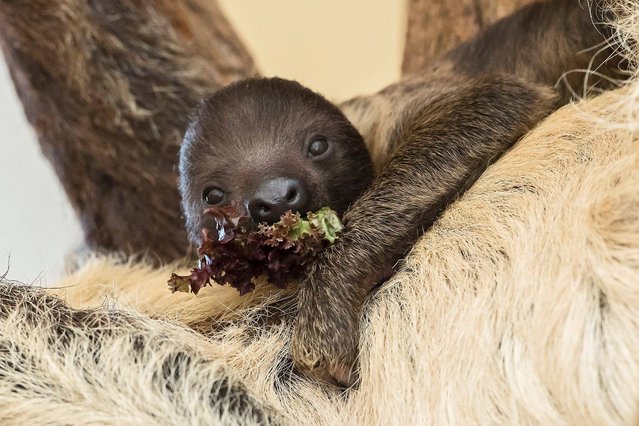
This handout picture taken on December 13, 2016 and released on December 14, 2016 by the Tiergarten Schoenbrunn zoo in Vienna, Austria, shows a baby sloth eating some salad as it hangs on it's mother's belly in their enclosure. The baby was born already on November 18, 2016, but according to the zoo it could be picured for the first time only now as it usually hides in it's mother's soft coat. (Photo by Daniel Zupanc/AFP Photo)

This handout picture taken on December 13, 2016 and released on December 14, 2016 by the Tiergarten Schoenbrunn zoo in Vienna, Austria, shows a baby sloth eating some salad as it hangs on it's mother's belly in their enclosure. The baby was born already on November 18, 2016, but according to the zoo it could be picured for the first time only now as it usually hides in it's mother's soft coat. (Photo by Daniel Zupanc/AFP Photo)
Details
18 Dec 2016 07:52:00
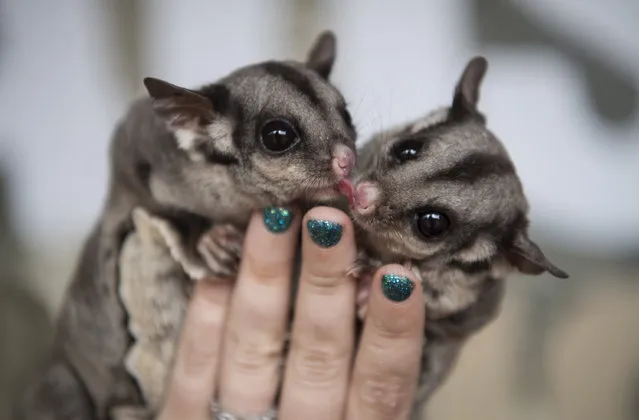
Sugar gliders, Candy and Popcorn, enjoy their favourite food, Nectar, at Wild Life Sydney Zoo on February 14, 2017 in Sydney, Australia. The treat made up of honey, high protein baby cereal and egg yolks is the human equivalent to chocolate to the Sugar Gliders. St. Valentine's Day or the Feast of Saint Valentine began as a celebration of the early Christian Saint Valentinus. From the 18th Century onwards it has steadily transformed into a celebration of romantic love and sentiment in many countries around the world. (Photo by James D. Morgan/Getty Images)

Sugar gliders, Candy and Popcorn, enjoy their favourite food, Nectar, at Wild Life Sydney Zoo on February 14, 2017 in Sydney, Australia. The treat made up of honey, high protein baby cereal and egg yolks is the human equivalent to chocolate to the Sugar Gliders. St. Valentine's Day or the Feast of Saint Valentine began as a celebration of the early Christian Saint Valentinus. From the 18th Century onwards it has steadily transformed into a celebration of romantic love and sentiment in many countries around the world. (Photo by James D. Morgan/Getty Images)
Details
19 Feb 2017 00:00:00
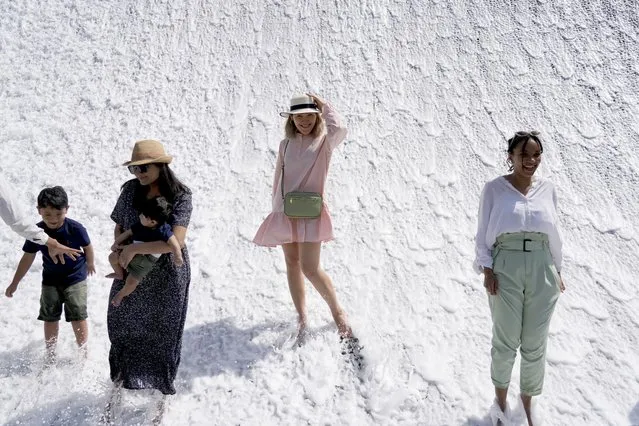
People enjoy their time during the last day of the Dubai Expo 2020 in Dubai, United Arab Emirates, Thursday, March 31, 2022. The world's fair in Dubai, the pandemic-delayed Expo 2020, closed on Thursday after six months of concerts, conferences and festivities. (Photo by Ebrahim Noroozi/AP Photo)

People enjoy their time during the last day of the Dubai Expo 2020 in Dubai, United Arab Emirates, Thursday, March 31, 2022. The world's fair in Dubai, the pandemic-delayed Expo 2020, closed on Thursday after six months of concerts, conferences and festivities. (Photo by Ebrahim Noroozi/AP Photo)
Details
07 May 2023 03:36:00
People wear traditional Chinese outfits as they walk in Chinatown in Bangkok on February 11, 2021, ahead of the start of the Lunar New Year, which ushers in the Year of the Ox on February 12. (Photo by Lillian Suwanrumpha/AFP Photo)

People wear traditional Chinese outfits as they walk in Chinatown in Bangkok on February 11, 2021, ahead of the start of the Lunar New Year, which ushers in the Year of the Ox on February 12. (Photo by Lillian Suwanrumpha/AFP Photo)
Details
12 Jan 2022 07:40:00
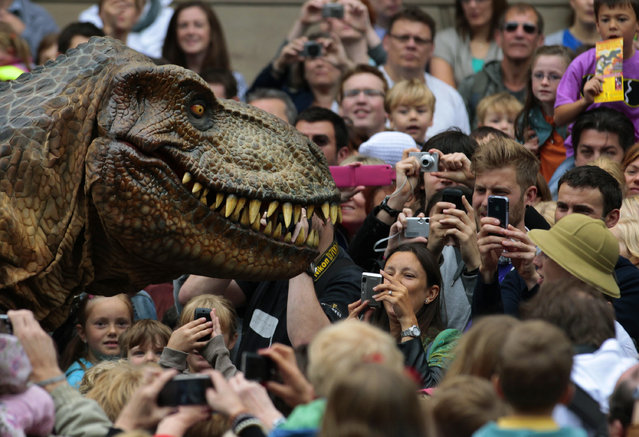
Visitors photograph an animatronic Tyrannosaurus Rex at the National Museum of Scotland, July 29, 2011. (Photo by David Moir/Reuters)

Visitors photograph an animatronic Tyrannosaurus Rex at the National Museum of Scotland, July 29, 2011. (Photo by David Moir/Reuters)
Details
12 Apr 2015 08:02:00
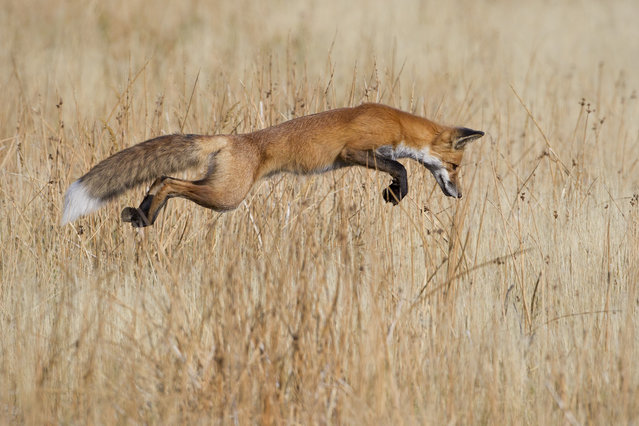
Canada: “Lucky pounce”. (Photo by Connor Stefanison/Wildlife Photographer of the Year 2013)

The winners of The London’s Natural History Museum's prestigious Wildlife Photographer of the Year for 2013 have finally been unveiled. Selected from almost 43,000 entries from 96 countries, the winners offer a glimpse of the stunning array of natural beauty on our planet. Photo: Canada: “Lucky pounce”. “Anticipating the pounce – that was the hardest part”, says Connor, who had come to Yellowstone National Park, Wyoming, USA, in search of wildlife as much as the spectacular landscape. He had found this fox, his first ever, on his last day in the park. It was so absorbed in hunting that Connor had plenty of time to get out of the car and settle behind a rock. It quartered the grassland, back and forth, and then started staring intently at a patch of ground, giving Connor just enough warning of the action to come. When it sprung up, Connor got his shot. And when it landed, the fox got his mouse. (Photo by Connor Stefanison/Wildlife Photographer of the Year 2013)

Details
17 Oct 2013 08:12:00
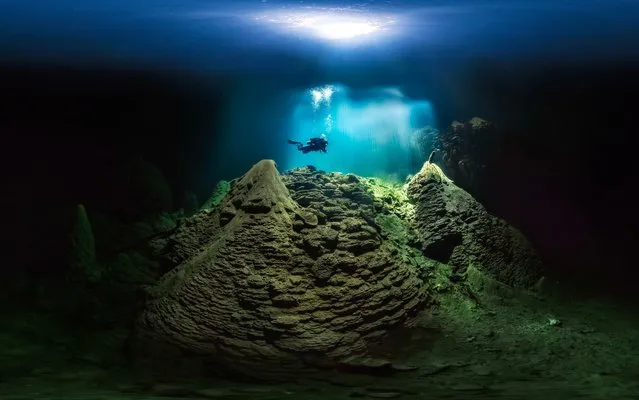
Cave Diver, Anhumas Abyss, Bonito, Brazil: The Anhumas Abyss is an underground cavern with a crystal-clear lake below, more than 260 feet (79 m) deep. A visitor must enter through a narrow opening at the top of the chamber and rappel into the cave. Snorkeling and scuba diving in the lake reveal amazing scenery. Distinctive, conical limestone stalagmites and stalactites occupy the lake and the surrounding area, some reaching 65 feet (20 m) high. “One must rappel about 235 feet (72 m) to get down into this deep lake. The photo was taken at a depth of 50 feet (15 m). It was a challenge to create the image because of the high contrast, plus the diver could not see into the darkness, making communication impossible”. (Photo by Marcio Cabral/Nature’s Best Photography Awards 2017)

Cave Diver, Anhumas Abyss, Bonito, Brazil: The Anhumas Abyss is an underground cavern with a crystal-clear lake below, more than 260 feet (79 m) deep. A visitor must enter through a narrow opening at the top of the chamber and rappel into the cave. Snorkeling and scuba diving in the lake reveal amazing scenery. Distinctive, conical limestone stalagmites and stalactites occupy the lake and the surrounding area, some reaching 65 feet (20 m) high. (Photo by Marcio Cabral/Nature’s Best Photography Awards 2017)
Details
26 Oct 2017 08:10:00
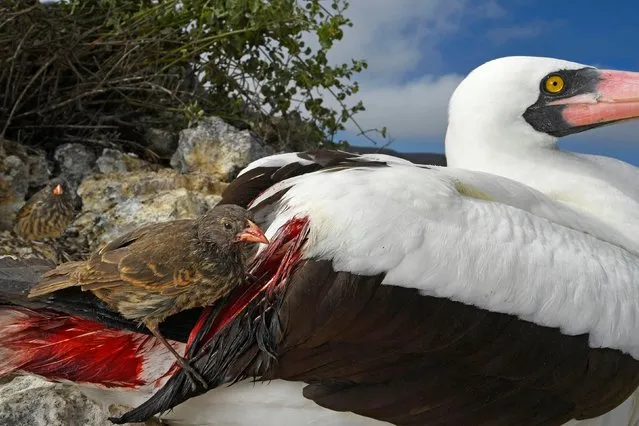
Bloodthirsty by Thomas P Peschak, Germany/South Africa — winner, Behaviour: birds. When rations run short on Wolf Island, in the remote northern Galápagos, the sharp-beaked ground finches become vampires. Their sitting targets are Nazca boobies and other large birds. The finches rely on a scant diet of seeds and insects, which regularly dries up, so they drink blood to survive. ‘I’ve seen more than half a dozen finches drinking from a single Nazca booby,’ says Tom. Rather than leave their nests the boobies tolerate the vampires, and the blood loss doesn’t seem to cause permanent harm. (Photo by Thomas P Peschak/2018 Wildlife Photographer of the Year)

Bloodthirsty by Thomas P. Peschak, Germany/South Africa — winner, Behaviour: birds. When rations run short on Wolf Island, in the remote northern Galápagos, the sharp-beaked ground finches become vampires. Their sitting targets are Nazca boobies and other large birds. The finches rely on a scant diet of seeds and insects, which regularly dries up, so they drink blood to survive. ‘I’ve seen more than half a dozen finches drinking from a single Nazca booby,’ says Tom. Rather than leave their nests the boobies tolerate the vampires, and the blood loss doesn’t seem to cause permanent harm. (Photo by Thomas P. Peschak/2018 Wildlife Photographer of the Year)
Details
19 Oct 2018 00:05:00