South Korean youths dance to electronic music during the Ultra Music Festival Korea at Olympic Stadium on June 10, 2016 in Seoul, South Korea. (Photo by Jean Chung/Getty Images)
SOFI TUKKER – Swing (Official Music Video). Sofi Tukker is a German American musical duo based in New York consisting of Sophie Hawley-Weld (German) and Tucker Halpern (American). In December 2018 their album Treehouse was nominated for a Grammy for Best Dance/Electronic Album.
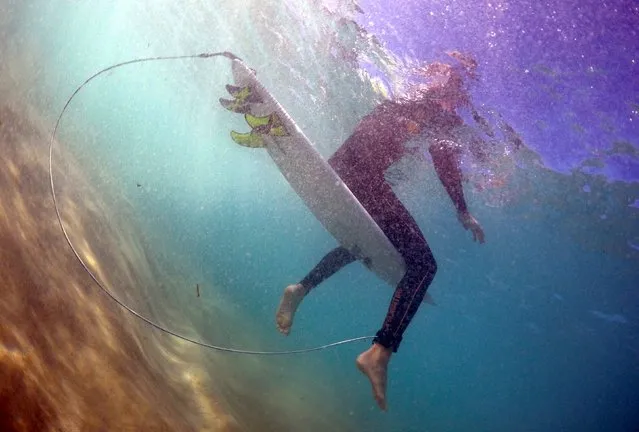
Surfer Arlen Macpherson sits on his board, which has an electronic shark repellent device installed, at Sydney's Bondi Beach in Australia, August 18, 2015. A spate of shark attacks in Australia has left some of world's top surfing beaches deserted and many people having second thoughts about taking a swim as the summer approaches. Macpherson paid A$390 for a device embedded in his surf board to repel sharks by emitting an electronic force field that overpowers its sensing organs. (Photo by David Gray/Reuters)
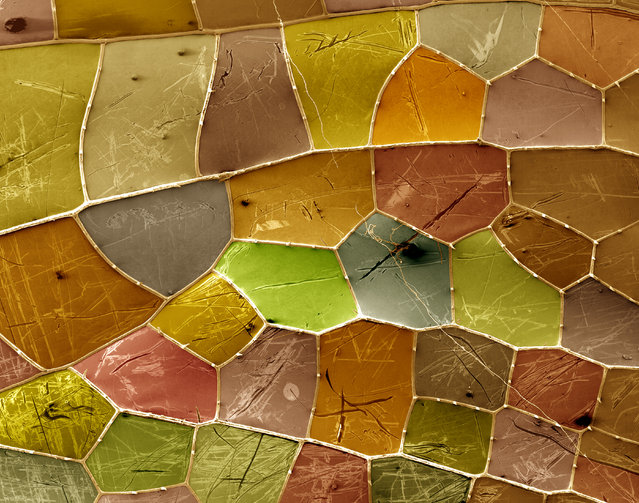
Macro or Micro? Scientists’ pictures baffle our sense of scale. It began when Stephen Young, a geography professor at Salem State University in Massachusetts, tricked his biologist colleague Paul Kelly into thinking a satellite image was one of his electron microscope scans. Can you guess whether they are close-up or very far away? (Photo by Paul Kelly)
A performer dressed as a lobster is seen during a lobster-themed electronic music party at a water park on August 01, 2020 in Hangzhou, Zhejiang Province of China. (Photo by Lian Guoqing/VCG via Getty Images)
A visitor tries the Segway “S-Pod” motorized chair on the manufacturer's booth during the 2020 International Consumer Electronics Show (CES) at the Las Vegas Convention Center in Las Vegas, Nevada, USA, 08 January 2020. (Photo by Etienne Laurent/EPA/EFE)
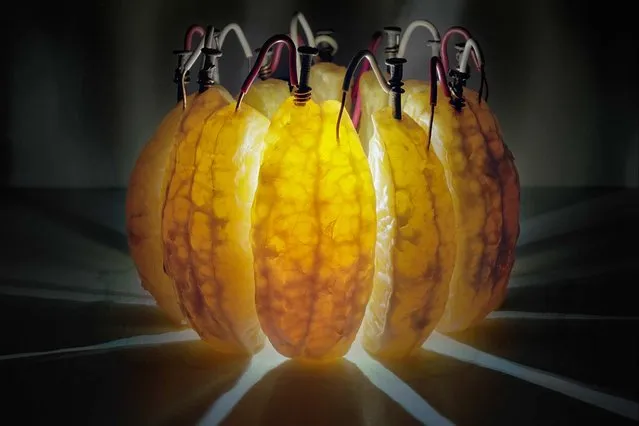
Wedges of an orange generate enough current and electrical juice – 3.5 volts – to power an LED. The fruit’s citric acid helps electrons flow from galvanized nails to copper wire in this 14-hour exposure. This image was published in September’s Visions of Earth, a trio of photos that appear in each issue of National Geographic. (Photo by Caleb Charland/National Geographic)
Nobumichi Asai has used projection mapping to put CGI onto cars, docks, building and more. What is his latest canvas? A real, live human face! Asai used Omote, a combination of real-time face tracking and projection mapping to transform a model's face into mesmerizing patterns. It's called “electronic makeup”, but as you will see in the (creepy-ish) video, it goes much, much beyond anything makeup can possibly do.