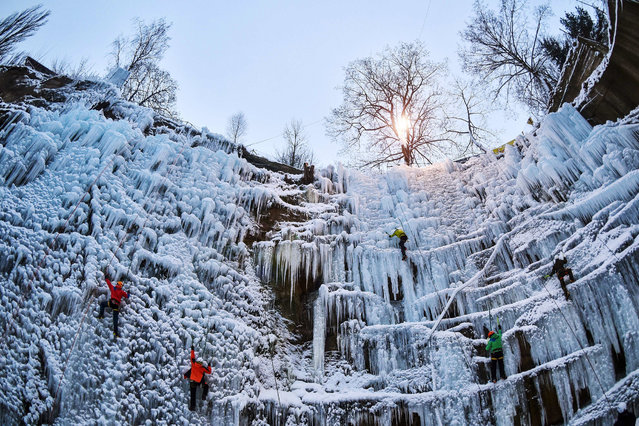
People climb on an artificial ice-wall in Liberec, about 100 km north of Prague, Czech Republic, Saturday, January 23, 2015. The wall was prepared in a former quarry just near the centre of the city. (Photo by Radek Petrasek/CTK via AP Photo)
The opening of sculptor Carole Feuerman solo outdoor public art show, Sea Idylls, on Park Avenue in NYC on April 27, 2023. The hyperrealistic sculptures in conjunction with Les Galeries Bartoux and Patrons of Park Avenue line the median. (Photo by Milo Hess/ZUMA Press Wire/Rex Features/Shutterstock)
Mother hen chicken with cute tiny baby chicks all protected beneath her wings keeping warm outdoors only their 12 legs visible poking out the bottom outside. (Photo by Matthew Troke/iStockphoto via Getty Images)
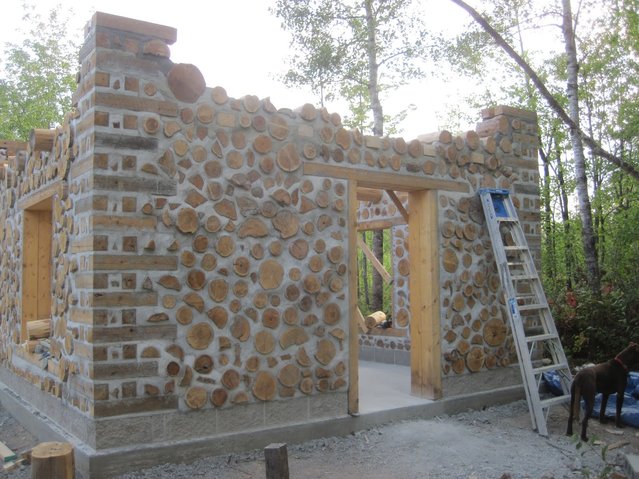
Cordwood construction is a method of natural building that originated roughly one thousand years ago in Greece and Siberia. This method involves using pieces of wood that slightly protrude from the mortar, giving the walls an attractive appearance. Usually, the walls are made 12 to 24 inches thick. However, in some parts of Canada, the walls can be as thick as 36 inches. This method appeals to many people due to its ease of construction economy of resources. Cordwood Construction can be separated into two main types: mortar-insulation-mortar (M-I-M) and Throughwall. M-I-M is a more preferable and widely used choice as it allows for better insulating properties.
Revellers enjoy a night out in central Liverpool, northwest England, on December 30, 2020 before hightened Tier 3 restrictions closing hospitality venues, and bars indoor and outdoor socialising between households are imposed in the city amid surging cases of the novel coronavirus. (Photo by Oli Scarff/AFP Photo)