Loading...
Done
The Daily Life Of Darth Vader By Pawel Kadysz

If you want to be Dart Vader, you will have to deal with his everyday problems, too. That’s what Paweł Kadysz is doing with his new photo project. He aims to take a picture every day for a year – and each one of them should show the Dark Lord of the Sith tackling everyday life. Washing dishes, ironing clothes, eating breakfast – all those little things that heroes do off screen.
Details
25 Nov 2015 10:06:00
Porcelain Figurines By Martin Klimas

From a height of three meters, porcelain figurines are dropped on the ground, and the sound they make when they hit trips the shutter release. The result: razor-sharp images of disturbing beauty—temporary sculptures made visible to the human eye by high-speed photography technology. The porcelain statuette bursting into pieces isn't what really captures the attention; the fascination lies in the genesis of a dynamic figure that replaces the static pose. In contrast to the inertness of the intact kitsch figurines Klimas started out with, the photographs of their destruction possess a powerfully narrative character.
Details
21 Apr 2014 12:59:00
Writing about the Ambassador, the art critic Robert Melville said it was “the most daring and enterprising trade journal ever conceived … No other magazine … has so consistently and brilliantly demonstrated the relevance of works of art to the problems of industrial design”. Here: Shelagh Wilson, Copacabana beach, Rio de Janeiro, 1951. (Photo by Elsbeth Juda Archive/Victoria and Albert Museum)

“Grit and Glamour”, a retrospective of the late British photographer Elsbeth Juda, who fled Nazi occupation and came to England in 1933, is at the Jewish Museum, in London, until July 1, 2018. Here: Shelagh Wilson, Copacabana beach, Rio de Janeiro, 1951. (Photo by Elsbeth Juda Archive/Victoria and Albert Museum)
Details
31 Mar 2018 00:05:00
Performers from the Joles ethnic group in Gambia prepare to perform with sharp blades  which they say will demonstrate the magic powers of a spiritual water, that will make them immune to the cuts, during a campaign rally by incumbent President Yahya Jammeh, leader of the APRC (The Alliance for Patriotic Reorientation and Construction) in Bikama on November 24, 2016. As electoral favorite Jammeh seeks his fifth term in power, a two-week campaign period will come to an end next week ahead of the December 1st presidential election with political leaders canvassing in rural areas. (Photo by Marco Longari/AFP Photo)

Performers from the Joles ethnic group in Gambia prepare to perform with sharp blades which they say will demonstrate the magic powers of a spiritual water, that will make them immune to the cuts, during a campaign rally by incumbent President Yahya Jammeh, leader of the APRC (The Alliance for Patriotic Reorientation and Construction) in Bikama on November 24, 2016. As electoral favorite Jammeh seeks his fifth term in power, a two-week campaign period will come to an end next week ahead of the December 1st presidential election with political leaders canvassing in rural areas. (Photo by Marco Longari/AFP Photo)
Details
26 Nov 2016 10:50:00
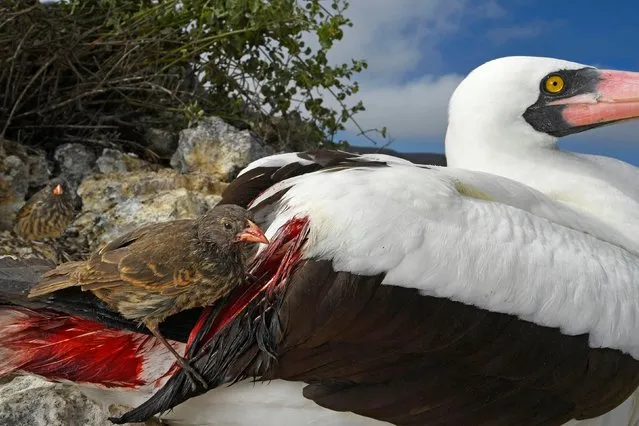
Bloodthirsty by Thomas P Peschak, Germany/South Africa — winner, Behaviour: birds. When rations run short on Wolf Island, in the remote northern Galápagos, the sharp-beaked ground finches become vampires. Their sitting targets are Nazca boobies and other large birds. The finches rely on a scant diet of seeds and insects, which regularly dries up, so they drink blood to survive. ‘I’ve seen more than half a dozen finches drinking from a single Nazca booby,’ says Tom. Rather than leave their nests the boobies tolerate the vampires, and the blood loss doesn’t seem to cause permanent harm. (Photo by Thomas P Peschak/2018 Wildlife Photographer of the Year)

Bloodthirsty by Thomas P. Peschak, Germany/South Africa — winner, Behaviour: birds. When rations run short on Wolf Island, in the remote northern Galápagos, the sharp-beaked ground finches become vampires. Their sitting targets are Nazca boobies and other large birds. The finches rely on a scant diet of seeds and insects, which regularly dries up, so they drink blood to survive. ‘I’ve seen more than half a dozen finches drinking from a single Nazca booby,’ says Tom. Rather than leave their nests the boobies tolerate the vampires, and the blood loss doesn’t seem to cause permanent harm. (Photo by Thomas P. Peschak/2018 Wildlife Photographer of the Year)
Details
19 Oct 2018 00:05:00
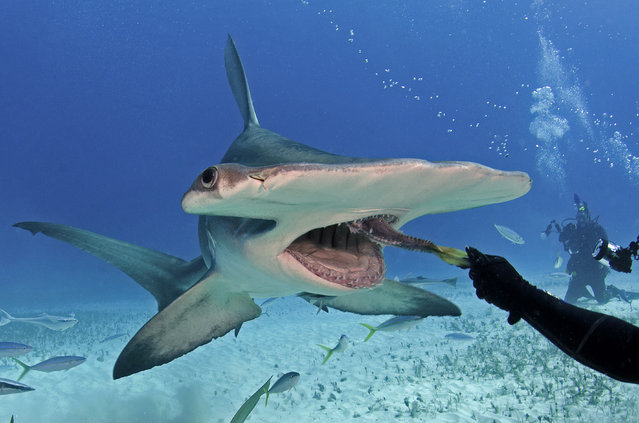
Eli Martinez with hammerhead shark. (Photo by J. P. Zegarra/Caters News)

“This is the terrifying moment a diver came head to head with a shark as it swims inches away snatching a bite for dinner. The close encounter, captured off Bimini Island in the Bahamas, shows the hammerhead approaching diver Eli Martinez who bravely stands his ground as the giant beast approaches. Eli, free diving outside of a protective cage, carefully handled the sea creature despite its menacing razor-sharp teeth – but admitted they are extremely shy and need a lot of work to allow divers close to them. After multiple trips and hours of diving nearby they finally got used to Eli in January this year – hammerheads regularly visit these waters during the winter season”. – Caters News. Photo: Eli Martinez with hammerhead shark. (Photo by J. P. Zegarra/Caters News)
Details
11 Mar 2014 09:24:00
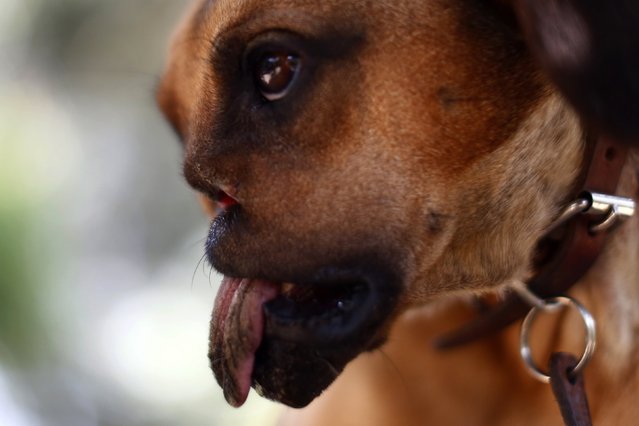
Fresa, 5, stands inside the dog shelter “Santuario Milagros Caninos” on the outskirts of Mexico City August 29 2014. (Photo by Edgard Garrido/Reuters)

Fresa, 5, stands inside the dog shelter “Santuario Milagros Caninos” on the outskirts of Mexico City August 29 2014. Fresa underwent reconstructive surgery after her previous owners hacked off half of her snout with a sharp object, possibly a machete, according to surgeon Jesus Paredes. After neighbours found Fresa wandering on the streets, they handed her over to a shelter where Paredes performed a three-hours intervention to enable her to breathe again through her nostrils, to remove her protruding jaw and reconstruct the lips with flaps of skin and mucous. (Photo by Edgard Garrido/Reuters)
Details
04 Sep 2014 08:04:00
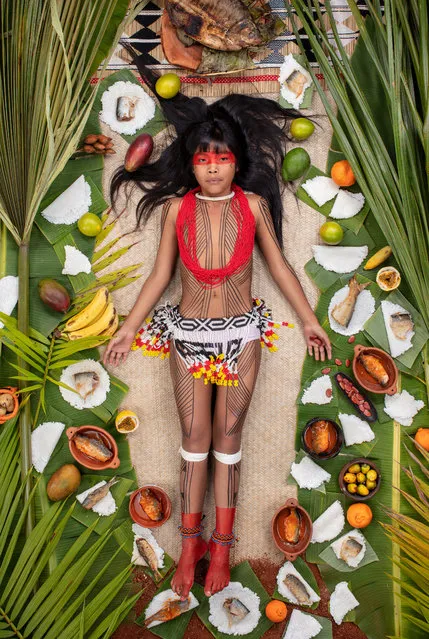
Kawakanih Yawalapiti, 9, Upper Xingu region of Mato Grosso, Brazil, 2018: Kawakanih lives with her tribe, the Yawalapiti, in Xingu national park, a preserve in the Amazon basin of Brazil. The Yawalapiti collect seeds to preserve species unique to their ecosystem, which lies between the rain forest and savannah. Kawakanih’s diet is simple, consisting mainly of fish, cassava, porridge, fruit and nuts. “It takes five minutes to catch dinner”, says Kawakanih. “When you’re hungry, you just go to the river with your net”. (Photo by Gregg Segal/The Guardian)

Photographer Gregg Segal travelled the world to document children and the food they eat in a week. Partly inspired by the increasing problems of childhood obesity, he tracked traditional regional diets as yet unaffected by globalisation, and ironically, found that the healthiest diets were often eaten by the least well off. (Photo by Gregg Segal/The Guardian)
Details
03 Jul 2019 00:03:00