Loading...
Done
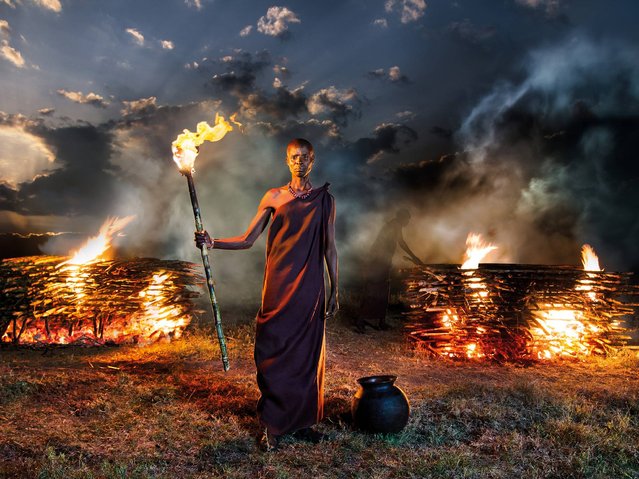
“The Salt of the Presidium”. Andrew Wanyonyi Sikanga is a salt producer in Nabuyole, western Kenya, who produces salt from an aquatic plant. (Photo by Steve McCurry/2015 Lavazza Calendar)

Extraordinary tales of everyday heroism have been illustrated beautifully by renowned US photographer Steve McCurry in the new 2015 Lavazza Calendar. The calendar which has been created in collaboration with the Slow Food movement, features twelve breathtaking pictures, capturing the spirit, strength and humanity of the Earth Defenders – women and men who protect their land and projects in Africa with passion and bravery. The proceeds from sales of the calendar and all donations will be contributed entirely to create 10,000 food gardens in African schools and villages by the end of 2016. (Photo by Steve McCurry/2015 Lavazza Calendar)
Details
27 Oct 2014 12:08:00
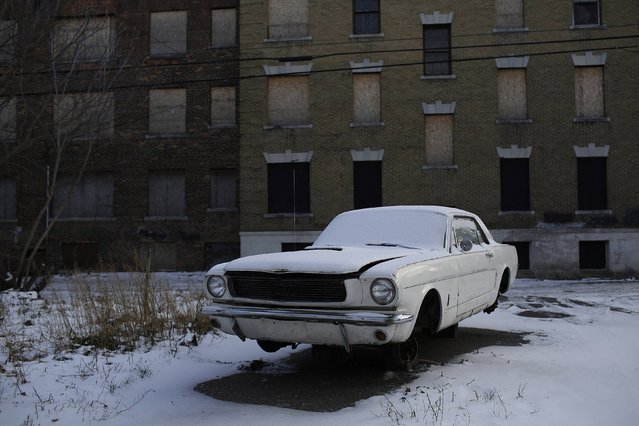
An older model Ford Mustang sits on cinder blocks with missing wheels near an abandoned apartment building in Detroit, Michigan January 7, 2015. Detroit, also known as the Motor City, is the historic hub of automobile manufacturing in the United States. (Photo by Joshua Lott/Reuters)

An older model Ford Mustang sits on cinder blocks with missing wheels near an abandoned apartment building in Detroit, Michigan January 7, 2015. Detroit, also known as the Motor City, is the historic hub of automobile manufacturing in the United States. A federal judge in December 2013 formally declared the city bankrupt but it won court approval to exit bankruptcy last November. Once the proud symbol of U.S. industrial strength, Detroit fell on hard times after decades of population loss, rampant debt and financial mismanagement left it struggling to provide basic services to residents. (Photo by Joshua Lott/Reuters)
Details
14 Jan 2015 12:48:00
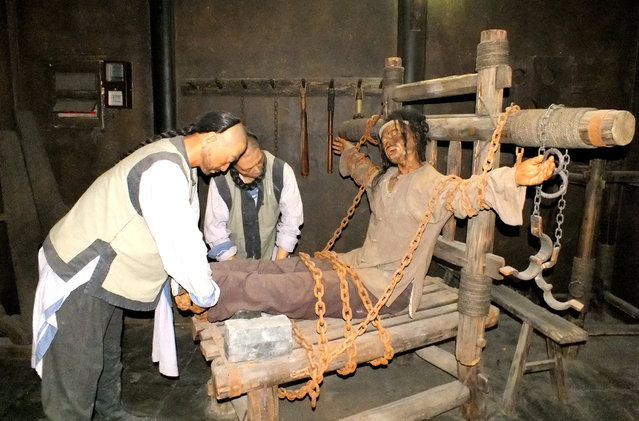
Wax figures with torture instrument named “torture-rack” are seen on October 25, 2014 in Huai'an, Jiangsu province of China. The exhibition, which opened last year at an educational center in the eastern city of Huai'an, includes reenactments of prisoners being hung over a fire, flayed and being tortured on what is known as a “Tiger Bench” – pictured above – a Qing dynasty (1644-1912) device that contorted victims' legs and arms in high pressure positions that could break bones or tear apart joints. (Photo by ChinaFotoPress)

Organizers of an exhibition of ancient instruments of torture in Huai'an, Jiangsu province, have suggested that children, heart disease patients and people with high blood pressure stay away because of the vivid depictions of shocking cruelty. The exhibition has more than 200 instruments of torture on display in the 50,000-square-meter exhibition halls of a restored ancient building. Wax figures, along with sound and light techniques, are incorporated for scary effect. The local government said the exhibition is for tourists and historians to research ancient torture practices. (Photo by ChinaFotoPress)
Details
29 Oct 2014 12:22:00
Plagued by Doubt By Thomas Wightman

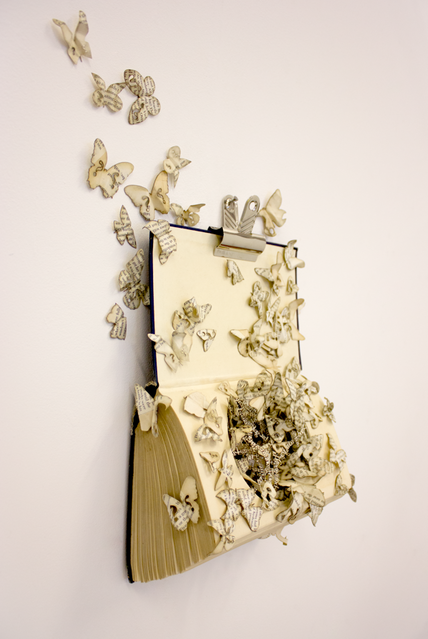
Thoughts. They fly through the broad expenses of our mind, floating gracefully in midair, going into the clouds, and then reemerging once again. Some are quick and furtive, others are grand and majestic. We reflect upon them as they enter our minds, and once they leave, they are usually gone for good. However, some thoughts are different. These thoughts resemble a flock of angry birds or a swarm of hungry moths that invade your mind, slowly eating away at your sanity, strength, and desire to live. Such thoughts often plague that minds of people with Obsessive Compulsive disorder. They completely occupy their time; constantly there; ever-present. With his book sculpture, Thomas Wightman was able to accurately convey the way these thoughts consume the mind, slowly building a nest within it, resisting all attempts to drive them away.

Thomas Wightman


See Also: Derailing My Train of Thought
Details
19 Mar 2015 09:11:00
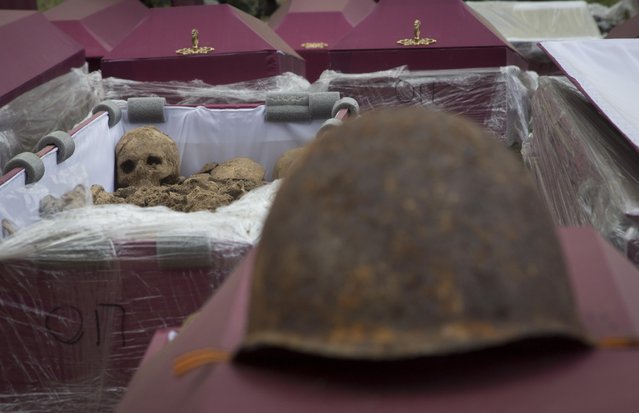
In this photo taken Thursday, May 7, 2015 photo,  remains of Soviet soldiers killed during World War II lay in a coffin prior to a reburial ceremony at the Sinyavino Heights memorial near the village of Sinyavino, 50 km (31 miles) east of  St. Petersburg, Russia. Hundreds of people came to a World War II battleground outside St. Petersburg this week to bury the remains of 964 Soviet soldiers recovered by volunteer search teams. (Photo by Dmitry Lovetsky/AP Photo)

In this photo taken Thursday, May 7, 2015 photo, remains of Soviet soldiers killed during World War II lay in a coffin prior to a reburial ceremony at the Sinyavino Heights memorial near the village of Sinyavino, 50 km (31 miles) east of St. Petersburg, Russia. Hundreds of people came to a World War II battleground outside St. Petersburg this week to bury the remains of 964 Soviet soldiers recovered by volunteer search teams. Fifty crimson coffins containing skulls and bones were solemnly buried at the Sinyavino Heights memorial as Russian war songs played and an honor guard fired a salute. (Photo by Dmitry Lovetsky/AP Photo)
Details
10 May 2015 11:12:00
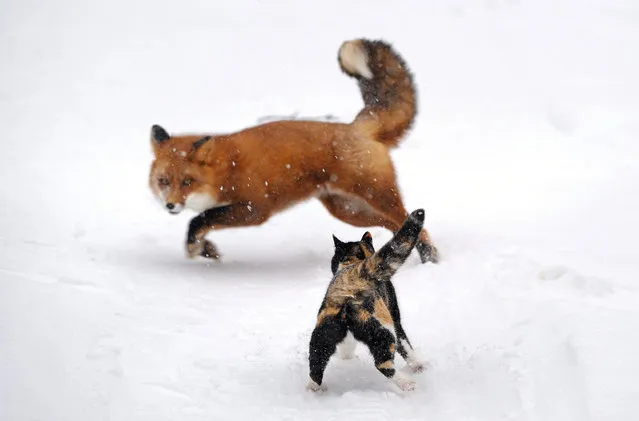
Respect, Kronotsky nature reserve, Russia. The photographer’s cat, Ryska – her name means little lynx in Russian – stands outside their cabin and with aggressive posturing warns off a fox. In winter, foxes would regularly visit the cabin searching for food. If one peered in at the window, possible when the snow was deep, Ryska would sit on the other side, fur raised, and growl. When outside, she would hold her ground. The foxes were not always frightened and so encounters could be a sort of dance. (Photo by Igor Shpilenok/Unforgettable Behaviour/NHM)

Respect, Kronotsky nature reserve, Russia. The photographer’s cat, Ryska – her name means little lynx in Russian – stands outside their cabin and with aggressive posturing warns off a fox. In winter, foxes would regularly visit the cabin searching for food. If one peered in at the window, possible when the snow was deep, Ryska would sit on the other side, fur raised, and growl. When outside, she would hold her ground. The foxes were not always frightened and so encounters could be a sort of dance. (Photo by Igor Shpilenok/Unforgettable Behaviour/NHM)
Details
08 Apr 2017 09:14:00
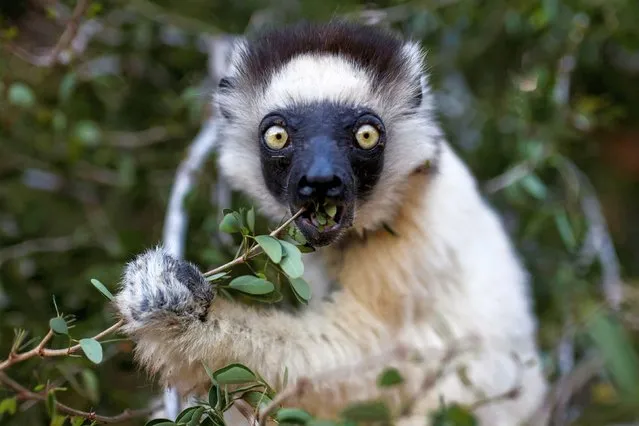
A sifaka lemur eats leaves at the Berenty Reserve in Toliara province, Madagascar, February 15, 2022. (Photo by Alkis Konstantinidis/Reuters)

A sifaka lemur eats leaves at the Berenty Reserve in Toliara province, Madagascar, February 15, 2022. (Photo by Alkis Konstantinidis/Reuters)
Details
06 Mar 2022 05:40:00
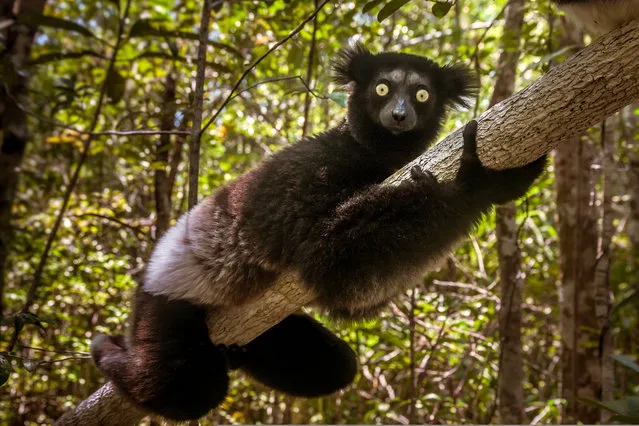
The secretive indri (Indri indri) of Madagascar, the largest living lemur. It is also critically endangered and highly evolutionarily distinct with no close relatives, which makes its branch one of most precarious on the mammal evolutionary tree. In the likely event that the indri goes extinct, we will lose 19m years of unique evolutionary history from the mammal tree of life. (Photo by Pierre-Yves Babelon/Aarhus University)

The secretive indri (Indri indri) of Madagascar, the largest living lemur. It is also critically endangered and highly evolutionarily distinct with no close relatives, which makes its branch one of most precarious on the mammal evolutionary tree. In the likely event that the indri goes extinct, we will lose 19m years of unique evolutionary history from the mammal tree of life. (Photo by Pierre-Yves Babelon/Aarhus University)
Details
18 Nov 2018 00:02:00