Loading...
Done
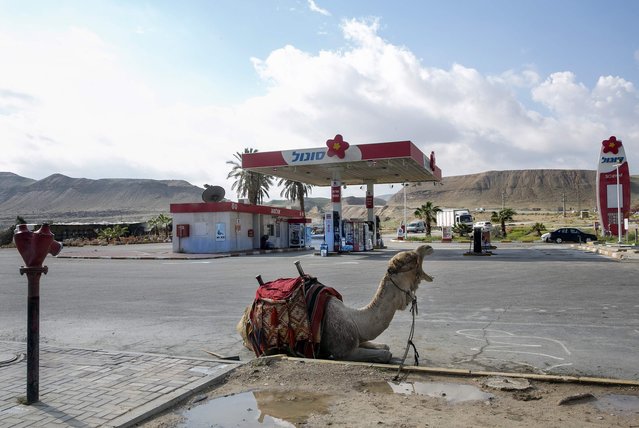
A camel rests at a fuel station in the Judean desert near the West Bank city of Jericho January 11, 2015. Reuters photographers from Mali to Mexico have shot a series of pictures of fuel stations. Whether it is plastic bottles by the roadside in Malaysia or a futuristic forecourt in Los Angeles, fuel stations help define our world. (Photo by Baz Ratner/Reuters)

A camel rests at a fuel station in the Judean desert near the West Bank city of Jericho January 11, 2015. Reuters photographers from Mali to Mexico have shot a series of pictures of fuel stations. Whether it is plastic bottles by the roadside in Malaysia or a futuristic forecourt in Los Angeles, fuel stations help define our world. Oil prices steadied above $48 a barrel on Tuesday, recovering from earlier losses as the dollar weakened against the euro. Oil prices have dropped nearly 60 percent since peaking in June 2014 on ample global supplies from the U.S. shale oil boom and a decision by OPEC to keep its production quotas unchanged. (Photo by Baz Ratner/Reuters)
Details
28 Jan 2015 12:15:00
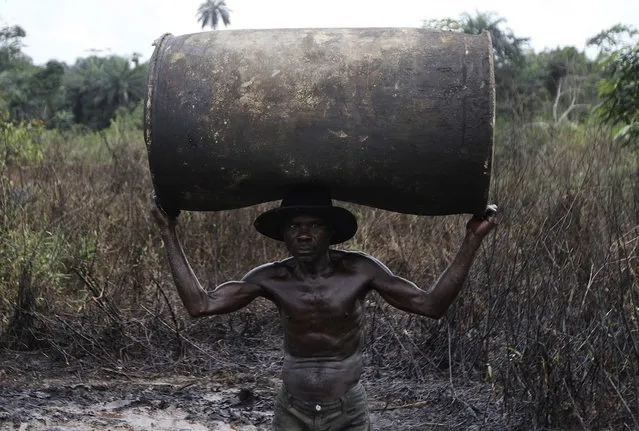
Ebiowei, 48, carries an empty oil container on his head to a place where it would be filled with refined fuel at an illegal refinery site near river Nun in Nigeria's oil state of Bayelsa November 27, 2012. (Photo by Akintunde Akinleye/Reuters)

Ebiowei, 48, carries an empty oil container on his head to a place where it would be filled with refined fuel at an illegal refinery site near river Nun in Nigeria's oil state of Bayelsa November 27, 2012. Locals in the industry say workers can earn $50 to $60 a day. Thousands of people in Nigeria engage in a practice known locally as “oil bunkering” – hacking into pipelines to steal crude then refining it or selling it abroad. The practice, which leaves oil spewing from pipelines for miles around, managed to lift around a fifth of Nigeria's two million barrel a day production last year according to the finance ministry. (Photo by Akintunde Akinleye/Reuters)
Details
18 Jan 2013 14:29:00
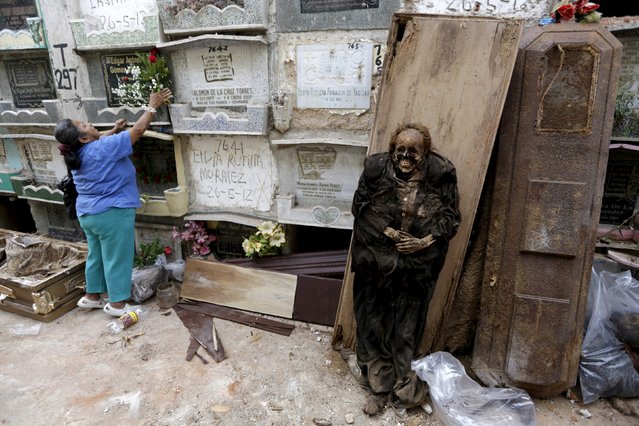
A woman (L) places flowers at a grave next to a mummified body during exhumation works at the General Cemetery in Guatemala City, April 15, 2015. (Photo by Jorge Dan Lopez/Reuters)

A woman (L) places flowers at a grave next to a mummified body during exhumation works at the General Cemetery in Guatemala City, April 15, 2015. If a lease on a grave has expired or not been paid, grave cleaners will break open the crypts to remove and rebury the bodies. Any remains that have not been claimed are packed into plastic bags, labeled and stored in mass graves. Bodies that have been stored in the upper crypt are exposed to dry and sunny conditions which means they do not decompose and instead become mummified. (Photo by Jorge Dan Lopez/Reuters)
Details
16 Apr 2015 13:01:00


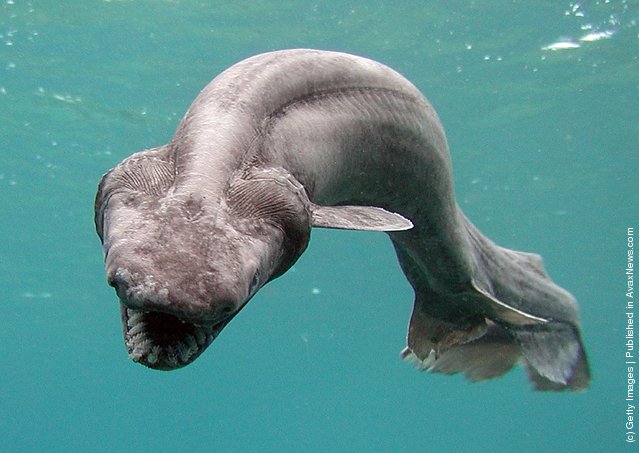
“The frilled shark (Chlamydoselachus anguineus) is one of two extant species of shark in the family Chlamydoselachidae, with a wide but patchy distribution in the Atlantic and Pacific Oceans. This uncommon species is found over the outer continental shelf and upper continental slope, generally near the bottom though there is evidence of substantial upward movements. It has been caught as deep as 1,570 m (5,150 ft), whereas in Suruga Bay, Japan it is most common at depths of 50–200 m (160–660 ft). Exhibiting several “primitive” features, the frilled shark has often been termed a «living fossil»”. – Wikipedia

Photo: A 1.6 meter long Frill shark swims in a tank after being found by a fisherman at a bay in Numazu, on January 21, 2007 in Numazu, Japan. The frill shark, also known as a Frilled shark usually lives in waters of a depth of 600 meters and so it is very rare that this shark is found alive at sea-level. It's body shape and the number of gill are similar to fossils of sharks which lived 350,000,000 years ago. (Photo by Awashima Marine Park/Getty Images)
Details
05 May 2011 10:01:00
Kawakanih Yawalapiti, 9, Upper Xingu region of Mato Grosso, Brazil, 2018: Kawakanih lives with her tribe, the Yawalapiti, in Xingu national park, a preserve in the Amazon basin of Brazil. The Yawalapiti collect seeds to preserve species unique to their ecosystem, which lies between the rain forest and savannah. Kawakanih’s diet is simple, consisting mainly of fish, cassava, porridge, fruit and nuts. “It takes five minutes to catch dinner”, says Kawakanih. “When you’re hungry, you just go to the river with your net”. (Photo by Gregg Segal/The Guardian)

Photographer Gregg Segal travelled the world to document children and the food they eat in a week. Partly inspired by the increasing problems of childhood obesity, he tracked traditional regional diets as yet unaffected by globalisation, and ironically, found that the healthiest diets were often eaten by the least well off. (Photo by Gregg Segal/The Guardian)
Details
03 Jul 2019 00:03:00
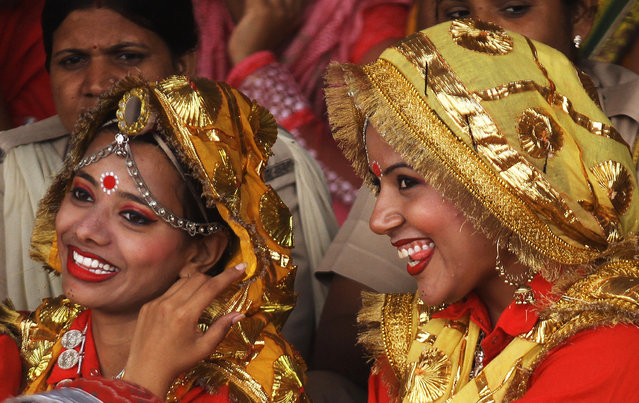
Participants share a moment after performing at a cultural program during India's Independence Day celebrations in Ajmer, in the desert state of Rajasthan, India, August 15, 2016. (Photo by Himanshu Sharma/Reuters)

Participants share a moment after performing at a cultural program during India's Independence Day celebrations in Ajmer, in the desert state of Rajasthan, India, August 15, 2016. (Photo by Himanshu Sharma/Reuters)
Details
23 Aug 2016 09:48:00


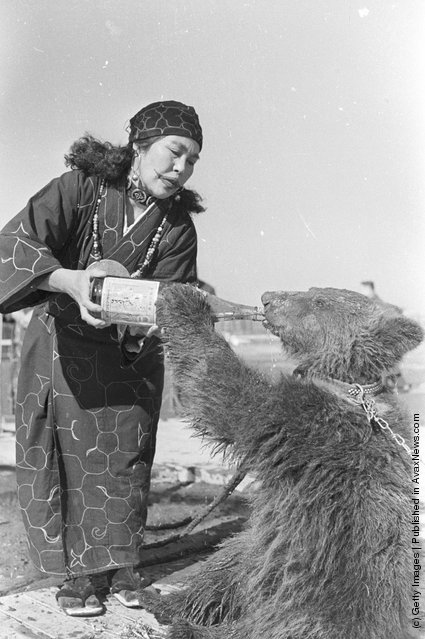
“The Ainu (アイヌ?), also called Aynu, Aino (アイノ), and in historical texts Ezo (蝦夷), are indigenous people or groups in Japan and Russia. Historically they spoke the Ainu language and related varieties and lived in Hokkaidō, the Kuril Islands, and much of Sakhalin. Most of those who identify themselves as Ainu still live in this same region, though the exact number of living Ainu is unknown. This is due to ethnic issues in Japan resulting in those with Ainu backgrounds hiding their identities and confusion over mixed heritages. In Japan, because of intermarriage over many years with Japanese, the concept of a 'pure Ainu' ethnic group is no longer feasible. Official estimates of the population are of around 25,000, while the unofficial number is upwards of 200,000 people”. – Wkipedia

Photo: A captive bear drinking from a large bottle held by an Ainu tribeswoman. (Photo by Evans/Three Lions/Getty Images). Circa 1955
Details
24 Mar 2011 14:01:00
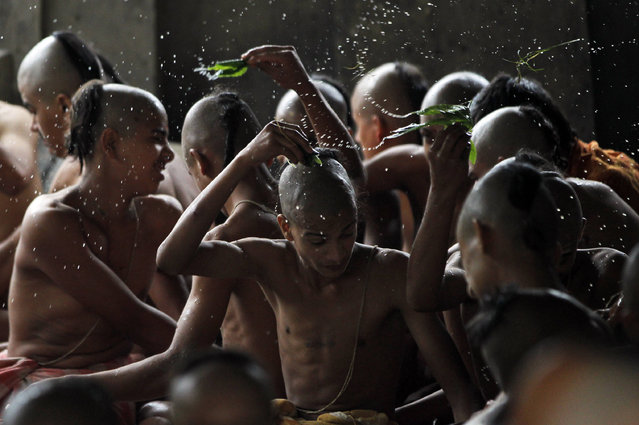
Nepalese Hindu priests perform rituals during Janai Purnima festival at Pashupatinath temple in Kathmandu, Nepal, Thursday, August 18, 2016. During this festival Hindus take holy baths and perform annual change of the Janai, a sacred cotton string worn around their chest or tied on the wrist, in the belief that it will protect and purify them. (Photo by Niranjan Shrestha/AP Photo)

Nepalese Hindu priests perform rituals during Janai Purnima festival at Pashupatinath temple in Kathmandu, Nepal, Thursday, August 18, 2016. During this festival Hindus take holy baths and perform annual change of the Janai, a sacred cotton string worn around their chest or tied on the wrist, in the belief that it will protect and purify them. (Photo by Niranjan Shrestha/AP Photo)
Details
19 Aug 2016 11:48:00