Loading...
Done
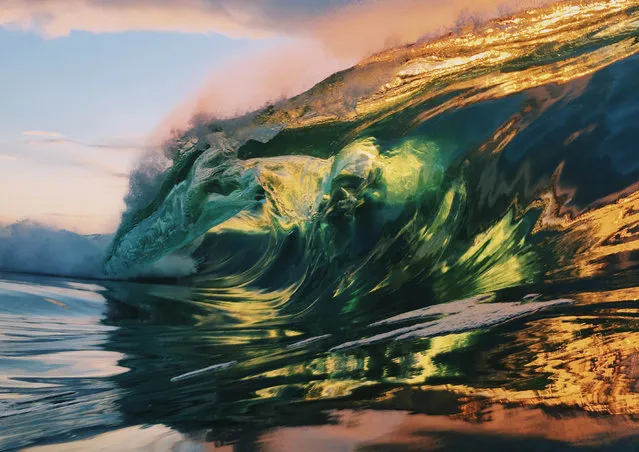
“Whether that means getting up way before the sun, like I do most days, going out somewhere that I’m not comfortable or just trying to get different angles or styles of photos, I am trying to display the crazy beauty of the ocean, and usually moments that literally last less than a split second”. (Photo by Ryan Pernoski/Caters News Agency)

These kaleidoscopic images are the work of one persistent photographer’s efforts to capture vibrant hues at the exact moment a wave breaks. Ryan Pernofski‘s stunning shots feature brilliant yellows, reds, blues and purples as an array of sunlight hits the water at the perfect time. What’s even more impressive: Ryan, a 27-year-old Australian, began shooting his popular masterpieces without using a professional camera, taking his iPhone out into the water instead. Ryan began experimenting with this method in 2012, using an underwater housing to protect his phone, as he could not afford a professional camera. (Photo by Ryan Pernoski/Caters News Agency)
Details
09 Jun 2018 00:05:00
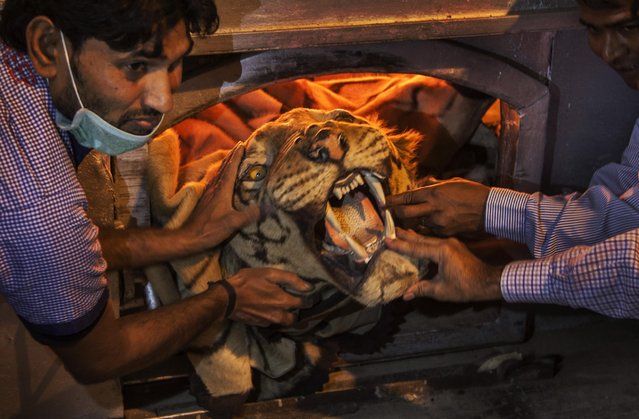
Indian authorities hold a tiger skin as they set fire to a stockpile of illegal wildlife parts at the Delhi Zoo in New Delhi, India, Sunday, November 2, 2014. A stockpile of tiger skins, elephant tusks, rhino horns and other illegal animal parts were burned Sunday in an effort to discourage wildlife smuggling in South Asia. (Photo by Tsering Topgyal/AP Photo)

Indian authorities hold a tiger skin as they set fire to a stockpile of illegal wildlife parts at the Delhi Zoo in New Delhi, India, Sunday, November 2, 2014. A stockpile of tiger skins, elephant tusks, rhino horns and other illegal animal parts were burned Sunday in an effort to discourage wildlife smuggling in South Asia. (Photo by Tsering Topgyal/AP Photo)
Details
03 Nov 2014 12:44:00
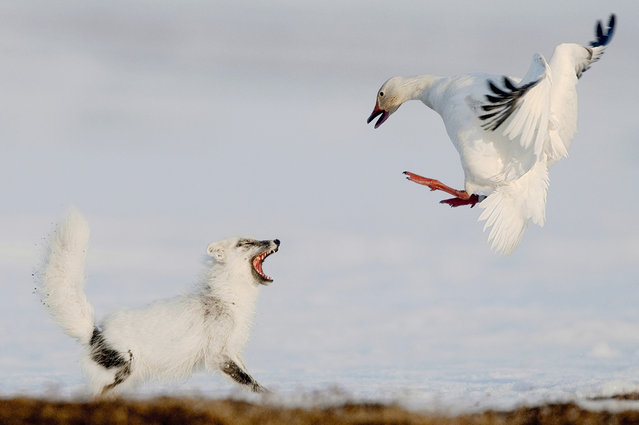
Commended. In late May, about a quarter of a million snow geese arrive from North America to nest on Wrangel Island, in northeastern Russia. They form the world's largest breeding colony of snow geese. Photographer Sergey Gorshkov spent two months on the remote island photographing the unfolding dramas. (Photo by Sergey Gorshkov/Veolia Environnement Wildlife Photographer)

Commended. In late May, about a quarter of a million snow geese arrive from North America to nest on Wrangel Island, in northeastern Russia. They form the world's largest breeding colony of snow geese. Photographer Sergey Gorshkov spent two months on the remote island photographing the unfolding dramas. Arctic foxes take advantage of the abundance of eggs, caching surplus eggs for leaner times. But a goose (here the gander) is easily a match for a fox, which must rely on speed and guile to steal eggs. “The battles were fairly equal”, notes Sergey, “and I only saw a fox succeed in grabbing an egg on a couple of occasions, despite many attempts”. Surprisingly, “the geese lacked any sense of community spirit”, he adds, “and never reacted when a fox harassed a neighboring pair nesting close by”. (Photo by Sergey Gorshkov/Veolia Environnement Wildlife Photographer)
Details
16 Jun 2015 12:30:00


A rare white kiwi chick is seen only days after being hatched on May 22, 2011 in Wellington, New Zealand. The all-white kiwi, named “Manukura” is suspected to be the first white chick born in captivity. The chick is the thirteenth of fourteen baby kiwis hatched at the wildlife centre this season. (Photo by Mike Heydon/Jet Productions NZ Limited via Getty Images)
Details
24 May 2011 09:07:00
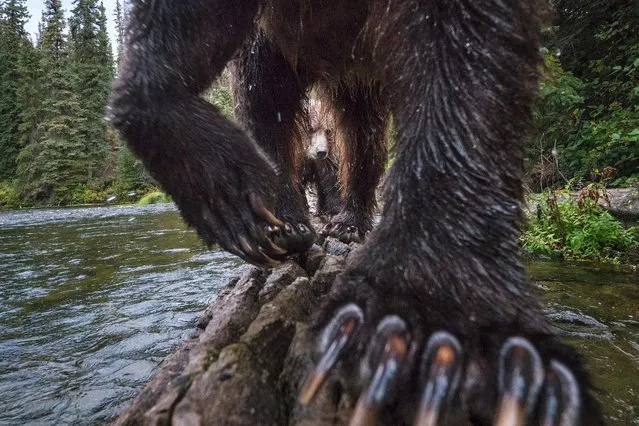
“The Salmon Catchers”. Terrestrial Wildlife. To capture this view of a mother grizzly bear and her cub, photographer Peter Mather set up a camera trap on a log that he knew the bears tended to traverse while fishing for salmon, in the Yukon River watershed in Canada. (Photo by Peter Mather/BigPicture Natural World Photography Competition 2017)

The fourth annual BigPicture Natural World Photography Competition aims to celebrate the diversity of life on Earth, and encourages people to protect and conserve it. Here: “The Salmon Catchers”. Terrestrial Wildlife. To capture this view of a mother grizzly bear and her cub, photographer Peter Mather set up a camera trap on a log that he knew the bears tended to traverse while fishing for salmon, in the Yukon River watershed in Canada. (Photo by Peter Mather/BigPicture Natural World Photography Competition 2017)
Details
02 Jul 2017 07:25:00
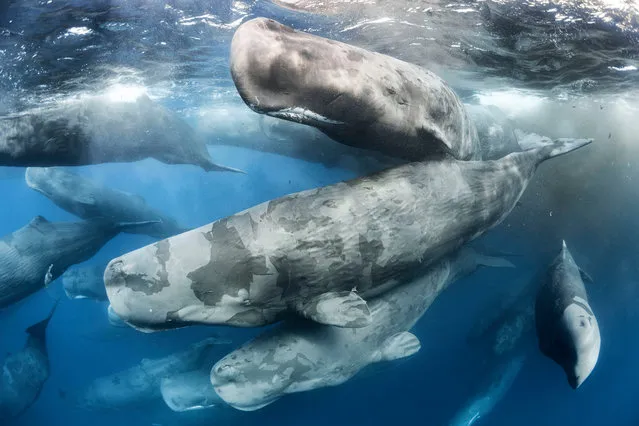
Behaviour: Mammals category. Giant Gathering by Tony Wu, USA. Dozens of sperm whales mingled noisily off Sri Lanka’s northeast coast, stacked as far down as Tony could see. This was a congregation of dozens of social units, like a gathering of the clans. Aggregations like this could be a critical part of the whales’ rich social lives but are rarely reported. Some two thirds of the population was wiped out before commercial whaling was banned in 1986. This kind of major gathering could be “a sign that populations are recovering”, says Tony. (Photo by Tony Wu/Wildlife Photographer of the Year 2017)

Behaviour: Mammals category. Giant Gathering by Tony Wu, USA. Dozens of sperm whales mingled noisily off Sri Lanka’s northeast coast, stacked as far down as Tony could see. This was a congregation of dozens of social units, like a gathering of the clans. Aggregations like this could be a critical part of the whales’ rich social lives but are rarely reported. Some two thirds of the population was wiped out before commercial whaling was banned in 1986. This kind of major gathering could be “a sign that populations are recovering”, says Tony. (Photo by Tony Wu/Wildlife Photographer of the Year 2017)
Details
19 Oct 2017 09:38:00
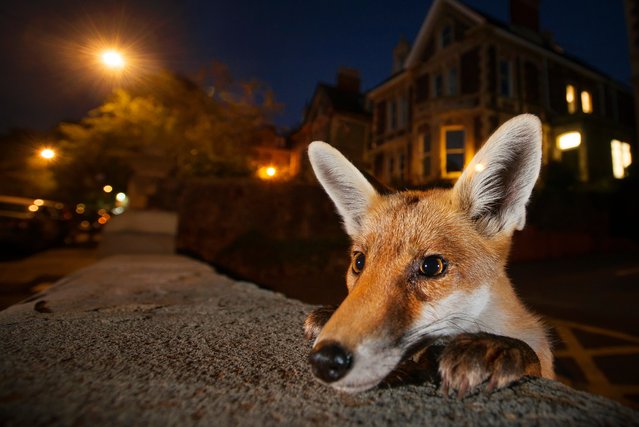
Nosy neighbour by Sam Hobson, UK. Sam knew exactly who to expect when he set his camera on the wall one summer’s evening in a suburban street in Bristol, the UK’s famous fox city. He wanted to capture the inquisitive nature of the urban red fox in a way that would pique the curiosity of its human neighbours about the wildlife around them. (Photo by Sam Hobson/2016 Wildlife Photographer of the Year)

Nosy neighbour by Sam Hobson, UK. Sam knew exactly who to expect when he set his camera on the wall one summer’s evening in a suburban street in Bristol, the UK’s famous fox city. He wanted to capture the inquisitive nature of the urban red fox in a way that would pique the curiosity of its human neighbours about the wildlife around them. (Photo by Sam Hobson/2016 Wildlife Photographer of the Year)
Details
31 Aug 2016 12:05:00
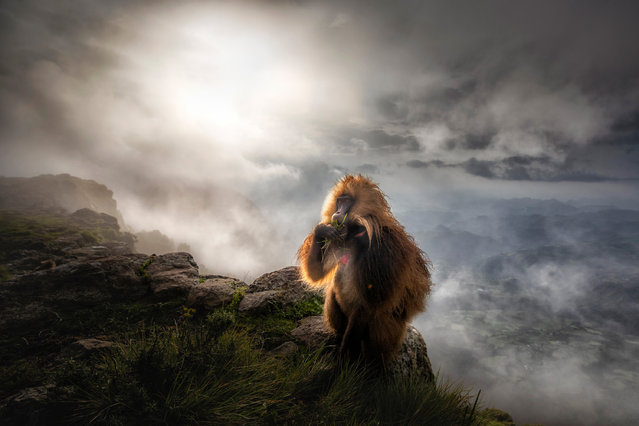
Highly commended, mammals: Gelada after the storm – Marco Gaiotti (Italy). “Gelada baboons are the only monkey species in the world that feed on grasses. They are native to the tableland of Ethiopia. Every morning large family groups wander from their sleeping places in the steep rock face, up to 1,000 metres high, to the feeding grounds at the tablelands. This image clearly depicts their feeding strategy: they pull out bunches of grass, sort the stalks and then lift them to their mouth. This shot was taken towards the end of the rainy season after a heavy storm”. (Photo by Marco Gaiotti/2019 GDT European Wildlife Photographer of the Year)

Highly commended, mammals: Gelada after the storm – Marco Gaiotti (Italy). “Gelada baboons are the only monkey species in the world that feed on grasses. They are native to the tableland of Ethiopia. Every morning large family groups wander from their sleeping places in the steep rock face, up to 1,000 metres high, to the feeding grounds at the tablelands. This image clearly depicts their feeding strategy: they pull out bunches of grass, sort the stalks and then lift them to their mouth. This shot was taken towards the end of the rainy season after a heavy storm”. (Photo by Marco Gaiotti/2019 GDT European Wildlife Photographer of the Year)
Details
31 Oct 2019 00:03:00