Loading...
Done
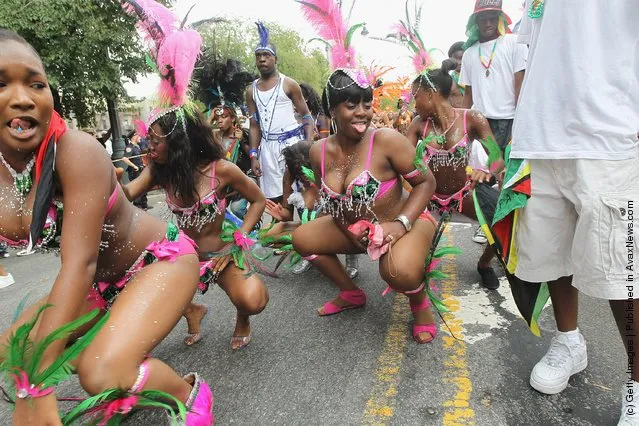
New Yorkers Celebrate At West Indian Day Parade

“The Labor Day Parade (or West Indian Carnival), is an annual celebration held on American Labor Day (the first Monday in September), in Crown Heights, Brooklyn, New York. Ms. Jessie Waddell and some of her West Indian friends started the Carnival in Harlem in the 1920s by staging costume parties in large enclosed places like the Savoy, Renaissance and Audubon Ballrooms due to the cold wintry weather of February. This is the usual time for the pre-Lenten celebrations held in most countries around the world. However, because of the very nature of Carnival, and the need to parade in costume to music, indoor confinement did not work well. The earliest known Carnival street parade was held on September 1, 1947. The Trinidad Carnival Pageant Committee was the founding force behind the parade, which was held in Harlem. The parade route was along Seventh Avenue, starting at 110th St.” – Wikipedia

Photo: A reveler looks on during the West Indian-American Day Parade September 5, 2011 in the Brooklyn borough of New York City. More than 2 million spectators were expected to attend the celebration of Caribbean culture. (Photo by Mario Tama/Getty Images)
Details
06 Sep 2011 11:18:00
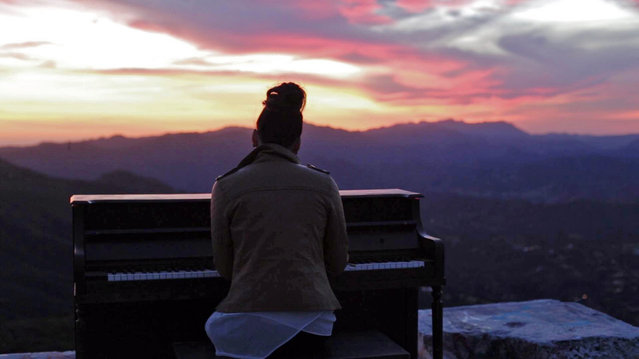
In this March, 2015 photo, a person sits at an upright piano that had been hauled up to Topanga Lookout in the Santa Monica Mountains in Calabasas, Calif. For a couple of days last week, a Southern California hilltop was alive with the sound of mystery. (Photo by Michael Flotron/AP Photo)

In this March, 2015 photo, a person sits at an upright piano that had been hauled up to Topanga Lookout in the Santa Monica Mountains in Calabasas, Calif. For a couple of days last week, a Southern California hilltop was alive with the sound of mystery. Hikers venturing to Topanga Lookout found a battered upright piano sitting on a graffiti-scrawled concrete slab with a panoramic view over the mountains between Calabasas and the Pacific Ocean. Turns out, the piano was used for a music video by Seattle-based artist Rachel Wong. The cinematographer, Michael Flotron, says he and four others used a dolly and rope to haul the 350-pound instrument a mile up the trail on Tuesday. After the shoot, it was too dark to get the piano back down. Flotron says people seem happy to leave it there. But if necessary, he'll haul the piano back down. (Photo by Michael Flotron/AP Photo)
Details
30 Mar 2015 13:08:00
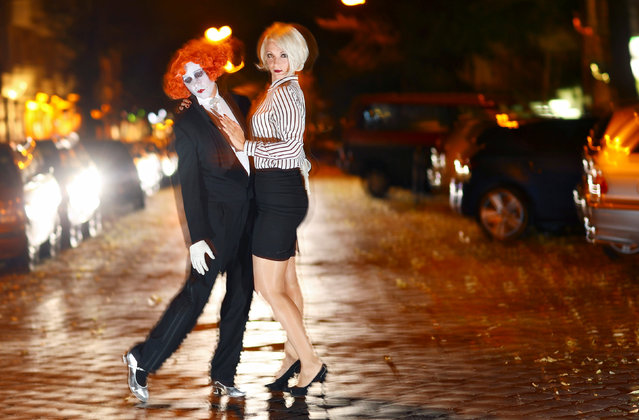
Artist Le Pustra and organiser Else Edelstahl pose for a picture at Simon Dach Strasse, a street filled with many bars, in Berlin, Germany, August 28, 2016. Else Edelstahl organises the party series “Boheme Sauvage”, in which people dress up in 1920s style, celebrating Berlin nightlife of a past era. (Photo by Hannibal Hanschke/Reuters)

Artist Le Pustra and organiser Else Edelstahl pose for a picture at Simon Dach Strasse, a street filled with many bars, in Berlin, Germany, August 28, 2016. Else Edelstahl organises the party series “Boheme Sauvage”, in which people dress up in 1920s style, celebrating Berlin nightlife of a past era. (Photo by Hannibal Hanschke/Reuters)
Details
20 Sep 2016 09:21:00
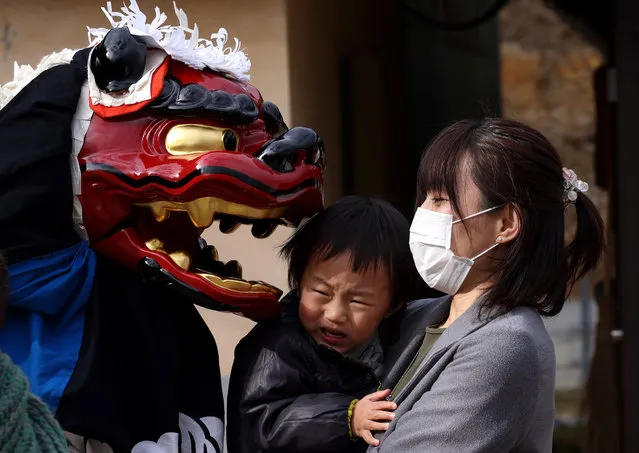
A performer wearing a lion mask performs the Ise Daikagura lion dance at the remote village of Yamanawa on February 08, 2021 in Ryuo, Japan. Ise Daikagura is a group of traditional Lion Dance performers who pray in front of farmers houses and businesses for good grain harvests and disease-free lives. Performers play sacred music using drums and flutes with two lion mask dancers. A lion mask is considered a symbol of God, who enters the house and performs in front of the Shinto God, a statue placed inside the house, mostly in the kitchen. These prayers are called “Kamodo Barai”. After the prayers, they are gifted with money, rice, sake and Japanese sweets from the householders. A group can travel for more than one hundred days to thousands of households and businesses throughout rural-villages in western Japan, and pray to those who are unable to visit the country’s most sacred shrine, the Grand Ise Shrine in Mie Prefecture. The group started its performance in the Edo era between 1603 to 1868 according to Japanese history. The Japanese government designated it as an important folk cultural national property in 1981. (Photo by Buddhika Weerasinghe/Getty Images)

A performer wearing a lion mask performs the Ise Daikagura lion dance at the remote village of Yamanawa on February 08, 2021 in Ryuo, Japan. Ise Daikagura is a group of traditional Lion Dance performers who pray in front of farmers houses and businesses for good grain harvests and disease-free lives. (Photo by Buddhika Weerasinghe/Getty Images)
Details
18 Feb 2021 09:27:00
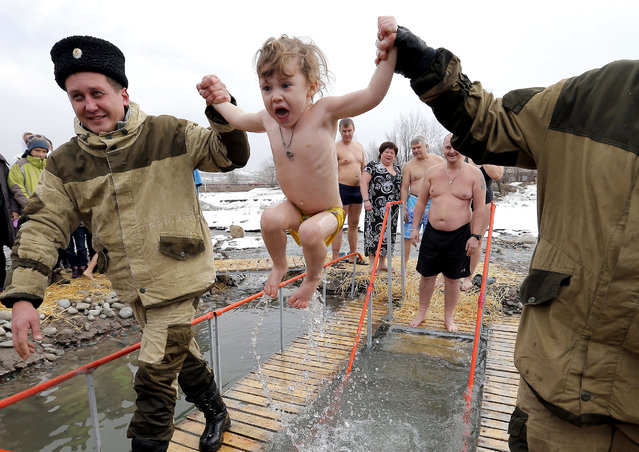
An Orthodox child is given an icy dip in a lake in celebration of Epiphan, near the village of Vorontsovka, some 20 km from the Kyrgyz capital of Bishkek, Kyrgyzstan, 19 January 2019. People believe that bathing in blessed waters during the holiday of Epiphany strengthens their spirit and body. (Photo by Igor Kovalenko/EPA/EFE)

An Orthodox child is given an icy dip in a lake in celebration of Epiphan, near the village of Vorontsovka, some 20 km from the Kyrgyz capital of Bishkek, Kyrgyzstan, 19 January 2019. People believe that bathing in blessed waters during the holiday of Epiphany strengthens their spirit and body. (Photo by Igor Kovalenko/EPA/EFE)
Details
21 Feb 2019 00:05:00
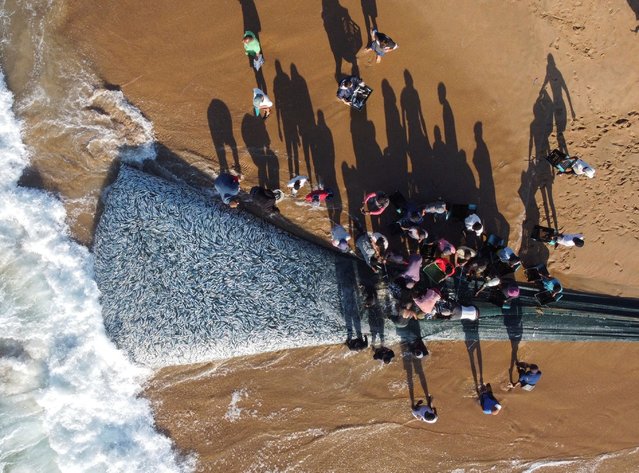
A drone view of fishermen unloading fish caught in a net during the sardine run in Scottburgh, South Africa, on June 12, 2024. (Photo by Rogan Ward/Reuters)

A drone view of fishermen unloading fish caught in a net during the sardine run in Scottburgh, South Africa, on June 12, 2024. (Photo by Rogan Ward/Reuters)
Details
18 Jun 2024 02:51:00
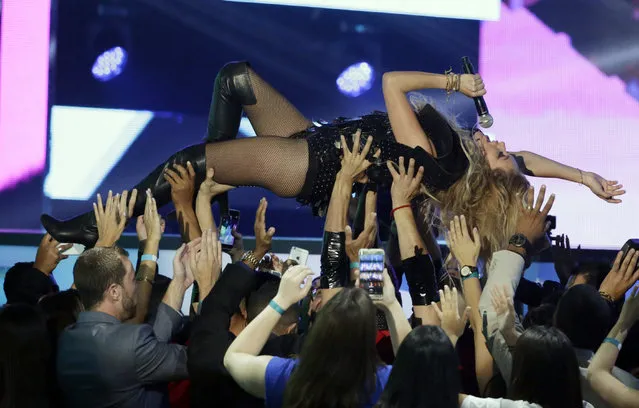
Singer Paulina Rubio performs during the Latin Billboard Awards, Thursday, April 28, 2016 in Coral Gables, Fla. (Photo by Wilfredo Lee/AP Photo)

Singer Paulina Rubio performs during the Latin Billboard Awards, Thursday, April 28, 2016 in Coral Gables, Fla. (Photo by Wilfredo Lee/AP Photo)
Details
30 Apr 2016 09:50:00
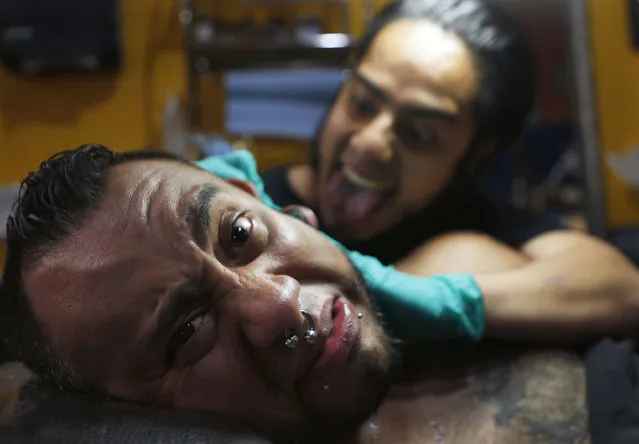
In this April 18, 2019 photo, tattoo artist Lalo Calva inks a tattoo on client Adrian Alonso Rodriguez, a journalist, announcer and dubbing artist, at the Corona Tattoo parlor in Mexico City. Not only inks and techniques have changed in Mexico over the years, but tattoos themselves have evolved from stigmatized symbols of gangs, violence and poverty to an art form. (Photo by Marco Ugarte/AP Photo)

In this April 18, 2019 photo, tattoo artist Lalo Calva inks a tattoo on client Adrian Alonso Rodriguez, a journalist, announcer and dubbing artist, at the Corona Tattoo parlor in Mexico City. Not only inks and techniques have changed in Mexico over the years, but tattoos themselves have evolved from stigmatized symbols of gangs, violence and poverty to an art form. (Photo by Marco Ugarte/AP Photo)
Details
14 Jul 2019 00:01:00