Loading...
Done
People wearing masks and carrying supplies walk past a mannequin wearing a mask in downtown Barcelona, Spain, Saturday, March 14, 2020. Spain's prime minister has announced a two-week state of emergency from Saturday in a bid to contain the new coronavirus outbreak. For most people, the new coronavirus causes only mild or moderate symptoms. For some, it can cause more severe illness, especially in older adults and people with existing health problems. (Photo by Emilio Morenatti/AP Photo)

People wearing masks and carrying supplies walk past a mannequin wearing a mask in downtown Barcelona, Spain, Saturday, March 14, 2020. Spain's prime minister has announced a two-week state of emergency from Saturday in a bid to contain the new coronavirus outbreak. For most people, the new coronavirus causes only mild or moderate symptoms. For some, it can cause more severe illness, especially in older adults and people with existing health problems. (Photo by Emilio Morenatti/AP Photo)
Details
18 Mar 2020 00:03:00
Man prepares wigs as he waits for customers in downtown Johannesburg. Some estimates put Africa's dry hair industry at as much as $6 billion a year; Nigerian singer Muma Gee recently boasted that she spends 500,000 naira ($3,100) on a single hair piece made of 11 sets of human hair. (Photo by Siphiwe Sibeko/Reuters)

Man prepares wigs as he waits for customers in downtown Johannesburg, on August 5, 2014. Some estimates put Africa's dry hair industry at as much as $6 billion a year; Nigerian singer Muma Gee recently boasted that she spends 500,000 naira ($3,100) on a single hair piece made of 11 sets of human hair. (Photo by Siphiwe Sibeko/Reuters)
Details
15 Aug 2014 09:08:00
Ocean voyage

Do you think that history is a science? Well, not exactly. First, and foremost, history is the state's “legend of wars”, it’s official regalia. Of course, public historians are not interested in scientific truth – quite the opposite. In this respect, any attempt to present a state’s history as altruistic and benevolent as possible is welcomed and encouraged – as opposed to any revisionism attempts that may be more accurate. In this matter, Chinese have surpassed us all – they revised in highly creative manner (but rather shamelessly) the technology already invented by Europeans, a process that resulted in oldest state on the planet. Here is an interesting paradox: ask any sinologist about the Middle Kingdom during second century B.C., and he will describe it to you in such a vivid manner as if he has been living there all his life – but as soon as you will ask him to describe Chinese history in the 19-20th centuries… let's say, his eagerness will be greatly diminished. However, we will discuss China in a different article, and in the meantime we will try to understand how exactly historic “legend of wars” is formed and functions – based on a specific and well-known example. A great example is Ferdinand Magellan's first voyage around the world.

Details
14 Nov 2011 09:11:00
A boy reacts as dogs play along the riverbank of Pasig river, in Manila, Philippines, June 10, 2021. (Photo by Lisa Marie David/Reuters)

A boy reacts as dogs play along the riverbank of Pasig river, in Manila, Philippines, June 10, 2021. (Photo by Lisa Marie David/Reuters)
Details
16 Jul 2021 10:19:00
Bloodthirsty by Thomas P Peschak, Germany/South Africa — winner, Behaviour: birds. When rations run short on Wolf Island, in the remote northern Galápagos, the sharp-beaked ground finches become vampires. Their sitting targets are Nazca boobies and other large birds. The finches rely on a scant diet of seeds and insects, which regularly dries up, so they drink blood to survive. ‘I’ve seen more than half a dozen finches drinking from a single Nazca booby,’ says Tom. Rather than leave their nests the boobies tolerate the vampires, and the blood loss doesn’t seem to cause permanent harm. (Photo by Thomas P Peschak/2018 Wildlife Photographer of the Year)

Bloodthirsty by Thomas P. Peschak, Germany/South Africa — winner, Behaviour: birds. When rations run short on Wolf Island, in the remote northern Galápagos, the sharp-beaked ground finches become vampires. Their sitting targets are Nazca boobies and other large birds. The finches rely on a scant diet of seeds and insects, which regularly dries up, so they drink blood to survive. ‘I’ve seen more than half a dozen finches drinking from a single Nazca booby,’ says Tom. Rather than leave their nests the boobies tolerate the vampires, and the blood loss doesn’t seem to cause permanent harm. (Photo by Thomas P. Peschak/2018 Wildlife Photographer of the Year)
Details
19 Oct 2018 00:05:00
The exhibition “All the colors of Warhol” on July 8, 2024 was opened in the SALON Gallery, the Museum of the City of Belgrade, organized by the Museum of the City of Belgrade and the Belgrade Festival Center of CEBEF, and will last until the end of the month. (Photo by L.L./ATAImages)

The exhibition “All the colors of Warhol” on July 8, 2024 was opened in the SALON Gallery, the Museum of the City of Belgrade, organized by the Museum of the City of Belgrade and the Belgrade Festival Center of CEBEF, and will last until the end of the month. (Photo by L.L./ATAImages)
Details
06 Sep 2024 04:19:00
Saraa Mutawkil (R), 18, practises boxing at Al Rabie club in Omdurman May 10, 2016. (Photo by Mohamed Nureldin Abdallah/Reuters)

Saraa Mutawkil (R), 18, practises boxing at Al Rabie club in Omdurman May 10, 2016. (Photo by Mohamed Nureldin Abdallah/Reuters)
Details
14 May 2016 11:16:00
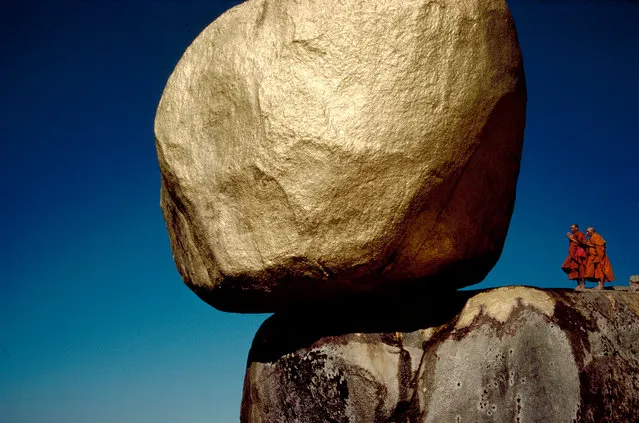
Kyaiktiyo, Burma, 1978. The Golden Rock at Shwe Pyi Daw (the Golden Country), the Buddhist holy place. Hiroji Kubota writes: “I was desperate to keep a distance from America for a while; luckily, I found Burma and its gentle and compassionate people. In the spring of 1978, on the top of the hill where I took this photo, I had two Leica bodies: the one with Tri-X and the other with Kodachrome 64. Soon after, I realised that the colour one looked very colourful and was more powerful. That was my decisive moment, to become a colour photographer”. (Photo by Hiroji Kubota/Magnum Photos)

Kyaiktiyo, Burma, 1978. The Golden Rock at Shwe Pyi Daw (the Golden Country), the Buddhist holy place. Hiroji Kubota writes: “I was desperate to keep a distance from America for a while; luckily, I found Burma and its gentle and compassionate people. In the spring of 1978, on the top of the hill where I took this photo, I had two Leica bodies: the one with Tri-X and the other with Kodachrome 64. Soon after, I realised that the colour one looked very colourful and was more powerful. That was my decisive moment, to become a colour photographer”. (Photo by Hiroji Kubota/Magnum Photos)
Details
10 Jun 2016 13:30:00