Loading...
Done
A tour guide shows a thumbs up as he sits on top of a crocodile on the Tarcoles river in Tarcoles, Costa Rica. (Photo and caption by Barcroft Media)

To most of us, hand-feeding crocodiles might sound like a one-way ticket to a watery grave. But for Jose Eduardo Chaves Salas, 32, coming within inches of the fearsome creatures’ razor-sharp teeth is all in a day’s work. He runs Jose's Crocodile River Tour on the Tarcoles River in Costa Rica, where tourists can watch him feed crocs up to 17 feet long. Photo: A tour guide shows a thumbs up as he sits on top of a crocodile on the Tarcoles river in Tarcoles, Costa Rica. (Photo and caption by Barcroft Media)
Details
20 Oct 2013 09:06:00
“Flashy Lady”. (Photo and caption by Roderique Arisiaman)

Some artists want to convey some deep message through their art, while some are simply satisfied with shocking the audience. Roderique Arisiaman is the latter kind. Though his works do not play on the strings of our emotion, they can pique the interest with their flashy and sometimes humorous appearance. Many of his works have a zombie theme, and are surprisingly well done, especially the one where a man pushes his fingers through his cheek and into his eye. If given the chance, Roderique Arisiaman would probably do a great job of designing a poster for some zombie apocalypse movie. (Photo and caption by Roderique Arisiaman)
Details
18 Mar 2015 09:27:00
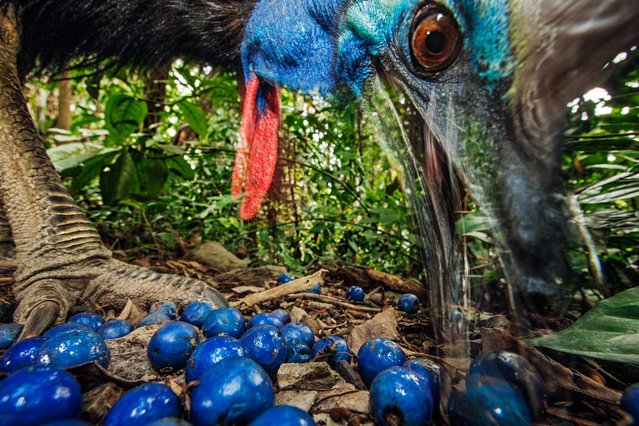
“Cassowaries are large, flightless birds related to emus and (more distantly) to ostriches, rheas, and kiwis”, writes Olivia Judson in the September issue of National Geographic magazine. (Photo by Christian Ziegler/National Geographic)

“Cassowaries are large, flightless birds related to emus and (more distantly) to ostriches, rheas, and kiwis”, writes Olivia Judson in the September issue of National Geographic magazine. How large? People-size: Adult males stand well over five foot five and top 110 pounds. Females are even taller, and can weigh more than 160 pounds. Dangerous when roused, they’re shy and peaceable when left alone. But even birds this big and tough are prey to habitat loss. The dense New Guinea and Australia rain forests where they live have dwindled. Today cassowaries might number 1,500 to 2,000. And because they help shape those same forests – by moving seeds from one place to another – “if they vanish”, Judson writes, “the structure of the forest would gradually change” too. (Photo by Christian Ziegler/National Geographic)
Details
06 Jan 2014 12:21:00
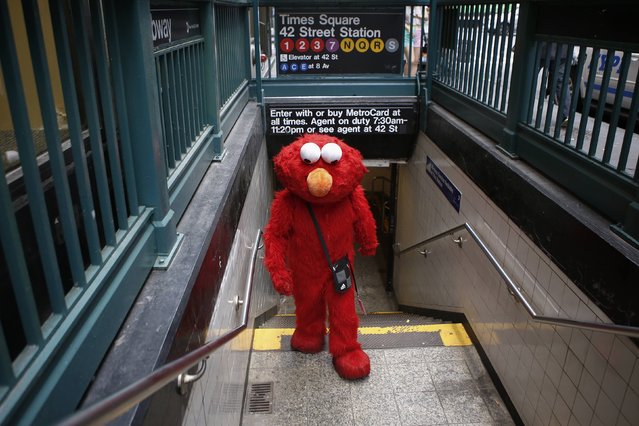
Jorge, an immigrant from Mexico, exits a subway station dressed as the Sesame Street character Elmo in Times Square, New York July 30, 2014. (Photo by Eduardo Munoz/Reuters)

Jorge, an immigrant from Mexico, exits a subway station dressed as the Sesame Street character Elmo in Times Square, New York July 30, 2014. Elmo and Cookie Monster have long delighted young viewers on TV's “Sesame Street”, but the recent antics of New York street performers dressed as the beloved characters have drawn the ire of city officials and now the show's producers. Sesame Workshop, which owns the rights to Big Bird, Ernie and the assorted puppet monsters on the 45-year-old program, said on July 29, 2014 it was drafting plans to stop performers who dress up as the characters from appearing in Times Square, where they pose for photos with tourists and then demand tips. (Photo by Eduardo Munoz/Reuters)
Details
05 Aug 2014 11:50:00


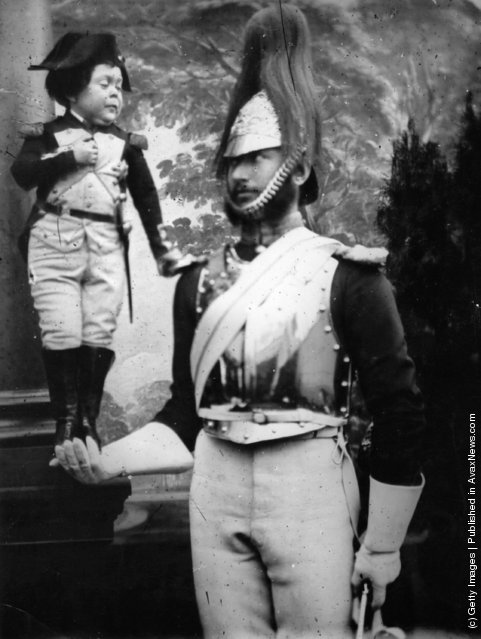
“Tom Thumb is a character of English folklore. The History of Tom Thumb was published in 1621, and has the distinction of being the first fairy tale printed in English. Tom is no bigger than his father's thumb, and his adventures include being swallowed by a cow, tangling with giants, and becoming a favourite of King Arthur. The earliest allusions to Tom occur in various 16th century works such as Reginald Scot's Discovery of Witchcraft (1584) where Tom is cited as one of the supernatural folk employed by servant maids to frighten children”. – Wikipedia

Photo: Portrait of the dwarf, Tom Thumb standing on the hand of a Guardsman. Charles Sherwood Stratton (1838 – 1883) was nicknamed General Tom Thumb by P T Barnum, the circus owner. (Photo by London Stereoscopic Company/Getty Images). Circa 1875
Details
24 Mar 2011 10:16:00


“Doctor fish is the name given to two species of fish: Garra rufa and Cyprinion macrostomus. Other nicknames include nibble fish, kangal fish, physio fish and doctorfishen; in non-medical contexts, Garra rufa is called the reddish log sucker. They live and breed in the outdoor pools of some Turkish spas, where they feed on the skin of patients with psoriasis. The fish are like combfishes in that they only consume the affected and dead areas of the skin, leaving the healthy skin to grow, with the outdoor location of the treatment bringing beneficial effects. The spas are not meant as a curative treatment option, only as a temporary alleviation of symptoms, and patients usually revisit the spas every few months”. – Wikipedia

Photo: Visitors to the Aqua Sheko fish therapy spa have their feet exfoliated on June 24, 2010 in London, England. Customers sit with their feet in a tank filled with 100-150 Garra Rufa fish which remove any dead skin by nibbling and sucking. A half hour session is then followed by a foot massage. (Photo by Peter Macdiarmid/Getty Images)
Details
22 Jun 2011 10:44:00
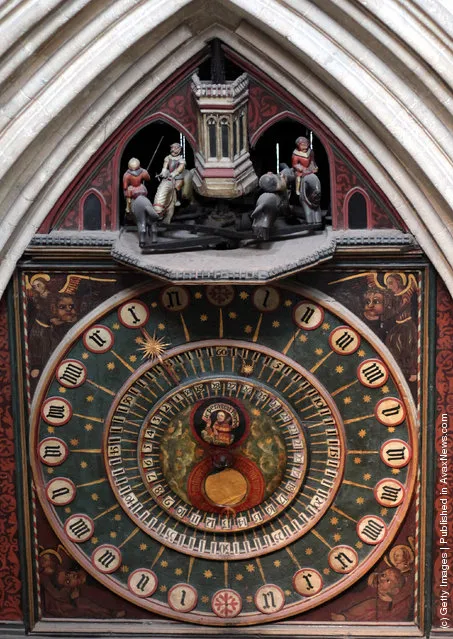
Wells Clock – World's Oldest Mechanical Clock

“Wells Cathedral is a Church of England cathedral in Wells, Somerset, England. Built between 1175 and 1490, Wells Cathedral has been described as “the most poetic of the English Cathedrals”. The Wells clock, an astronomical clock, is located in the north transept. The surviving mechanism, dated to between 1386 and 1392, was replaced in the 19th century, and was eventually moved to the Science Museum in London, where it continues to operate. It is the second-oldest surviving clock in England”. – Wikipedia

Photo: The clock face of world's oldest continually-working mechanical clock is seen as it is hand wound for the very last time on August 21, 2010 in Wells, England. (Photo by Matt Cardy/Getty Images)
Details
10 Aug 2011 11:23:00
Japanese children wear loincloths as they splash about in freezing cold water during Saidaiji Naked Festival, at Saidaiji Temple

“A Hadaka Matsuri (“Naked Festival”) is a type of Japanese festival, or matsuri, in which participants wear a minimum amount of clothing; usually just a Japanese loincloth (called fundoshi), sometimes with a short happi coat, and rarely completely naked. Whatever the clothing, it is considered to be above vulgar, or everyday, undergarments, and on the level of holy Japanese shrine attire. Naked festivals are held in dozens of places throughout Japan every year, usually in the summer or winter. The most famous festival is held in Okayama, where the festival originated. Every year, over 9,000 men participate in this festival”. – Wikipedia

Photo: Japanese men wear loincloths as they splash about in freezing cold water during Saidaiji Naked Festival, at Saidaiji Temple on February 18, 2012 in Okayama, Japan. (Photo by Buddhika Weerasinghe/Getty Images)
Details
19 Feb 2012 12:18:00