Loading...
Done
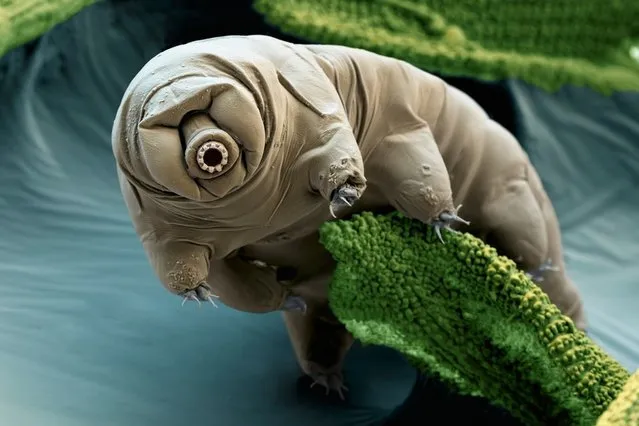
Tardigrades (commonly known as waterbears or moss piglets). (Photo by SPL/East News)

“Tardigrades (commonly known as waterbears or moss piglets) are small, water-dwelling, segmented animals with eight legs. Tardigrades were first discovered in 1773 by Johann August Ephraim Goeze, who called them kleiner Wasserbär, meaning “little water bear” in German. The name Tardigrada means “slow walker” and was given by Lazzaro Spallanzani in 1777. The name water bear comes from the way they walk, reminiscent of a bear's gait. The biggest adults may reach a body length of 1.5 millimetres (0.059 in), the smallest below 0.1 mm. Freshly hatched tardigrades may be smaller than 0.05 mm”. – Wikipedia. Photo: Tardigrades. (Photo by SPL/East News)
Details
26 Sep 2012 09:55:00


French tennis champion Suzanne Lenglen (1899–1938) high-kicking during a doubles match at the Wimbledon Lawn Tennis Championships. (Photo by Kirby/Topical Press/Getty Images). 1924
Details
14 Jun 2011 10:02:00
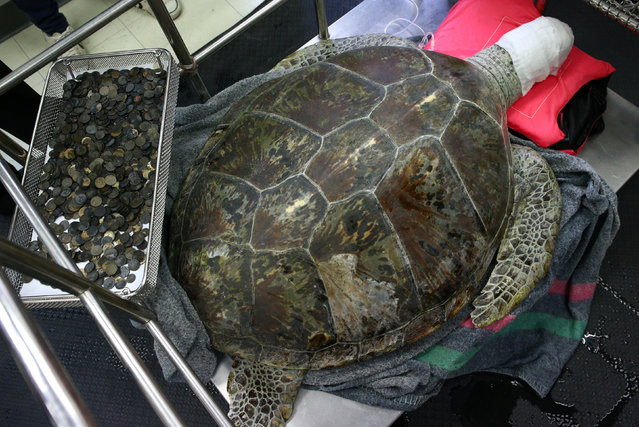
Omsin, a 25 year old femal green sea turtle, rests next to a tray of coins that were removed from her stomach after a surgical operation at the Faculty of Veterinary Science, Chulalongkorn University in Bangkok, Thailand, March 6, 2017. (Photo by Athit Perawongmetha/Reuters)

Omsin, a 25 year old femal green sea turtle, rests next to a tray of coins that were removed from her stomach after a surgical operation at the Faculty of Veterinary Science, Chulalongkorn University in Bangkok, Thailand, March 6, 2017. (Photo by Athit Perawongmetha/Reuters)
Details
08 Mar 2017 00:02:00
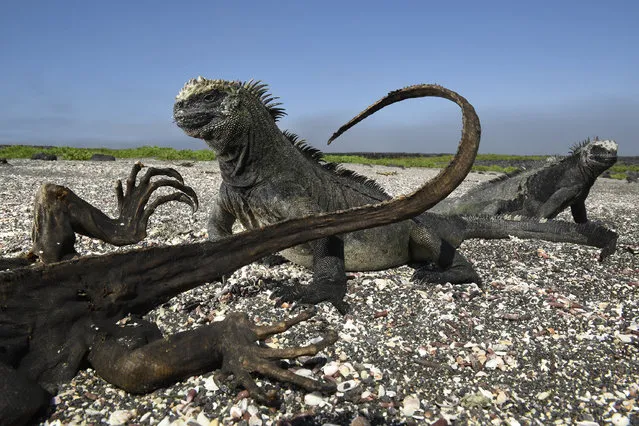
Galapagos – Rocking the Cradle: Four major ocean currents converge along the Galapagos archipelago, creating the conditions for an extraordinary diversity of animal life, April 25, 2016. The islands are home to at least 7,000 flora and fauna species, of which 97 percent of the reptiles, 80 percent of the land birds, 50 percent of the insects and 30 percent of the plants are endemic. The local ecosystem is highly sensitive to the changes in temperature, rainfall and ocean currents that characterize the climatic events known as El Niño and La Niña. These changes cause marked fluctuations in weather and food availability. Many scientists expect the frequency of El Niño and La Niña to increase as a result of climate change, making the Galapagos a possible early-warning location for its effects. (Photo by Thomas P. Peschak for National Geographic/World Press Photo)

Galapagos – Rocking the Cradle: Four major ocean currents converge along the Galapagos archipelago, creating the conditions for an extraordinary diversity of animal life, April 25, 2016. The islands are home to at least 7,000 flora and fauna species, of which 97 percent of the reptiles, 80 percent of the land birds, 50 percent of the insects and 30 percent of the plants are endemic. (Photo by Thomas P. Peschak for National Geographic/World Press Photo)
Details
16 Apr 2018 00:01:00
Two women pose as they drink real ale at the Great British Beer Festival in the Olympia exhibition centre on August 13, 2013 in London, England. The festival, which runs until August 17, 2013, has over 24 bars serving over 800 different beers, ciders and perries. (Photo by Oli Scarff/Getty Images)

Two women pose as they drink real ale at the Great British Beer Festival in the Olympia exhibition centre on August 13, 2013 in London, England. The festival, which runs until August 17, 2013, has over 24 bars serving over 800 different beers, ciders and perries. (Photo by Oli Scarff)
Details
04 Sep 2013 08:18:00


Konishiki “The Dumptruck” of Hawaii stares down at his opponent during the first Sumo Bashai held outside Japan, at the Albert Hall in London, England. (Photo by Chris Cole /Getty Images). 1991
Details
18 Mar 2011 08:23:00
“Just a little beaver”. (John Wilhelm)

“Just a little beaver”. (Photo by John Wilhelm)
Details
20 Feb 2014 13:37:00
In this June 8, 2015 photo, Omkarnath, who goes by the name “Medicine Baba”, pays his reverence at a neighborhood temple as he begins his day in New Delhi, India. The chatty, 79-year-old retired blood-bank technician has been collecting unused prescription drugs from the affluent for the past eight years, and distributing whatever hasn't expired to patients who need medicines they cannot afford. (Photo by Saurabh Das/AP Photo)

In this June 8, 2015 photo, Omkarnath, who goes by the name “Medicine Baba”, pays his reverence at a neighborhood temple as he begins his day in New Delhi, India. The chatty, 79-year-old retired blood-bank technician has been collecting unused prescription drugs from the affluent for the past eight years, and distributing whatever hasn't expired to patients who need medicines they cannot afford. (Photo by Saurabh Das/AP Photo)
Details
25 Jul 2015 12:18:00