Loading...
Done
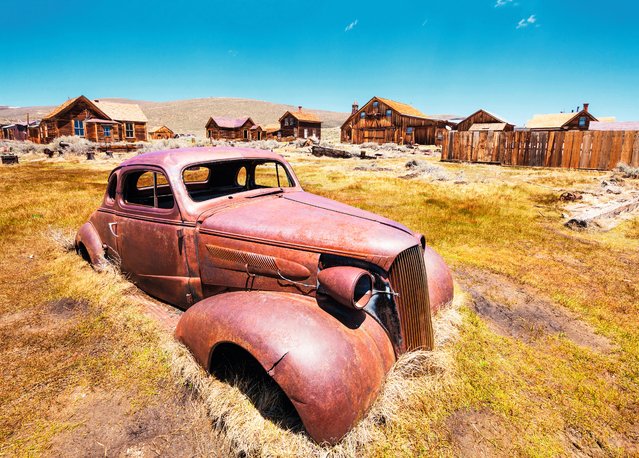
Bodie, Mono County, California. Gold was discovered at Bodie in 1859 (just after the initial California gold rush) and it went from mining camp to boomtown. Its decline began in 1880, when word spread of new boomtowns elsewhere. The Standard Consolidated Mine closed in 1913, and four years later the Bodie Railway was abandoned. By 1940 the population was down to 40. Today, Bodie is maintained in a state of arrested decay as a visitor attraction. (Photo by Alamy Stock Photo)

Kieron Connolly’s new book of photographs of more than 100 once-busy and often elegant buildings gives an idea of how the world might look if humankind disappeared. Here: Bodie, Mono County, California. Gold was discovered at Bodie in 1859 (just after the initial California gold rush) and it went from mining camp to boomtown. Its decline began in 1880, when word spread of new boomtowns elsewhere. The Standard Consolidated Mine closed in 1913, and four years later the Bodie Railway was abandoned. By 1940 the population was down to 40. Today, Bodie is maintained in a state of arrested decay as a visitor attraction. (Photo by Alamy Stock Photo)
Details
07 Sep 2016 09:50:00
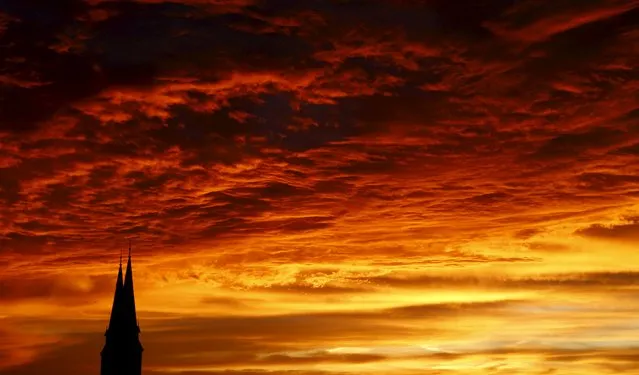
The rising sun illuminates the sky above the spires of a church in Vienna, Austria, November 17, 2015. (Photo by Heinz-Peter Bader/Reuters)

The rising sun illuminates the sky above the spires of a church in Vienna, Austria, November 17, 2015. (Photo by Heinz-Peter Bader/Reuters)
Details
19 Nov 2015 08:05:00
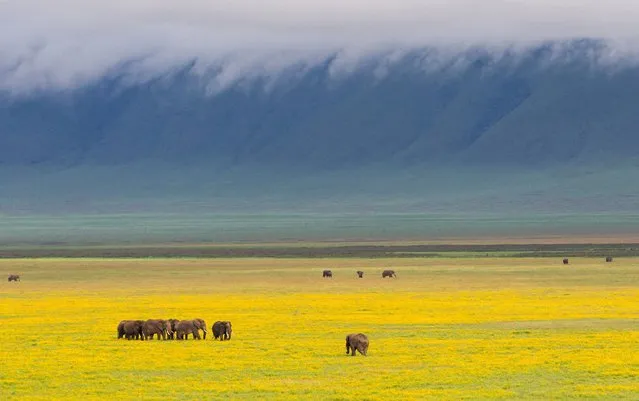
Ngorongoro Crater (Tanzania). At 610m deep and 260 sq km, this is the largest unflooded caldera in the world. A blue-green vision from above it's a haven for engangered wildlife and Maasai livestock. The crater was formed three million years ago when a giant volcano, which could have been as high as Kilimanjaro, exploded and collapsed. The caldera formed the concentric fractures in the crust cracked down to a magma reservoir deep underground. (Photo by John Bryant/Getty Images)

Ngorongoro Crater (Tanzania). At 610m deep and 260 sq km, this is the largest unflooded caldera in the world. A blue-green vision from above it's a haven for engangered wildlife and Maasai livestock. The crater was formed three million years ago when a giant volcano, which could have been as high as Kilimanjaro, exploded and collapsed. The caldera formed the concentric fractures in the crust cracked down to a magma reservoir deep underground. (Photo by John Bryant/Getty Images)
Details
28 Mar 2014 08:08:00
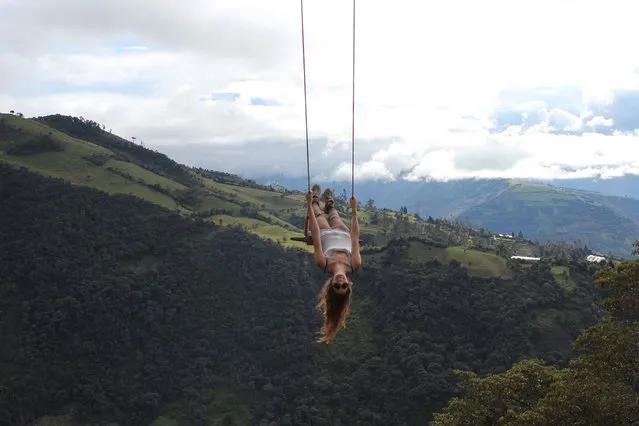
These are the stomach-churning pictures of the swing at the end of the world – a rickety wooden swing hanging over a precipice 2,660 metres above sea level – and not a seatbelt in sight. (Photo by Caters News)

These are the stomach-churning pictures of the swing at the end of the world – a rickety wooden swing hanging over a precipice 2,660 metres above sea level – and not a seatbelt in sight. (Photo by Caters News)
Details
18 May 2014 10:36:00
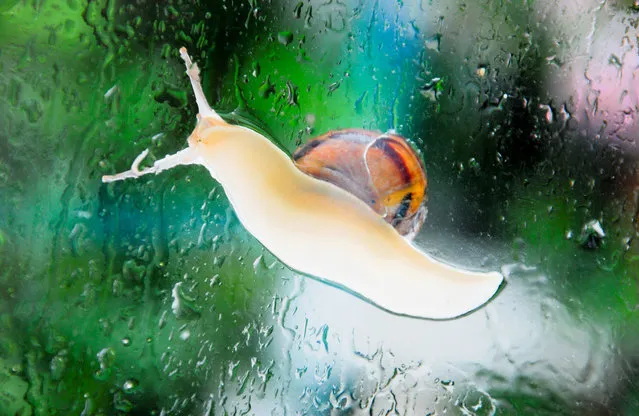
A snail slithers up a rain spattered window during stormy weather on the Isle of Portland, Fortuneswell, England on July 29, 2018. (Photo by Stuart Fretwell/Rex Features/Shutterstock)

A snail slithers up a rain spattered window during stormy weather on the Isle of Portland, Fortuneswell, England on July 29, 2018. (Photo by Stuart Fretwell/Rex Features/Shutterstock)
Details
11 Sep 2018 05:38:00
A man stands by an installation depicting “2019” in the Red Square in Moscow, Russia on December 17, 2018. (Photo by Maxim Shemetov/Reuters)

A man stands by an installation depicting “2019” in the Red Square in Moscow, Russia on December 17, 2018. (Photo by Maxim Shemetov/Reuters)
Details
31 Dec 2018 00:03:00
A labourer rides a donkey cart through a flooded street after heavy monsoon rains in Lahore on August 20, 2020. (Photo by Arif Ali/AFP Photo)

A labourer rides a donkey cart through a flooded street after heavy monsoon rains in Lahore on August 20, 2020. (Photo by Arif Ali/AFP Photo)
Details
29 Aug 2020 00:05:00
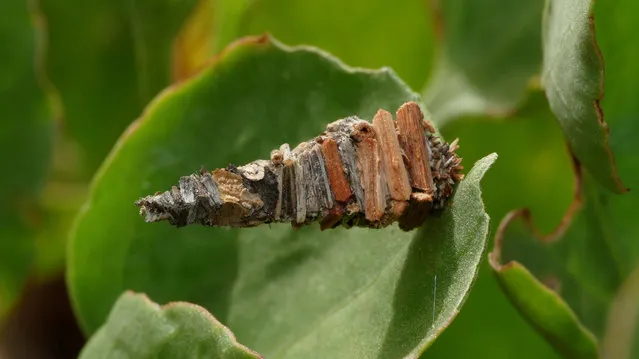
An undated handout photo made available by the Zerynthia Association shows the pupa of an amicta moneiba, a recently discovered species of moth endemic to La Gomera and El Hierro islands in the Canary Islands, Spain (issued 01 July 2020), as those two islands pulled apart from the rest of the Canary Islands 2.5 million years ago. The Institute of Evolutionary Biology of the Spanish National Research Council (CSIC) and the Zerynthia Association have recently discovered two new moth species in El Hierro and La Gomera. (Photo by Yeray Monasterio/Zerynthia/EPA/EFE)

An undated handout photo made available by the Zerynthia Association shows the pupa of an amicta moneiba, a recently discovered species of moth endemic to La Gomera and El Hierro islands in the Canary Islands, Spain (issued 01 July 2020), as those two islands pulled apart from the rest of the Canary Islands 2.5 million years ago. The Institute of Evolutionary Biology of the Spanish National Research Council (CSIC) and the Zerynthia Association have recently discovered two new moth species in El Hierro and La Gomera. (Photo by Yeray Monasterio/Zerynthia/EPA/EFE)
Details
11 Oct 2020 00:01:00