Loading...
Done
Cornish students (R) Nina Brooke, 21 and (L) Bonnie Mably, 20, laugh as they pose for a photograph as they try a Cornish pasty that has been baked as part of the World Cornish Pasty Championships at The Eden Project

“A Cornish pasty, sometimes known as a pastie or British pasty in the United States, is a filled pastry case, associated in particular with Cornwall in Great Britain. It is made by placing the uncooked filling on a flat pastry circle, and folding it to wrap the filling, crimping the edge at the side or top to form a seal. The result is a raised semicircular package”. – Wikipedia

Photo: Cornish students (R) Nina Brooke, 21 and (L) Bonnie Mably, 20, laugh as they pose for a photograph as they try a Cornish pasty that has been baked as part of the World Cornish Pasty Championships at The Eden Project on March 3, 2012 in St Austell, England. (Photo by Matt Cardy/Getty Images)
Details
04 Mar 2012 11:49:00


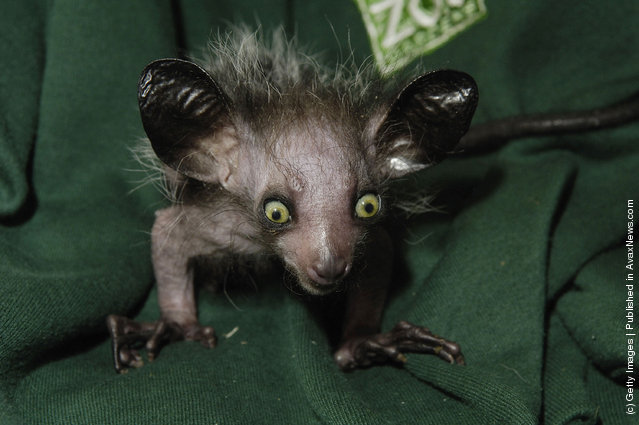
“The aye-aye (Daubentonia madagascariensis) is a lemur, a strepsirrhine primate native to Madagascar that combines rodent-like teeth and a special thin middle finger to fill the same ecological niche as a woodpecker. It is the world's largest nocturnal primate, and is characterized by its unusual method of finding food; it taps on trees to find grubs, then gnaws holes in the wood and inserts its narrow middle finger to pull the grubs out. The only other animal species known to find food in this way is the striped possum. From an ecological point of view the aye-aye fills the niche of a woodpecker as it is capable of penetrating wood to extract the invertebrates within”. – Wikipedia

Photo: In this handout image from Bristol Zoo is seen the first captive bred aye-aye in the UK named “Kintana” (meaning star in Malagasy) April 15, 2005 at Bristol Zoo Gardens, England. The zoo announced today only the second baby aye-aye to be hand-reared in the world (the first was in Jersey Zoo) and has now made his first public appearance since his birth on 11 February 2005. (Photo by Rob Cousins/Bristol Zoo via Getty Images)
Details
13 Apr 2011 13:33:00
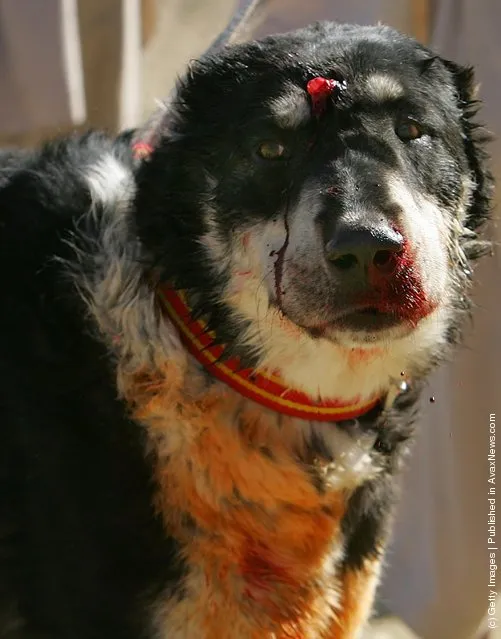
Afghan Dog Fighting

“Dog fighting is a form of blood sport in which game dogs are made to fight, sometimes to the death. It is illegal in most developed countries. Dog fighting is used for entertainment and may also generate revenue from stud fees, admission fees and gambling”. – Wikipedia

Photo: A bloody Afghan dog is bleeding with many wounds after he lost a dog fight November 24, 2006 in Kabul, Afghanistan. While the Afghan government is trying to ban the violent use of dogs for fighting, the unofficial sport remains a regular weekly event. Afghan dog fighting is popular among Afghan men who gamble on the dogs making upwards of 15,000 Afghanie (300 USD). (Photo by Paula Bronstein/Getty Images)
Details
07 Aug 2011 11:47:00
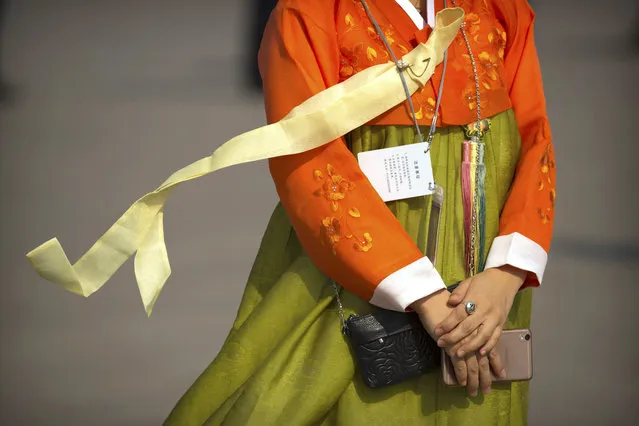
In this Friday, March 3, 2017 photo, a ribbon on a staff member's outfit blows in the breeze as she arrives for the opening session of the Chinese People's Political Consultative Congress (CPPCC) at the Great Hall of the People in Beijing. (Photo by Mark Schiefelbein/AP Photo)

In this Friday, March 3, 2017 photo, a ribbon on a staff member's outfit blows in the breeze as she arrives for the opening session of the Chinese People's Political Consultative Congress (CPPCC) at the Great Hall of the People in Beijing. The annual session of China's ceremonial legislature is designed to awe onlookers with its size and sweep, yet the experience is also made up of tiny moments, details that point to the personalities of the participants and the event's unique, sometimes quirky, traits that a casual observer might easily miss. (Photo by Mark Schiefelbein/AP Photo)
Details
15 Mar 2017 00:05:00
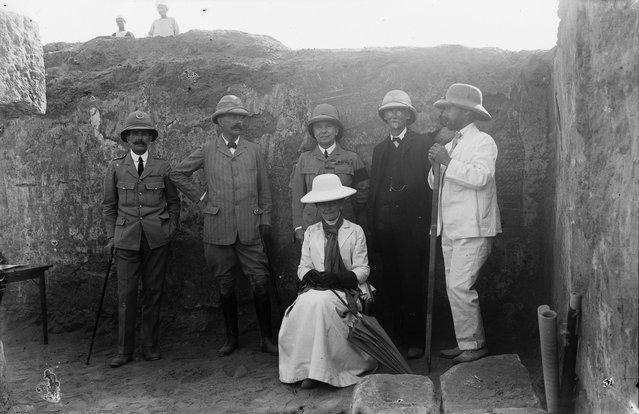
Remarkable discoveries were made, like the decapitated head of a bronze statue of Roman emperor Augustus, sacked from a raid on Roman garrisons further north in Egypt. Here: A group visiting the excavations at Meroë, including (from left) Midwinter Bey, director of Sudan Railways; Lord Kitchener; General Sir Francis Reginald Wingate, Sirdar of the Egyptian Army; Professor Archibald Sayce; John Garstang; and Lady Catherine Wingate, 1911. (Photo by Garstang Museum of Archaeology)

The city of Meroë laid undiscovered for two millennia before British archaeologist John Garstang excavated it in the early 20th century. Garstang took the radical decision to document his discoveries with photography – and immortalised an ancient world. “Meroë: Africa’s Forgotten Empire” is being shown until 14 September at Garstang Museum of Archaeology, Liverpool. Here: A group visiting the excavations at Meroë, including (from left) Midwinter Bey, director of Sudan Railways; Lord Kitchener; General Sir Francis Reginald Wingate, Sirdar of the Egyptian Army; Professor Archibald Sayce; John Garstang; and Lady Catherine Wingate, 1911. (Photo by Garstang Museum of Archaeology)
Details
15 Jun 2016 14:49:00
A giant panda cub is pictured in an incubator at the Ya'an Bifengxia Giant Panda Breeding and Research Center in Ya'an city, southwest China's Sichuan province, 21 August 2015. (Photo by Imaginechina/Splash News)

A giant panda cub is pictured in an incubator at the Ya'an Bifengxia Giant Panda Breeding and Research Center in Ya'an city, southwest China's Sichuan province, 21 August 2015. Ten tiny panda cubs made their first public appearance at China's Ya'an Bifengxia Giant Panda Breeding and Research Center in southwestern Sichuan province on Friday (21 August 2015). All of the ten giant pandas were born in 2015. The oldest of them is just two month old, while the youngest one was born a week ago. This marks the first time they were put together as a group since they were born. (Photo by Imaginechina/Splash News)
Details
23 Aug 2015 09:33:00
Israeli fashion design student from the Shenkar College of Engineering and Design Danit Peleg (R) assists a fashion blogger to wear an outfit from her graduate collection during a conference on 3-D printing in Tel Aviv, Israel September 3, 2015. (Photo by Nir Elias/Reuters)

Israeli fashion design student from the Shenkar College of Engineering and Design Danit Peleg (R) assists a fashion blogger to wear an outfit from her graduate collection during a conference on 3-D printing in Tel Aviv, Israel September 3, 2015. Peleg, 27, says she spent over 2000 hours to create her graduate collection which is made solely from home 3-D printers. International fashion bloggers, taking part in a project supported by “Stand With Us Israel fellowship”, a non-profit organisation, attended the conference and tried on Peleg's clothing before listening to her talk about her collection. (Photo by Nir Elias/Reuters)
Details
05 Sep 2015 12:08:00
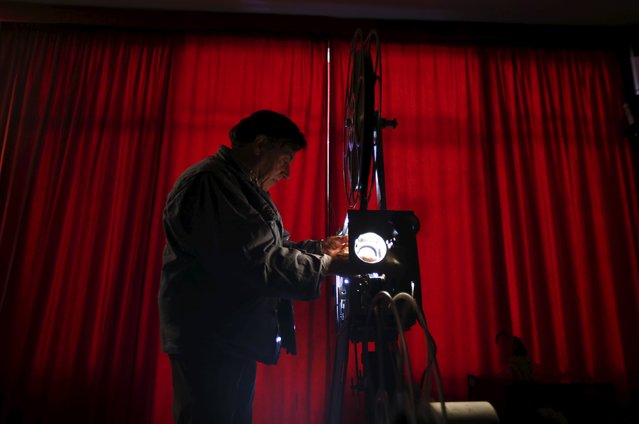
Projectionist Antonio Feliciano, 75, checks his projector before showing a film in Monforte, Portugal May 16, 2015. (Photo by Rafael Marchante/Reuters)

Projectionist Antonio Feliciano, 75, checks his projector before showing a film in Monforte, Portugal May 16, 2015. Shades of Oscar-winning classic "Cinema Paradiso" run through the life of Feliciano, a sprightly 75-year-old who fears he may be the last of Portugal's travelling film projectionists.After six decades travelling four million km (2.5 million miles) to screen 4,000 films in Portugal's far-flung villages, Feliciano does not plan to retire just yet. But he is resigned to the fact that the Internet, digital TV and distribution monopolies have made his craft obsolete. (Photo by Rafael Marchante/Reuters)
Details
12 Nov 2015 08:06:00