Loading...
Done
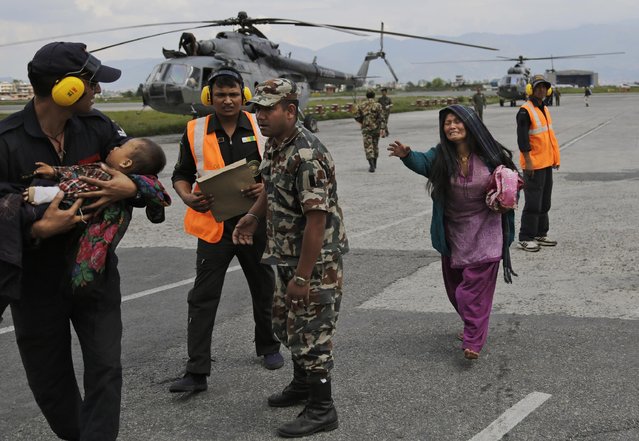
An Indian Air Force person walks carrying a Nepalese child, wounded in Saturday's earthquake, to a waiting ambulance as the mother rushes to join after they were evacuated from a remote area at the airport in Kathmandu, Nepal, Monday, April 27, 2015. (Photo by Altaf Qadri/AP Photo)

An Indian Air Force person walks carrying a Nepalese child, wounded in Saturday's earthquake, to a waiting ambulance as the mother rushes to join after they were evacuated from a remote area at the airport in Kathmandu, Nepal, Monday, April 27, 2015. The death toll from Nepal's earthquake is expected to rise depended largely on the condition of vulnerable mountain villages that rescue workers were still struggling to reach two days after the disaster. (Photo by Altaf Qadri/AP Photo)
Details
28 Apr 2015 13:52:00
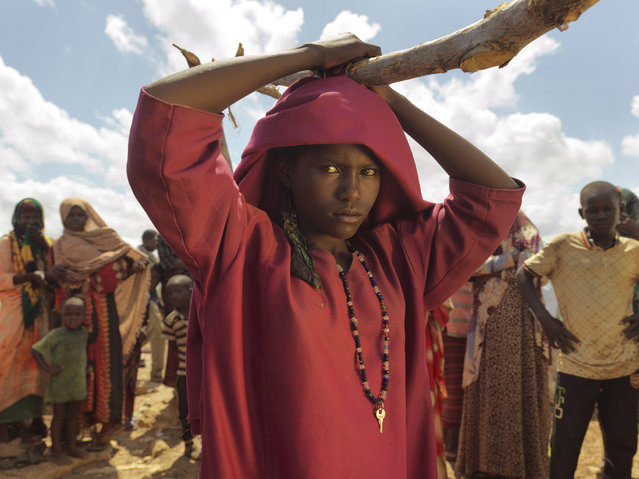
Fadumo Nunow Abdillow, 15, lives at Muuri camp. The UN has appealed for $1.5bn to address the crisis. Just 40% of the money ($611.m) has been received so far. (Photo by Peter Caton/Mercy Corps)

The worst drought in 40 years has a cruel grip on Somalia. A struggling young government and militant violence have compounded to bring crisis to 6.7 million lives. The town of Baidoa is facing some of the harshest conditions. Surrounded by territory controlled by al-Shabaab militants and amid ongoing attacks, 160,000 people have had to leave their farms and are surviving in camps where hunger, thirst and cholera await them. (Photo by Peter Caton/Mercy Corps)
Details
12 Aug 2017 05:47:00
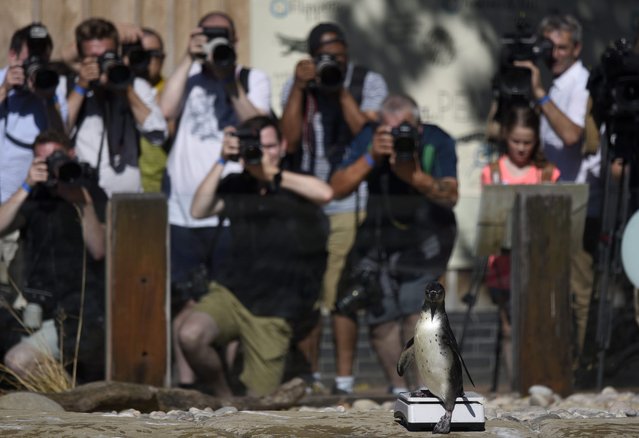
A Humboldt penguin stands on weighing scales whilst being photographed by members of the press during a photocall at the annual weigh-in at London Zoo in London, Britain, 24 August 2016. Every animal that is in the zoo is weighed and measured and the statistics recorded so the data can be shared with zoos across the world. (Photo by Hannah McKay/EPA)

A Humboldt penguin stands on weighing scales whilst being photographed by members of the press during a photocall at the annual weigh-in at London Zoo in London, Britain, 24 August 2016. Every animal that is in the zoo is weighed and measured and the statistics recorded so the data can be shared with zoos across the world. (Photo by Hannah McKay/EPA)
Details
25 Aug 2016 10:06:00
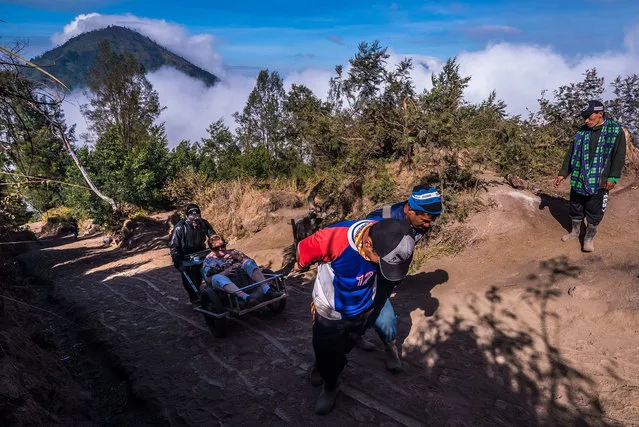
Miners pulling up lazy tourists to the rim of Kawah Ijen (Ijen Volcano), East Java, Indonesia on September 21, 2017. They will earn as much as they would bring down a load of sulfur. Nomadic Explorer, Cultural Lifestyle Photographer Claudio Sieber captured striking images of miners working at Ijen volcanic range in East Java, Indonesia. The sulphur miners risk their lives daily as they climb the active volcano carrying heavy loads, which they sell to sugar refineries. Shortly after midnight curious tourists are flocking in hundreds through the gate of Ijen's foothills to be right on time, driven by the images others took before them. Kawah Ijen is the one of the world's largest acidic volcanic crater lake; famous for its turquoise color as well as the unreal atmosphere it offers during darkness. A dusty path zigzags 3 kilometers up to the crater rim. This doesn't mean anything challenging; in particular, special sights have to be deserved anyway. The irritating smell of sulfur announces the near of the crater's existence. Arriving on the crater's rim the reward for the torture becomes visible. Blue fire darts its tongues through the fumes of sulfur dioxide. Somehow, the spectacle isn't as romantic as expected, since it is also the rough working space of approx. 150 sulfur miners who start their shift at 1 am. Lately, harvesting the abundance of devil's gold received international attention. This did obviously not really improve a miner's lifestyle; neither did it contribute to a better wage. (Photo by Claudio Sieber/Barcroft Images)

Miners pulling up lazy tourists to the rim of Kawah Ijen (Ijen Volcano), East Java, Indonesia on September 21, 2017. They will earn as much as they would bring down a load of sulfur. Nomadic Explorer, Cultural Lifestyle Photographer Claudio Sieber captured striking images of miners working at Ijen volcanic range in East Java, Indonesia. The sulphur miners risk their lives daily as they climb the active volcano carrying heavy loads, which they sell to sugar refineries. (Photo by Claudio Sieber/Barcroft Images)
Details
02 Oct 2017 08:31:00
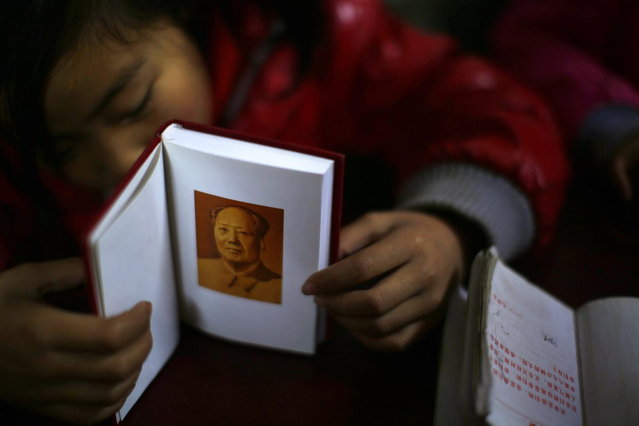
A student falls asleep as she holds a book containing a portrait of China's late chairman Mao Zedong during a lesson at the Democracy Elementary and Middle School in Sitong town, Henan province December 3, 2013. (Photo by Carlos Barria/Reuters)

A student falls asleep as she holds a book containing a portrait of China's late chairman Mao Zedong during a lesson at the Democracy Elementary and Middle School in Sitong town, Henan province December 3, 2013. In a remote part of central China, the day starts at the Democracy Elementary and Middle School with a pre-dawn jog, some revolutionary songs and then an activity long since forgotten at other schools: reciting quotations from Mao Zedong's famed “Little Red Book”. While the ruling Communist Party that Mao led continues to hold him in esteem as the leader of the Communist Revolution, his radical policies and teachings have been largely shelved since his death in 1976 in favour of a pro-market approach that has turned China from a backwater into the world's second biggest economy. The 120th anniversary of Mao's birth is on December 26, 2013. (Photo by Carlos Barria/Reuters)
Details
19 Dec 2013 09:40:00
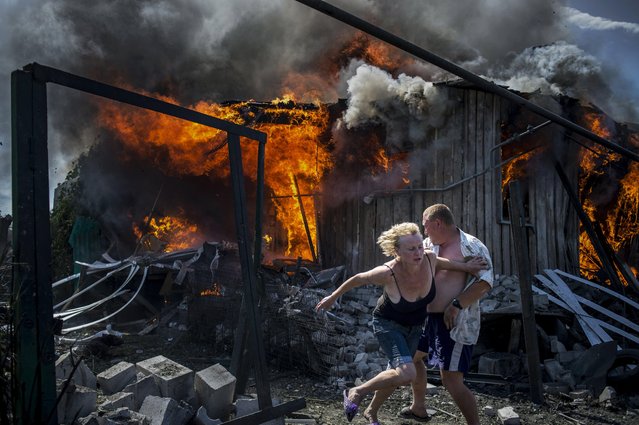
A handout photo made available by the World Press Photo (WPP) organization on 13 February 2017 shows a picture by Rossiya Segodnya photographer Valery Melnikov that won the Long-Term Projects – First Prize award of the 60th annual World Press Photo Contest, it was announced by the WPP Foundation in Amsterdam, The Netherlands on 13 February 2017. Caption: Civilians escape from a fire at a house destroyed by an air attack in the Luhanskaya village. Story: Ordinary people became victims of the conflict between self-proclaimed republics and the official Ukrainian authorities from 2014 onwards in the region of Donbass. Disaster came into their lives unexpectedly. These people were involved in the military confrontation against their will. They experienced the most terrible things: the death of their friends and relatives, destroyed homes and the ruined lives of thousands of people. (Photo by Valery Melnikov/EPA/Rossiya Segodnya/World Press Photo)

A handout photo made available by the World Press Photo (WPP) organization on 13 February 2017 shows a picture by Rossiya Segodnya photographer Valery Melnikov that won the Long-Term Projects – First Prize award of the 60th annual World Press Photo Contest, it was announced by the WPP Foundation in Amsterdam, The Netherlands on 13 February 2017. Caption: Civilians escape from a fire at a house destroyed by an air attack in the Luhanskaya village. (Photo by Valery Melnikov/EPA/Rossiya Segodnya/World Press Photo)
Details
15 Feb 2017 00:06:00
Takeoka Chisaka, Hiroshima, Japan. “One morning in August 1945, I was walking home from the night shift at a factory in Hiroshima. As I reached my door, there was a huge explosion. When I came to, my head was bleeding and I had been blasted 30m away”. (Photo and caption by Sasha Maslov)

Takeoka Chisaka, Hiroshima, Japan. “One morning in August 1945, I was walking home from the night shift at a factory in Hiroshima. As I reached my door, there was a huge explosion. When I came to, my head was bleeding and I had been blasted 30m away. The atomic bomb had detonated. When I found my mother, her eyes were badly burned. A doctor said they had to come out, but he didn’t have the proper tools so used a knife instead. It was hellish. I became a peace-worker after the war. In the 1960s, at a meeting at the UN, I met one of the people who created the atomic bomb. He apologised”. (Photo and caption by Sasha Maslov)
Details
11 May 2015 11:56:00
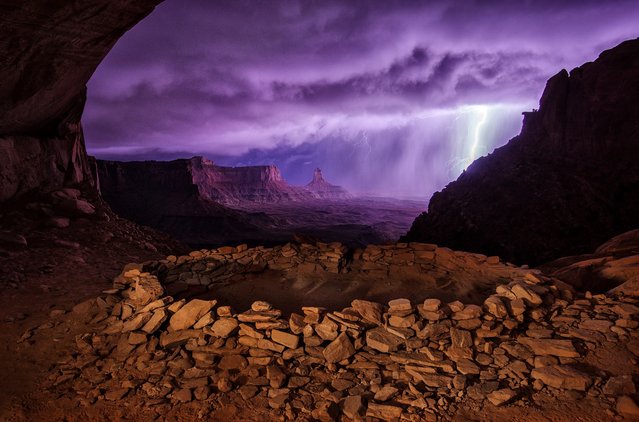
Second Place Winner: “Thunderstorm at False Kiva”. I hiked out to these ruins at night hoping to photograph them with the Milky Way, but instead a thunderstorm rolled through, creating this dramatic image. – Max Seigal. (Photo and caption by Max Seigal/National Geographic Traveler Photo Contest)

Second Place Winner: “Thunderstorm at False Kiva”. I hiked out to these ruins at night hoping to photograph them with the Milky Way, but instead a thunderstorm rolled through, creating this dramatic image. – Max Seigal. National Geographic Traveler Director of Photography Dan Westergren, one of this year's judges, shares his thoughts on the second place winner: “This photo combines two different scenes into one: the small kiva in a cliff dwelling and the grand vista of Canyonlands National Park across the valley. I really like the two different color palettes – warm inside and purple outside. This two-for-one scene was caused by the lightning storm outside the dwelling, which lit up the landscape like it was a huge electronic flash. Looking at this picture I can imagine what a wonderful sight it must have been for the ancient people who lived here. It doesn't seem too amazing now in our modern world, but might have been mind-blowing for the prehistoric residents”. Location: Utah. (Photo and caption by Max Seigal/National Geographic Traveler Photo Contest)
Details
02 Aug 2013 06:16:00