Loading...
Done
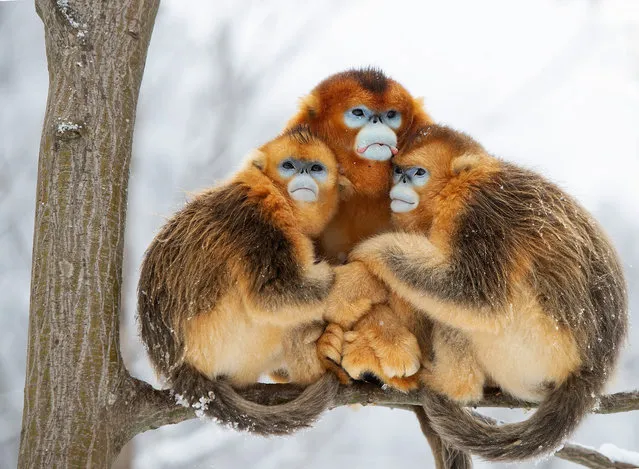
A golden huddle by Minqiang Lu, China. Two females and a male golden snub-nosed monkey huddle together to keep warm in the extreme cold. Threatened by forest loss and fragmentation, this endangered species is confined to central China. Restricted to living high up in the temperate forests, these monkeys – here in the Qinling mountains in Shaanxi province – feed mostly in the trees, on leaves, bark, buds and lichen. In heavy wind and snow, Minqiang walked up the mountain carrying his equipment. He stayed for half an hour in temperatures of –10C opposite the tree where the group was huddled before achieving this eye-level composition. (Photo by Minqiang Lu/Wildlife Photographer of the Year)

A golden huddle by Minqiang Lu, China. Two females and a male golden snub-nosed monkey huddle together to keep warm in the extreme cold. Threatened by forest loss and fragmentation, this endangered species is confined to central China. Restricted to living high up in the temperate forests, these monkeys – here in the Qinling mountains in Shaanxi province – feed mostly in the trees, on leaves, bark, buds and lichen. In heavy wind and snow, Minqiang walked up the mountain carrying his equipment. He stayed for half an hour in temperatures of –10C opposite the tree where the group was huddled before achieving this eye-level composition. (Photo by Minqiang Lu/Wildlife Photographer of the Year)
Details
12 Jan 2023 01:19:00
In this Thursday, April 11, 2013 photo, North Korean female soldiers stand watch on the river bank of the North Korean town of Sinuiju, opposite to the Chinese border city of Dandong. (Photo by AP Photo)

In this Thursday, April 11, 2013 photo, North Korean female soldiers stand watch on the river bank of the North Korean town of Sinuiju, opposite to the Chinese border city of Dandong. (Photo by AP Photo)
Details
22 May 2013 13:28:00
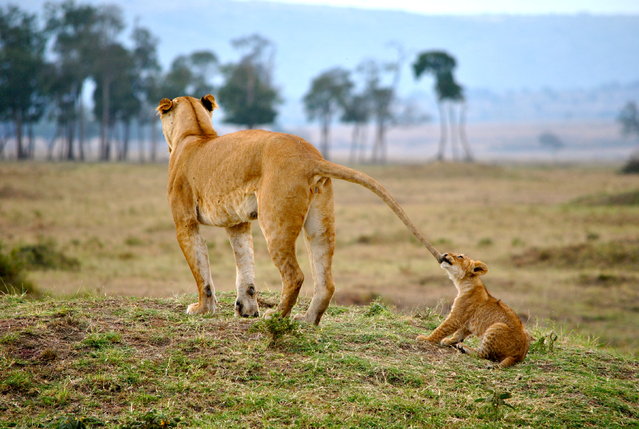
“A Mothers Tail”. A baby cub pulls on his mother's tail to get attention. Photo location: Masai Mara, Kenya. (Photo and caption by Tori Marsh/National Geographic Photo Contest)

“A Mothers Tail”. A baby cub pulls on his mother's tail to get attention. Photo location: Masai Mara, Kenya. (Photo and caption by Tori Marsh/National Geographic Photo Contest)
Details
21 Oct 2014 12:40:00
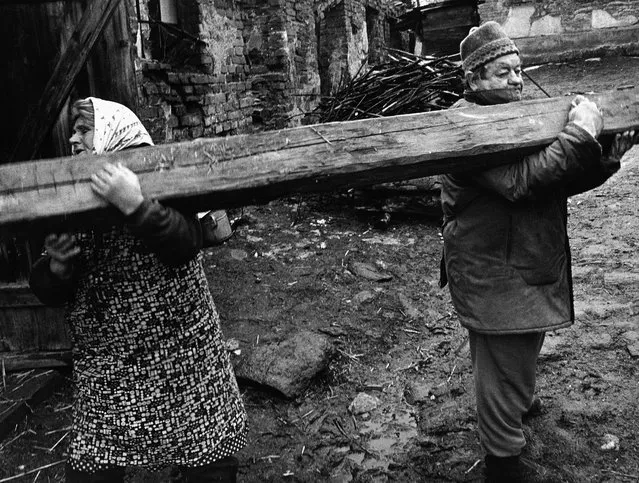
A love story with two log choppers. “In 1993, I was working on a project about life in the Olomouc region of Czechoslovakia. One day, I came to the village of Dlouhá Loučka-Křivá and went into a courtyard where I saw two old people, a husband and wife, sawing firewood for winter. They were working quietly, concentrating. I watched them fetch a beam from a wrecked barn, but they didn’t discuss how they planned to carry it to the saw. The woman faced one way, the man the other. When they realised, the woman eventually turned and followed her husband. The picture I took is the picture of many relationships – when each partner wants something different, but they have to come to an agreement, pull together eventually”. (Photo by Jindrich Streit)

A love story with two log choppers. “In 1993, I was working on a project about life in the Olomouc region of Czechoslovakia. One day, I came to the village of Dlouhá Loučka-Křivá and went into a courtyard where I saw two old people, a husband and wife, sawing firewood for winter. They were working quietly, concentrating. I watched them fetch a beam from a wrecked barn, but they didn’t discuss how they planned to carry it to the saw. The woman faced one way, the man the other. When they realised, the woman eventually turned and followed her husband. The picture I took is the picture of many relationships – when each partner wants something different, but they have to come to an agreement, pull together eventually”. (Photo by Jindrich Streit)
Details
04 Aug 2016 12:34:00
A boy fires confetti poppers as he participates in a procession to mark Eid-e-Milad-ul-Nabi, the birthday celebration of Prophet Mohammad, in Mumbai January 4, 2015. (Photo by Danish Siddiqui/Reuters)

A boy fires confetti poppers as he participates in a procession to mark Eid-e-Milad-ul-Nabi, the birthday celebration of Prophet Mohammad, in Mumbai January 4, 2015. (Photo by Danish Siddiqui/Reuters)
Details
05 Jan 2015 13:20:00
Hikers walk to reach the top of Naqba Rum area in South Sinai, Egypt, November 20, 2015. (Photo by Asmaa Waguih/Reuters)

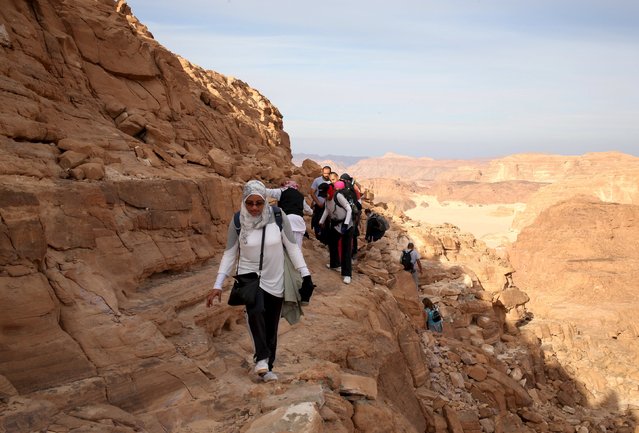
Hikers walk to reach the top of Naqba Rum area in South Sinai, Egypt, November 20, 2015. Bedouins in the "Sinai is Safe" group guided more than 100 hikers over a 25 km (15 mile) trek over the trails of the White Canyon and the Closed Canyon. The NGO aims to challenge mainstream perceptions of the area by encouraging Nile Valley residents to explore the untamed wilderness with the Bedouin tribes. (Photo by Asmaa Waguih/Reuters)
Details
03 Dec 2015 08:00:00
Star Wars collector James Burns, 44, poses for a photograph with some of his collection in London December 2, 2015. He said “I've met so many wonderful people, all over the world. It's a wonderful community of likeminded people with an interest in Star Wars. There's nothing else like it”. (Photo by Paul Hackett/Reuters)

Star Wars collector James Burns, 44, poses for a photograph with some of his collection in London December 2, 2015. He said “I've met so many wonderful people, all over the world. It's a wonderful community of likeminded people with an interest in Star Wars. There's nothing else like it”. (Photo by Paul Hackett/Reuters)
Details
17 Dec 2015 08:03:00
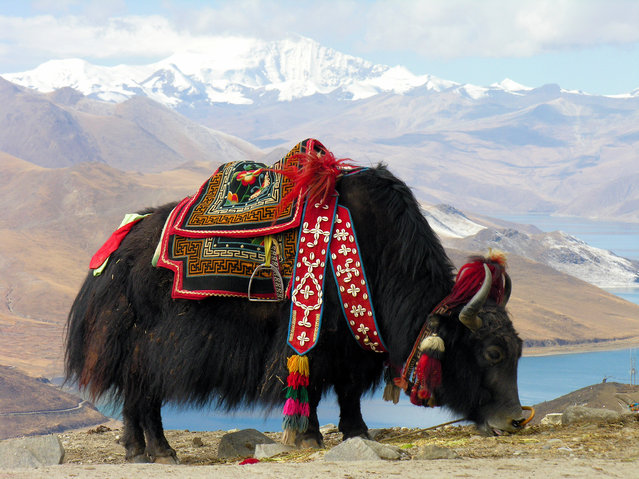
Yak near Yamdrok lake, Tibet. It is a long-haired bovinae found throughout the Himalayan region of south Central Asia, the Tibetan Plateau and as far north as Mongolia and Russia. The Tibetan economy is dominated by subsistence agriculture. Due to limited arable land, the primary occupation of the Tibetan Plateau is raising livestock, such as sheep, cattle, goats, camels, yaks, dzo, and horses. The Tibetan yak is an integral part of Tibetan life. (Photo by Dennis Jarvis)

Yak near Yamdrok lake, Tibet. It is a long-haired bovinae found throughout the Himalayan region of south Central Asia, the Tibetan Plateau and as far north as Mongolia and Russia. The Tibetan economy is dominated by subsistence agriculture. Due to limited arable land, the primary occupation of the Tibetan Plateau is raising livestock, such as sheep, cattle, goats, camels, yaks, dzo, and horses. The Tibetan yak is an integral part of Tibetan life. (Photo by Dennis Jarvis)
Details
10 Jun 2015 10:48:00