Loading...
Done
Kiyomura Co's President Kiyoshi Kimura (C), who runs a chain of sushi restaurants Sushi Zanmai, poses with a 212 kg (467 lbs) bluefin tuna at his sushi restaurant outside Tsukiji fish market in Tokyo, Japan, January 5, 2017. Kimura won the bid for the tuna caught off Oma, Aomori prefecture, northern Japan, with a 74 million yen (633,000 USD) at the fish market's first tuna auction this year. (Photo by Issei Kato/Reuters)

Kiyomura Co's President Kiyoshi Kimura (C), who runs a chain of sushi restaurants Sushi Zanmai, poses with a 212 kg (467 lbs) bluefin tuna at his sushi restaurant outside Tsukiji fish market in Tokyo, Japan, January 5, 2017. Kimura won the bid for the tuna caught off Oma, Aomori prefecture, northern Japan, with a 74 million yen (633,000 USD) at the fish market's first tuna auction this year. (Photo by Issei Kato/Reuters)
Details
06 Jan 2017 13:49:00
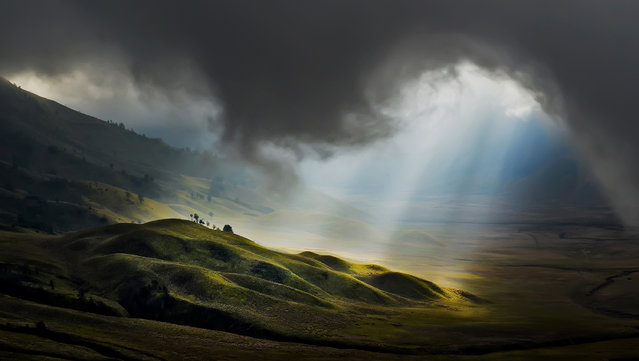
“Light From Heaven”. Taken around Mount Bromo, East Java, Indonesia in the morning. Photo location: East Java, Indonesia. (Photo and caption by Pimpin Nagawan/National Geographic Photo Contest)

“Light From Heaven”. Taken around Mount Bromo, East Java, Indonesia in the morning. Photo location: East Java, Indonesia. (Photo and caption by Pimpin Nagawan/National Geographic Photo Contest)

ATTENTION! All pictures are presented in high resolution. To see Hi-Res images – just TWICE click on any picture. In other words, click small picture – opens the BIG picture. Click BIG picture – opens VERY BIG picture.
Details
29 Nov 2013 12:36:00
In this Tuesday, March 31, 2015 photo, Indian women walk carrying firewood they collected from a forest at Gobhali village on the outskirts of Gauhati, India. Every evening, hundreds of millions of Indian women hover over crude stoves making dinner for their families. They feed the flames with polluting fuels like kerosene or cow dung, and breathe the acrid smoke wafting from the fires. (Photo by Anupam Nath/AP Photo)

In this Tuesday, March 31, 2015 photo, Indian women walk carrying firewood they collected from a forest at Gobhali village on the outskirts of Gauhati, India. Every evening, hundreds of millions of Indian women hover over crude stoves making dinner for their families. They feed the flames with polluting fuels like kerosene or cow dung, and breathe the acrid smoke wafting from the fires. (Photo by Anupam Nath/AP Photo)
Details
16 Apr 2015 12:29:00
Indigenous women participate in the Hanal Pixan (Food of the Souls), in the community of Tres Reyes, Quintana Roo state, Mexico, 31 October 2022. With the Hanal Pixan, the celebration of the Day of the Dead begins Monday to remember people's loved ones in the State of Quintana. (Photo by Alonso Cupul/EPA/EFE)

Indigenous women participate in the Hanal Pixan (Food of the Souls), in the community of Tres Reyes, Quintana Roo state, Mexico, 31 October 2022. With the Hanal Pixan, the celebration of the Day of the Dead begins Monday to remember people's loved ones in the State of Quintana. (Photo by Alonso Cupul/EPA/EFE)
Details
10 Dec 2022 04:39:00
The space shuttle Endeavour is transported to the California Science Center in Exposition Park from Los Angeles International Airport (LAX)  in Los Angeles, California. (Photo by Kevork Djansezian)

The space shuttle Endeavour is transported to the California Science Center in Exposition Park from Los Angeles International Airport (LAX) in Los Angeles, California. (Photo by Kevork Djansezian)
Details
14 Oct 2012 09:18:00
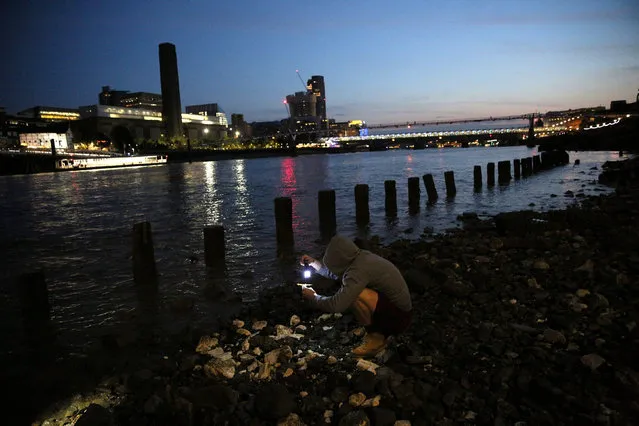
A mudlark uses a torch to look for items on the bank of the River Thames in London, Britain June 06, 2016. Mudlarking is believed to trace its origins to the 18th and 19th century, when scavengers searched the Thames' shores for items to sell. These days, history and archaeology fans are the ones hoping to find old relics such as coins, ceramics, artifacts or everyday items from across centuries. They wait for the low tide and then scour specific areas of exposed shores. "If you're in a field you could be out all day long, with the river you're restricted to about two or three hours," mudlark Nick Stevens said. While many just use the naked eye for their searches, others rely on metal detectors for which a permit from the Port of London Authority is needed. Digging also requires consent. (Photo by Neil Hall/Reuters)

A mudlark uses a torch to look for items on the bank of the River Thames in London, Britain June 06, 2016. Mudlarking is believed to trace its origins to the 18th and 19th century, when scavengers searched the Thames' shores for items to sell. These days, history and archaeology fans are the ones hoping to find old relics such as coins, ceramics, artifacts or everyday items from across centuries. their finds with the Portable Antiquities Scheme. Any item over 300 years old must be recorded. (Photo by Neil Hall/Reuters)
Details
27 Aug 2016 10:43:00
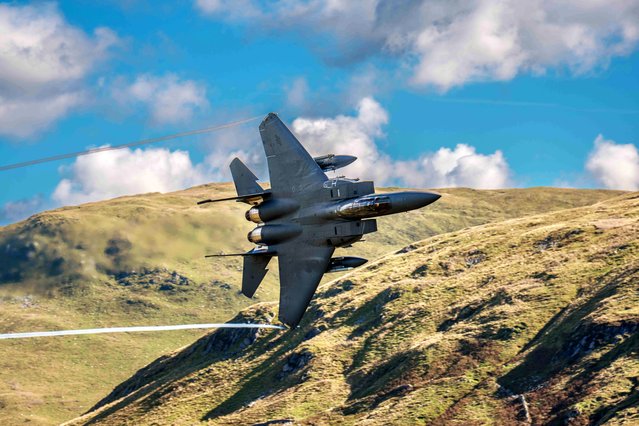
A military aircraft flies low through the Mach Loop in west-central Wales on September 25, 2025 during Cobra Warrior 25-2, one of Nato’s largest multinational air exercises. The operation, running across the UK until October 3, brings together air forces from the UK, US, Canada, Italy and Germany for three weeks of high-intensity training in challenging low-level environments. (Photo by Tony Marsh)

A military aircraft flies low through the Mach Loop in west-central Wales on September 25, 2025 during Cobra Warrior 25-2, one of Nato’s largest multinational air exercises. The operation, running across the UK until October 3, brings together air forces from the UK, US, Canada, Italy and Germany for three weeks of high-intensity training in challenging low-level environments. (Photo by Tony Marsh)
Details
15 Nov 2025 03:07:00
A fuel cell electric vehicle (FCEV) by Nissan is shown at China (Guangzhou) International Automobile Exhibition in Guangzhou, China November 18, 2016. (Photo by Bobby Yip/Reuters)

A fuel cell electric vehicle (FCEV) by Nissan is shown at China (Guangzhou) International Automobile Exhibition in Guangzhou, China November 18, 2016. (Photo by Bobby Yip/Reuters)
Details
19 Nov 2016 10:58:00