Loading...
Done
English television personality, Love Island's Faye Winter is seen painted as a Killer Whale as part of a PETA protest photocall for marine animals in London's Piccadilly Circus on November 18, 2022. (Photo by The Mega Agency)

English television personality, Love Island's Faye Winter is seen painted as a Killer Whale as part of a PETA protest photocall for marine animals in London's Piccadilly Circus on November 18, 2022. (Photo by The Mega Agency)
Details
16 Jan 2024 17:19:00
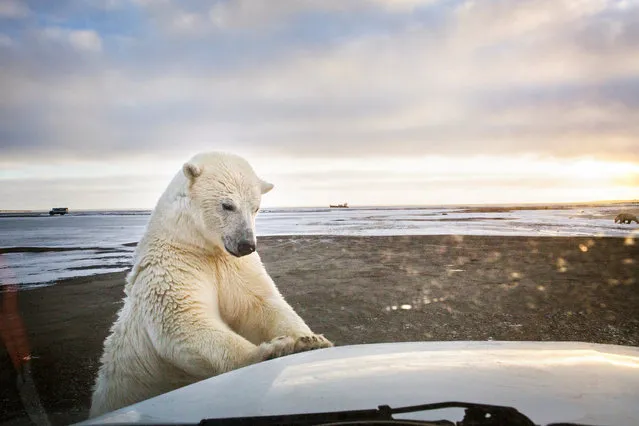
In late summer and early autumn polar bears flock to the native village of Kaktovik in the Alaskan Arctic to eat at “the boneyard” – the remains of whales annually hunted by the community. (Photo by Katie Orlinsky/Getty Images)

A selection of work by four photojournalists who have won grants of $10,000 and editorial support from the agency. Here: “Chasing Winter” by Katie Orlinksy. In late summer and early autumn polar bears flock to the native village of Kaktovik in the Alaskan Arctic to eat at “the boneyard” – the remains of whales annually hunted by the community. (Photo by Katie Orlinsky/Getty Images)
Details
02 Sep 2016 13:55:00
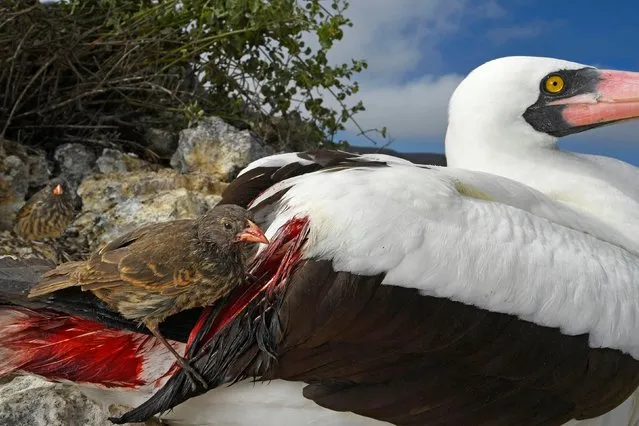
Bloodthirsty by Thomas P Peschak, Germany/South Africa — winner, Behaviour: birds. When rations run short on Wolf Island, in the remote northern Galápagos, the sharp-beaked ground finches become vampires. Their sitting targets are Nazca boobies and other large birds. The finches rely on a scant diet of seeds and insects, which regularly dries up, so they drink blood to survive. ‘I’ve seen more than half a dozen finches drinking from a single Nazca booby,’ says Tom. Rather than leave their nests the boobies tolerate the vampires, and the blood loss doesn’t seem to cause permanent harm. (Photo by Thomas P Peschak/2018 Wildlife Photographer of the Year)

Bloodthirsty by Thomas P. Peschak, Germany/South Africa — winner, Behaviour: birds. When rations run short on Wolf Island, in the remote northern Galápagos, the sharp-beaked ground finches become vampires. Their sitting targets are Nazca boobies and other large birds. The finches rely on a scant diet of seeds and insects, which regularly dries up, so they drink blood to survive. ‘I’ve seen more than half a dozen finches drinking from a single Nazca booby,’ says Tom. Rather than leave their nests the boobies tolerate the vampires, and the blood loss doesn’t seem to cause permanent harm. (Photo by Thomas P. Peschak/2018 Wildlife Photographer of the Year)
Details
19 Oct 2018 00:05:00
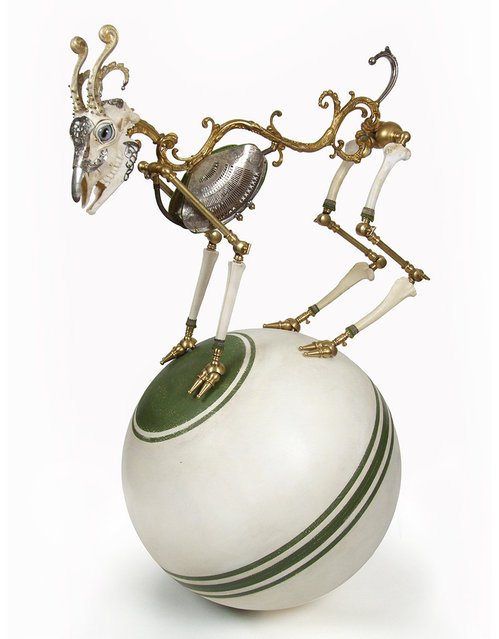
Sculpture By Jessica Joslin

More great and peculiar work from Chicago based sculptor Jessica Joslin. Joslin assembles her hybrid creatures from objects found in obscure junk shops, flea markets, attics, taxidermy supply houses, specialty hardware distributors…or even just walking through the woods. “Miniature machine bolts, springs and couplings comprise anatomical structures. Many of the beasts have hidden movements: a spring loaded beak, snapping jaws, jointed legs and adjustable tails. Some creatures are free-standing but have mechanisms to allow for movement or multiple positions.”
Details
03 Nov 2013 14:28:00


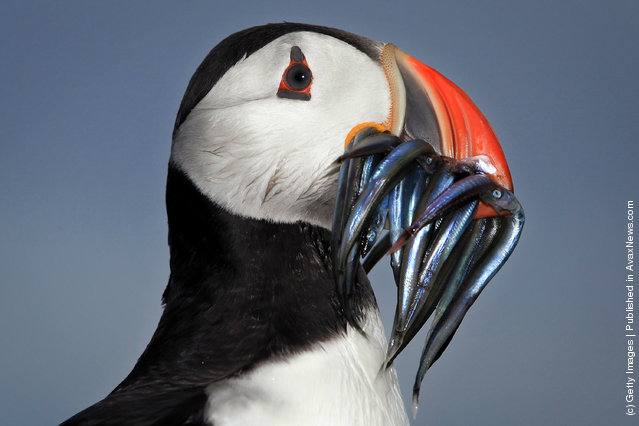
A Puffin returns to it's nest with a beak full of sand eels on June 25, 2011 on Inner Farne, England. The Farne Islands, which are run by the National Trust, are situated two to three miles off the Northumberland coastline. The archipeligo of 16-28 separate islands (depending on the tide) make the summer home to approximately 100,000 pairs of breeding seabirds including around 36,000 Puffins, 32,000 Guillemots and 2,000 pairs of Arctic Terns. The species of birds which nest in internationally important numbers include Shag, Sandwich Tern and Arctic Tern. The coastline around The Farnes are also the breeding ground to one of Europe's largest Grey Seal colonies with around 4,000 adults giving birth to 1500 pups every year. (Photo by Dan Kitwood/Getty Images)

Details
27 Jun 2011 12:58:00
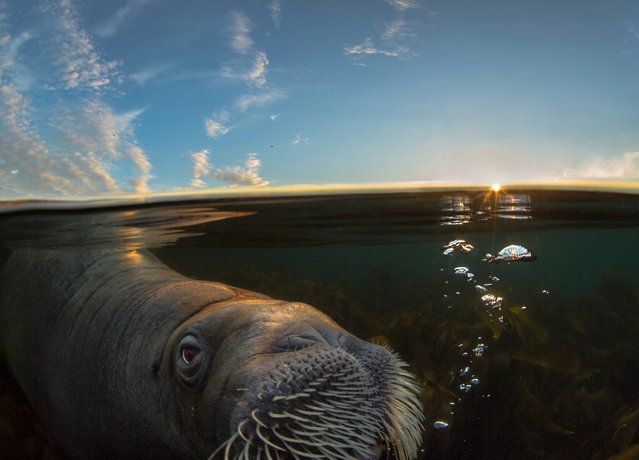
The Wildscreen festival is the world’s biggest celebration of screen-based natural history storytelling which takes place every two years in Bristol. Here: “Walrus in Midnight Sun”. Walrus feed mostly on bivalves in productive, shallow and often sandy habitats in the Arctic. This individual, though, arrived on a beach outside Tromsø, northern Norway, and found comfort on a stranded dead sperm whale. After two weeks he approached Audun, and only half a metre away he stretched his tusk forward and touched his hand gently. “This was one of the most memorable moments of my life”, Rikardsen says. He named the 500kg male Buddy. After two months, the dead whale was decomposed and Buddy suddenly disappeared. (Photo by Audun Rikardsen/Wildscreen 2016)

The Wildscreen festival is the world’s biggest celebration of screen-based natural history storytelling which takes place every two years in Bristol. Here: “Walrus in Midnight Sun”. Walrus feed mostly on bivalves in productive, shallow and often sandy habitats in the Arctic. This individual, though, arrived on a beach outside Tromsø, northern Norway, and found comfort on a stranded dead sperm whale. After two weeks he approached Audun, and only half a metre away he stretched his tusk forward and touched his hand gently. “This was one of the most memorable moments of my life”, Rikardsen says. He named the 500kg male Buddy. After two months, the dead whale was decomposed and Buddy suddenly disappeared. (Photo by Audun Rikardsen/Wildscreen 2016)
Details
07 Oct 2016 10:02:00
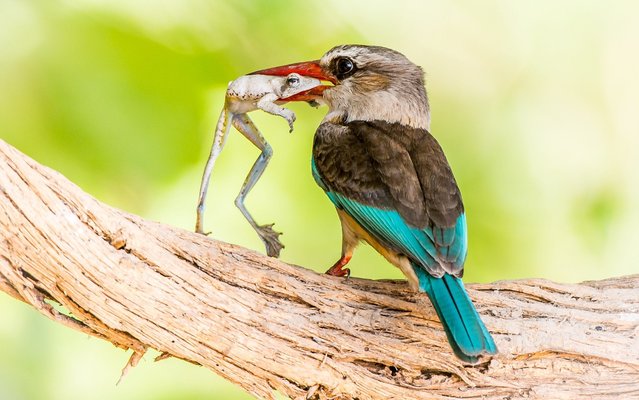
A brown-hooded kingfisher sits on a branch with a freshly caught frog in it's beak. Riaan Marais who took the photo said, “We were doing a boat safari on the Rufiji river in Selous Game Reserve, Tanzania when I spotted the bird with the frog on an overhanging branch on the river bank. It most probably caught the frog in the reeds along the river’s edge as this is where these frogs stay. The kingfisher must have caught the Common Reed Frog just before I took the image, as the frog was still alive, I had a brief moment to take the image before the bird flew off with the frog”. (Photo by Riaan Marais/Solent News and Photo Agency)

A brown-hooded kingfisher sits on a branch with a freshly caught frog in it's beak. Riaan Marais who took the photo said, “We were doing a boat safari on the Rufiji river in Selous Game Reserve, Tanzania when I spotted the bird with the frog on an overhanging branch on the river bank. It most probably caught the frog in the reeds along the river’s edge as this is where these frogs stay. The kingfisher must have caught the Common Reed Frog just before I took the image, as the frog was still alive, I had a brief moment to take the image before the bird flew off with the frog”. (Photo by Riaan Marais/Solent News and Photo Agency)
Details
10 Jun 2018 00:03:00
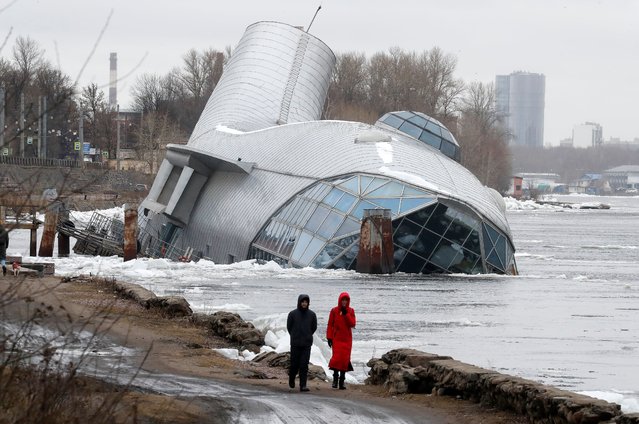
People pass by the floating restaurant “Silver Whale” which partially sank during ice drift on the Neva River in St. Petersburg, Russia, 27 March 2023. Rescuers try to secure it with ropes so that the restaurant is not swept away by the river. The temperatures have reached zero degrees Celsius in the second largest city of Russia. (Photo by Anatoly Maltsev/EPA/EFE/Rex Features/Shutterstock)

People pass by the floating restaurant “Silver Whale” which partially sank during ice drift on the Neva River in St. Petersburg, Russia, 27 March 2023. Rescuers try to secure it with ropes so that the restaurant is not swept away by the river. The temperatures have reached zero degrees Celsius in the second largest city of Russia. (Photo by Anatoly Maltsev/EPA/EFE/Rex Features/Shutterstock)
Details
26 Apr 2023 03:05:00