Loading...
Done
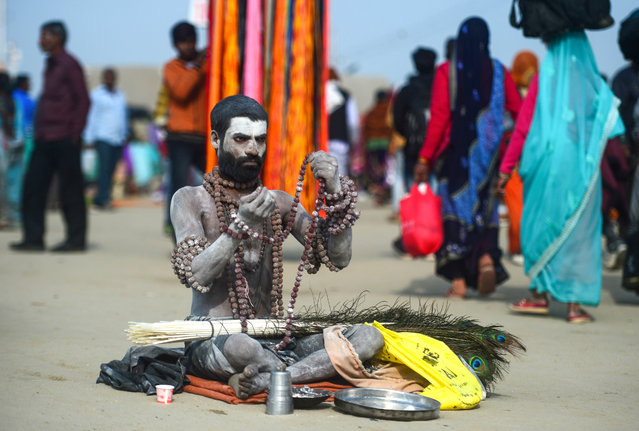
An Indian sadhu (Hindu holy man) sits on the banks of Sangam – the confluence of the Ganges, Yamuna and mythical Saraswati rivers – on the auspicious bathing day of 'Maghi Purnima' during the Kumbh Mela festival in Allahabad on February 19, 2019. Millions of Hindu pilgrims took the plunge in holy rivers on the most auspicious bathing days of the Kumbh Mela festival, led by naked, ash-smeared holy men and accompanied by chants from Hindu holy texts. (Photo by Sanjay Kanojia/AFP Photo)

An Indian sadhu (Hindu holy man) sits on the banks of Sangam – the confluence of the Ganges, Yamuna and mythical Saraswati rivers – on the auspicious bathing day of 'Maghi Purnima' during the Kumbh Mela festival in Allahabad on February 19, 2019. Millions of Hindu pilgrims took the plunge in holy rivers on the most auspicious bathing days of the Kumbh Mela festival, led by naked, ash-smeared holy men and accompanied by chants from Hindu holy texts. (Photo by Sanjay Kanojia/AFP Photo)
Details
16 Mar 2019 00:05:00
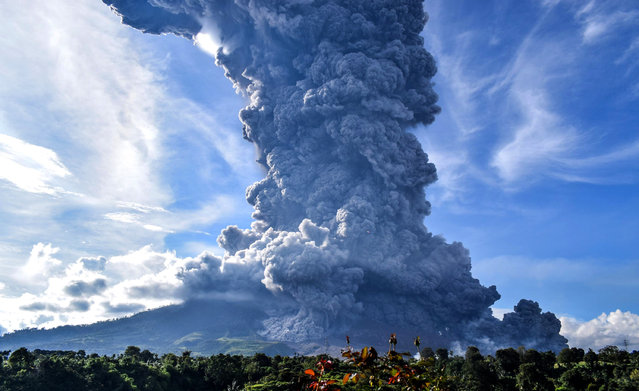
Sinabung mountain spews volcanic smoke in Tiga Pancur Village, Karo, North Sumatra, Indonesia, 09 June 2019. According to BNPB, Mount Sinabung erupted, blowing volcanic ash more than 7,000 meters high. Sinabung is one of the most active volcanos in Indonesia. It erupted in 2010 and since then killed 17 people in eruptions in 2014 and another nine people in 2016. (Photo by Sarianto Sembiring/EPA/EFE)

Sinabung mountain spews volcanic smoke in Tiga Pancur Village, Karo, North Sumatra, Indonesia, 09 June 2019. According to BNPB, Mount Sinabung erupted, blowing volcanic ash more than 7,000 meters high. Sinabung is one of the most active volcanos in Indonesia. It erupted in 2010 and since then killed 17 people in eruptions in 2014 and another nine people in 2016. (Photo by Sarianto Sembiring/EPA/EFE)
Details
12 Jun 2019 00:01:00
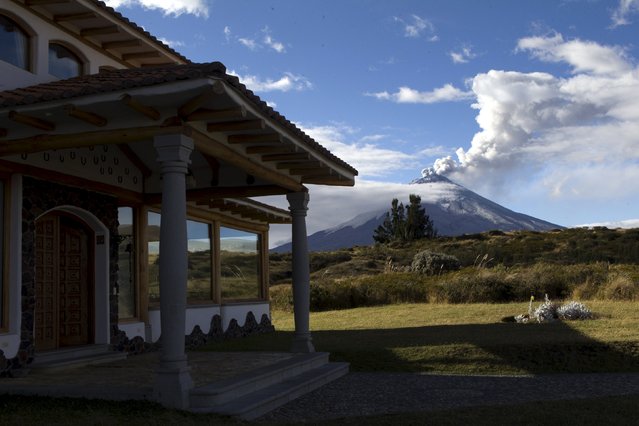
The Cotopaxi volcano, one of the world's highest active volcanoes, spews smoke as seen from El Pedregal, Ecuador, October 22, 2015. (Photo by Guillermo Granja/Reuters)

The Cotopaxi volcano, one of the world's highest active volcanoes, spews smoke as seen from El Pedregal, Ecuador, October 22, 2015. Ecuadorian authorities are monitoring activity at Cotopaxi volcano, which prompted Ecuador's President Rafael Correa to maintain a yellow alert for eruptions as bursts of ash keep spewing from the snow-encircled crater of the volcano and falling in gusts on residential communities. (Photo by Guillermo Granja/Reuters)
Details
25 Oct 2015 08:05:00
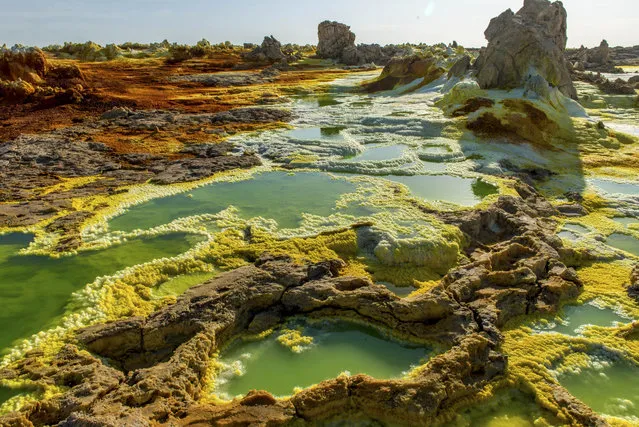
Despite the amazing sight, Netal said that seeing the pools came with a downside. “The smell was horrible, and it was difficult to breath”. (Photo by Neta Dekel/Caters News Agency)

These stunning images show the beauty and drama of Mother Nature at work. Captured deep in heart of the Danakil Desert in East Africa, the images show the acid pools near the Erta Ale volcano. Pools of brightly colored acid can be seen amid the dramatic blast of volcanic ash. The photos were taken by Neta Dekel, an Israeli photographer. He the acid pools were one of the most extraordinary sights he had ever seen. (Photo by Neta Dekel/Caters News Agency)
Details
27 Jun 2018 00:03:00
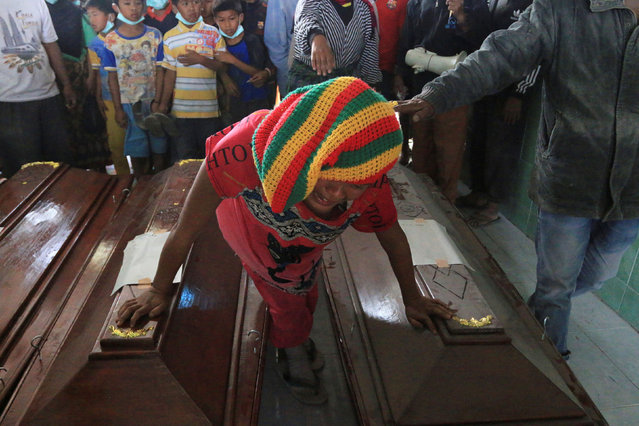
A woman mourns over the coffin of a relative after a deadly eruption of Mount Sinabung in Sukandebi village, Karo, North Sumatra, Indonesia May 22, 2016, in this photo taken by Antara Foto. (Photo by Irsan Mulyadi/Reuters/Antara Foto)

A woman mourns over the coffin of a relative after a deadly eruption of Mount Sinabung in Sukandebi village, Karo, North Sumatra, Indonesia May 22, 2016, in this photo taken by Antara Foto. The volcano in western Indonesian unleashed hot clouds of ash on Saturday, killing several villagers, an official said. (Photo by Irsan Mulyadi/Reuters/Antara Foto)
Details
23 May 2016 09:48:00
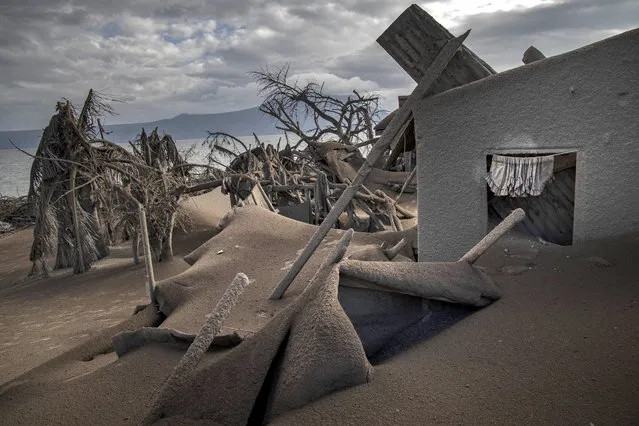
Houses near Taal Volcano's crater are seen buried in volcanic ash from the volcano's eruption on January 14, 2020 in Taal Volcano Island, Batangas province, Philippines. The Philippine Institute of Volcanology and Seismology raised the alert level to four out of five, warning that a hazardous eruption could take place anytime, as authorities have evacuated tens of thousands of people from the area. An estimated $10 million worth of crops and livestock have been damaged by the on-going eruption, according to the country's agriculture department. (Photo by Ezra Acayan/Getty Images)

Houses near Taal Volcano's crater are seen buried in volcanic ash from the volcano's eruption on January 14, 2020 in Taal Volcano Island, Batangas province, Philippines. The Philippine Institute of Volcanology and Seismology raised the alert level to four out of five, warning that a hazardous eruption could take place anytime, as authorities have evacuated tens of thousands of people from the area. An estimated $10 million worth of crops and livestock have been damaged by the on-going eruption, according to the country's agriculture department. (Photo by Ezra Acayan/Getty Images)
Details
18 Jan 2020 00:03:00
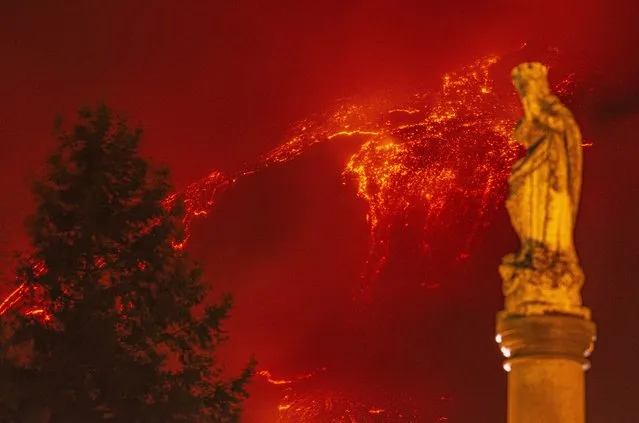
Mount Etna erupts near Sicily, Italy on March 15, 2021. This is the thirteenth time in twenty-eight days. During the early evening of 14 March and the night between 14 and 15 March a strombolian activity at the Southeast Crater gradually increased, leading to a paroxysmal event which had its peak around 01:00 am, ash blown by the wind touched the south-southeast slope of the volcano reaching also Catania, the event ceased completely around 3:45, photo taken from Milo near Catania on March 15, 2021. (Photo by Salvatore Allegra/Anadolu Agency via Getty Images)

Mount Etna erupts near Sicily, Italy on March 15, 2021. This is the thirteenth time in twenty-eight days. During the early evening of 14 March and the night between 14 and 15 March a strombolian activity at the Southeast Crater gradually increased, leading to a paroxysmal event which had its peak around 01:00 am, ash blown by the wind touched the south-southeast slope of the volcano reaching also Catania, the event ceased completely around 3:45, photo taken from Milo near Catania on March 15, 2021. (Photo by Salvatore Allegra/Anadolu Agency via Getty Images)
Details
24 Mar 2021 10:25:00
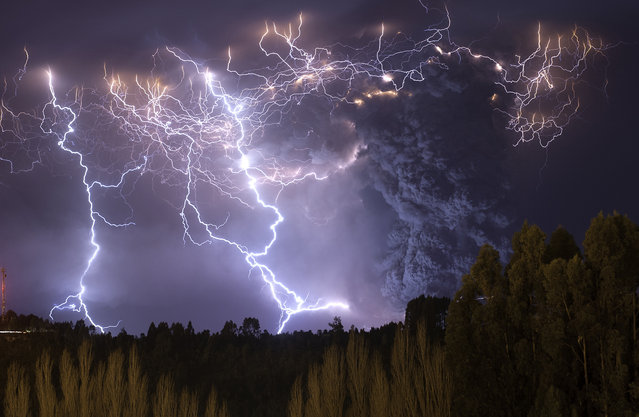
The eruption of Cordon Caulle began on June 4, 2011, located in the Region of Los Rios in Chile. For about 12 months, people and animals became accustomed to living with the daily fall of ash, which also caused problems in the air traffic in South America. The explosions and lightning during first days of the eruption could be seen from hundreds of miles around. This photograph was taken on the second night of eruption from the town of Lago Ranco. (Photo and caption by Francisco Negroni/National Geographic Traveler Photo Contest)

The eruption of Cordon Caulle began on June 4, 2011, located in the Region of Los Rios in Chile. For about 12 months, people and animals became accustomed to living with the daily fall of ash, which also caused problems in the air traffic in South America. The explosions and lightning during first days of the eruption could be seen from hundreds of miles around. This photograph was taken on the second night of eruption from the town of Lago Ranco. (Photo and caption by Francisco Negroni/National Geographic Traveler Photo Contest)

ATTENTION! All pictures are presented in high resolution. To see Hi-Res images – just TWICE click on any picture. In other words, click small picture – opens the BIG picture. Click BIG picture – opens VERY BIG picture.
Details
23 Jun 2013 11:24:00