Loading...
Done
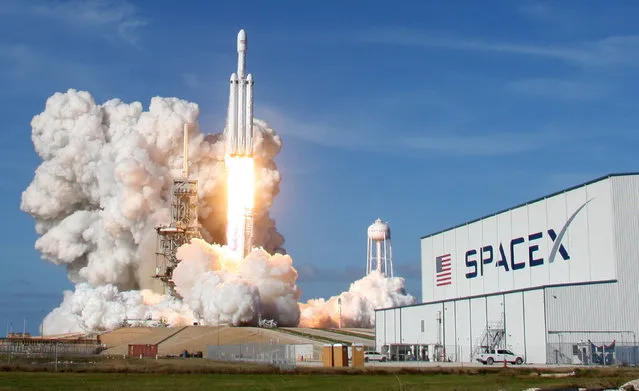
A SpaceX Falcon Heavy rocket lifts off from historic launch pad 39-A at the Kennedy Space Center in Cape Canaveral, Florida, February 6, 2018. (Photo by Thom Baur/Reuters)

A SpaceX Falcon Heavy rocket lifts off from historic launch pad 39-A at the Kennedy Space Center in Cape Canaveral, Florida, February 6, 2018. The world' s most powerful rocket, SpaceX' s Falcon Heavy, blasted off Tuesday on its highly anticipated maiden test flight, carrying CEO Elon Musk' s cherry red Tesla roadster to an orbit near Mars. Screams and cheers erupted at Cape Canaveral, Florida as the massive rocket fired its 27 engines and rumbled into the blue sky over the same NASA launchpad that served as a base for the US missions to Moon four decades ago. (Photo by Thom Baur/Reuters)
Details
07 Feb 2018 08:40:00
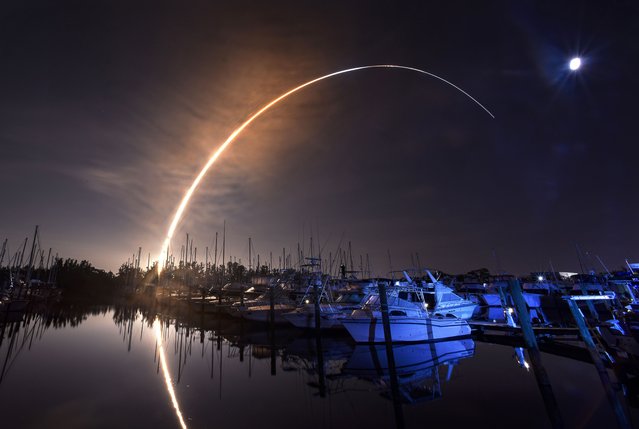
NASA's new moon rocket lifts off from the Kennedy Space Center in Cape Canaveral, Wednesday morning, November 16, 2022, as seen from Harbor town Marina on Merritt Island, Fla. The moon is visible in the sky. (Photo by Malcolm Denemark/Florida Today via AP Photo)

NASA's new moon rocket lifts off from the Kennedy Space Center in Cape Canaveral, Wednesday morning, November 16, 2022, as seen from Harbor town Marina on Merritt Island, Fla. The moon is visible in the sky. (Photo by Malcolm Denemark/Florida Today via AP Photo)
Details
23 Nov 2022 04:21:00
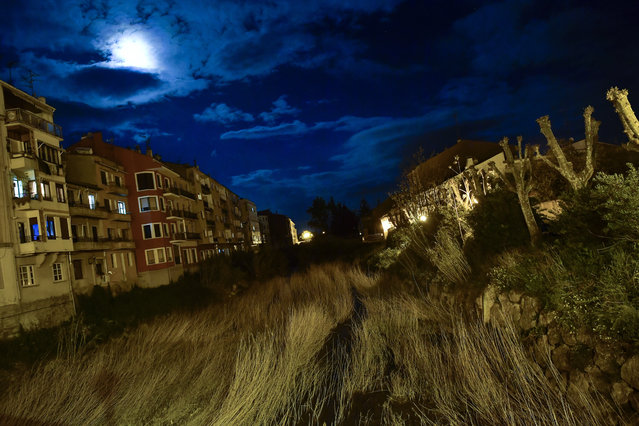
A moon light illuminates the sky through the clouds over a large line of grass between some home houses in the small village of Tafalla, northern Spain, Tuesday, May 1, 2018. (Photo by Alvaro Barrientos/AP Photo)

A moon light illuminates the sky through the clouds over a large line of grass between some home houses in the small village of Tafalla, northern Spain, Tuesday, May 1, 2018. (Photo by Alvaro Barrientos/AP Photo)
Details
25 Sep 2018 00:05:00
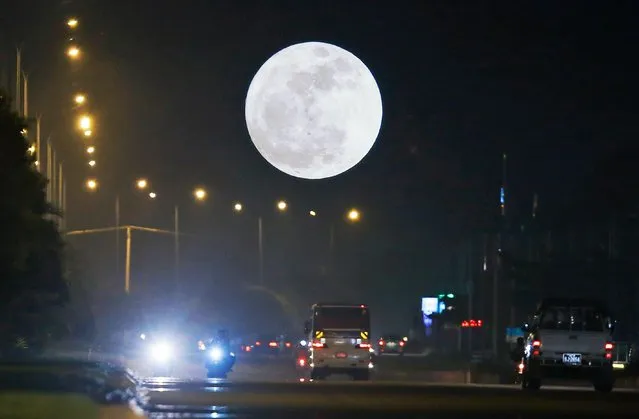
A so-called “Supermoon” dominates the sky while traffic rolls in the streets in Naypyitaw, Myanmar, 03 December 2017. According to the National Aeronautics and Space Administration (NASA) a series of three “Supermoons” – dubbed the “Supermoon trilogy” – will appear in the sky on 03 December 2017, on 01 January 2018 and and 31 January 2018. A 'Supermoon' commonly is a full moon at its closest distance to the earth with the moon appearing larger than usual. (Photo by Hein Htet/EPA/EFE)

A so-called “Supermoon” dominates the sky while traffic rolls in the streets in Naypyitaw, Myanmar, 03 December 2017. According to the National Aeronautics and Space Administration (NASA) a series of three “Supermoons” – dubbed the “Supermoon trilogy” – will appear in the sky on 03 December 2017, on 01 January 2018 and and 31 January 2018. A “Supermoon” commonly is a full moon at its closest distance to the earth with the moon appearing larger than usual. (Photo by Hein Htet/EPA/EFE)
Details
05 Dec 2017 07:45:00
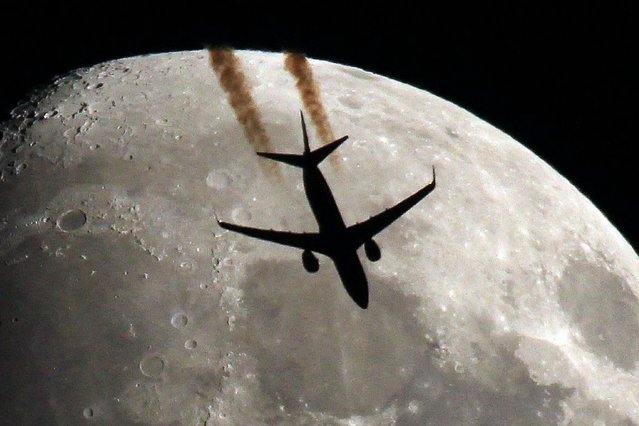
This plane looks like it's bound for the moon as it shoots across the sky. Photographer Sebastien Lebrigand was impressed he could even see the lights on the jet's wings in this stunning silhouette. (Photo by Sebastien Lebrigand/Solent News)

This plane looks like it's bound for the moon as it shoots across the sky. Photographer Sebastien Lebrigand was impressed he could even see the lights on the jet's wings in this stunning silhouette. (Photo by Sebastien Lebrigand/Solent News)
Details
25 May 2014 13:03:00
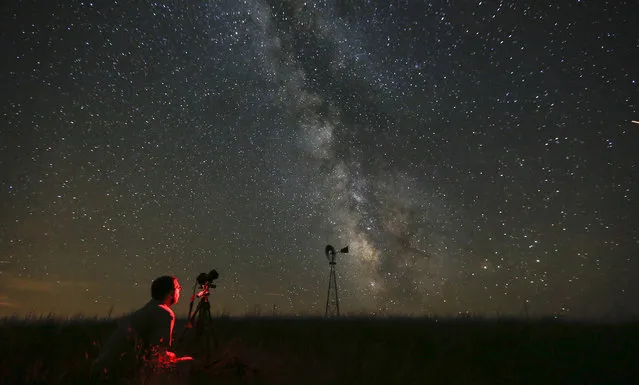
In this Wednesday, July 23, 2014 file photo, Omaha photographer Lane Hickenbottom photographs the night sky in a pasture near Callaway, Neb. With no moon in the sky, the Milky Way was visible to the naked eye. More than one-third of the world’s population can no longer see the Milky Way because of man-made lights, according to a scientific paper by Light Pollution Science and Technology Institute's Fabio Falchi and his team members, published on Friday, June 10, 2016. (Photo by Travis Heying/The Wichita Eagle via AP Photo)

In this Wednesday, July 23, 2014 file photo, Omaha photographer Lane Hickenbottom photographs the night sky in a pasture near Callaway, Neb. With no moon in the sky, the Milky Way was visible to the naked eye. More than one-third of the world’s population can no longer see the Milky Way because of man-made lights, according to a scientific paper by Light Pollution Science and Technology Institute's Fabio Falchi and his team members, published on Friday, June 10, 2016. (Photo by Travis Heying/The Wichita Eagle via AP Photo)
Details
11 Jun 2016 12:37:00
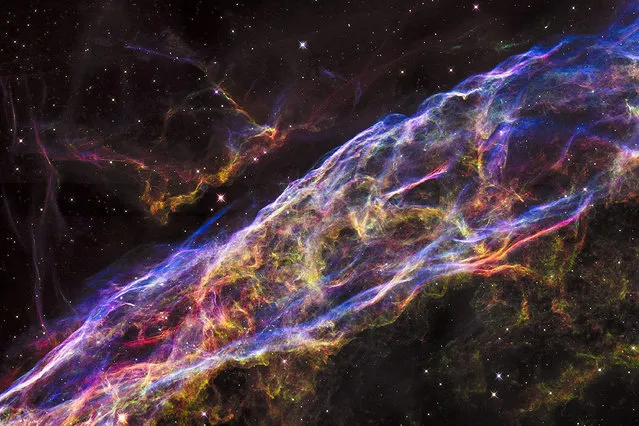
A small section of the expanding remains of the Veil Nebula, a massive star that exploded about 8,000 years ago. The entire nebula is 110 light-years across, covering six full moons on the sky as seen from Earth, and resides about 2,100 light-years away in the constellation Cygnus, the Swan. (Photo by Reuters/NASA/ESA/Hubble)

A small section of the expanding remains of the Veil Nebula, a massive star that exploded about 8,000 years ago. The entire nebula is 110 light-years across, covering six full moons on the sky as seen from Earth, and resides about 2,100 light-years away in the constellation Cygnus, the Swan. (Photo by Reuters/NASA/ESA/Hubble)
Details
29 Feb 2016 11:30:00
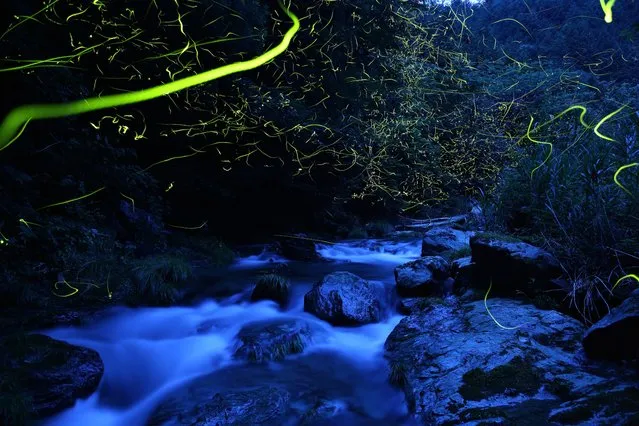
“In the late afternoon after a rain, genji botaru fireflies (luciola cruciate) dance above the swollen creek. The rocks darkened by the rain reflecting the blue sky, and the yellow-green ribbon of the glow from the fireflies, make a beautiful contrast”. – Takehito Miyatake. (Photo by Takehito Miyatake/Steven Kasher Gallery)

“In the late afternoon after a rain, genji botaru fireflies (luciola cruciate) dance above the swollen creek. The rocks darkened by the rain reflecting the blue sky, and the yellow-green ribbon of the glow from the fireflies, make a beautiful contrast”. – Takehito Miyatake. (Photo by Takehito Miyatake/Steven Kasher Gallery)
Details
19 Jun 2014 09:13:00