Loading...
Done
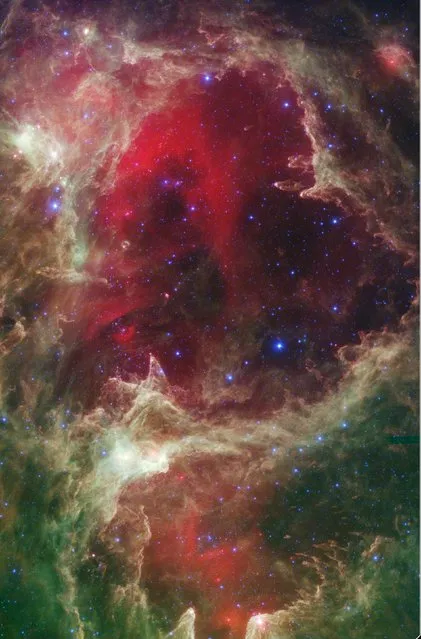
An infrared portrait from NASA's Spitzer Space Telescope which shows generations of stars is seen in this undated NASA handout image released February 14, 2013. In this wispy star-forming region, called W5, the oldest stars can be seen as blue dots in the centers of the two hollow cavities (other blue dots are background and foreground stars not associated with the region). Red shows heated dust that pervades the region's cavities, while green highlights dense clouds. (Photo by NASA/Reuters/JPL-Caltech/Harvard-Smithsonian/Handout)

An infrared portrait from NASA's Spitzer Space Telescope which shows generations of stars is seen in this undated NASA handout image released February 14, 2013. In this wispy star-forming region, called W5, the oldest stars can be seen as blue dots in the centers of the two hollow cavities (other blue dots are background and foreground stars not associated with the region). Red shows heated dust that pervades the region's cavities, while green highlights dense clouds. (Photo by NASA/Reuters/JPL-Caltech/Harvard-Smithsonian/Handout)
Details
03 Mar 2013 08:44:00
A British fan waits to enter the Malmo arena ahead of the finals of the 2013 Eurovision Song Contest on May 18, 2013. (Photo by John MacDougall/AFP Photo)

A British fan waits to enter the Malmo arena ahead of the finals of the 2013 Eurovision Song Contest on May 18, 2013. (Photo by John MacDougall/AFP Photo)
Details
19 May 2013 11:25:00
Annual celebration of Dinagyang festival of Iloilo, Philippines. (Photo by Raniel Jose Castañeda/Sony World Photography Awards)

Annual celebration of Dinagyang festival of Iloilo, Philippines. (Photo by Raniel Jose Castañeda/Sony World Photography Awards)
Details
21 Sep 2016 09:56:00
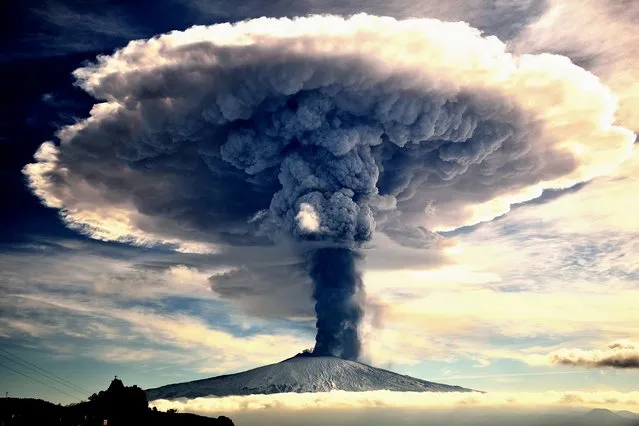
“The power of nature”. Magma, ash and gas erupt from Mount Etna in December 2015, rising to a height of several kilometres. Winner: Nature. (Photo by Giuseppe Mario Famiani/SIPA Contest)

“The power of nature”. Magma, ash and gas erupt from Mount Etna in December 2015, rising to a height of several kilometres. Winner: Nature. (Photo by Giuseppe Mario Famiani/SIPA Contest)
Details
31 Oct 2016 11:49:00
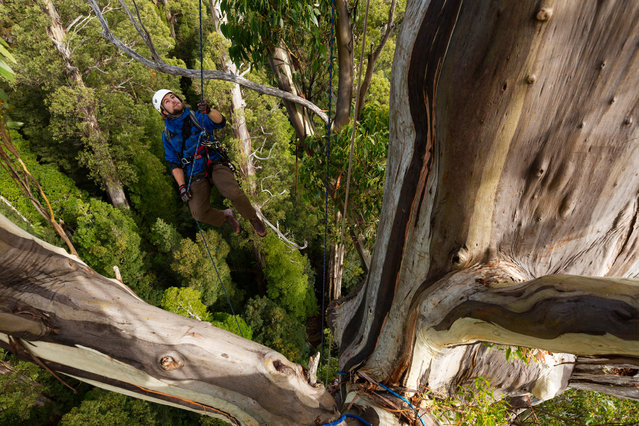
Haley nears the top of the tree. (Photo by Steven Pearce/The Tree Projects/The Guardian)

The Tree Projects team spent 67 days documenting one eucalyptus regnans in the Styx valley of Tasmania. Using a combination of tree-climbing and elaborate arboreal rigging techniques, they produced an intimate portrait from an impossible perspective of one of the world’s largest individual flowering trees, which goes by several common names. These photos document the process that resulted in an extraordinary ultra high-definition photograph. Here: Haley nears the top of the tree. (Photo by Steven Pearce/The Tree Projects/The Guardian)
Details
01 Feb 2017 06:37:00
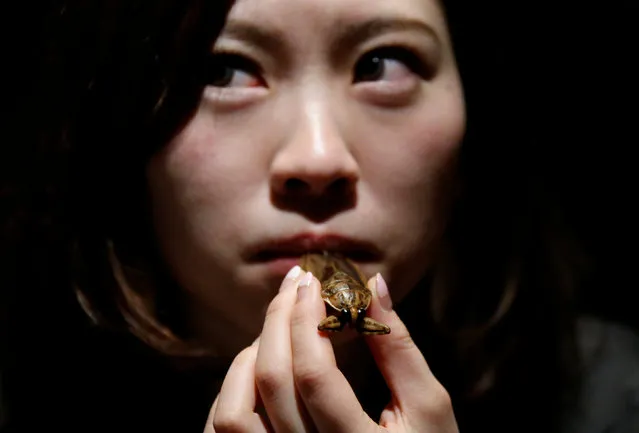
A woman tries to eat a water bug at a bar in downtown Tokyo, Japan, February 12, 2017. (Photo by Toru Hanai/Reuters)

A woman tries to eat a water bug at a bar in downtown Tokyo, Japan, February 12, 2017. A Tokyo bar on Sunday offered courageous couples and curious gourmets a special menu of desserts and drinks made with insects ahead of Tuesday's holiday. (Photo by Toru Hanai/Reuters)
Details
15 Feb 2017 00:02:00
“Entwined Lives”. Tim Laman, US Winner, Wildlife photographer of the year. A young male orangutan makes the 30-metre climb up the thickest root of the strangler fig high above the canopy in Gunung Palung national park, one of the few protected orangutan strongholds in Indonesian Borneo. Laman had to do three days of climbing to position several GoPro cameras that he could trigger remotely. This shot was the one he had long visualised, looking down on the orangutan within its forest home. (Photo by Tim Laman/2016 Wildlife Photographer of the Year)

“Entwined Lives”. Tim Laman, US Winner, Wildlife photographer of the year. A young male orangutan makes the 30-metre climb up the thickest root of the strangler fig high above the canopy in Gunung Palung national park, one of the few protected orangutan strongholds in Indonesian Borneo. Laman had to do three days of climbing to position several GoPro cameras that he could trigger remotely. This shot was the one he had long visualised, looking down on the orangutan within its forest home. (Photo by Tim Laman/2016 Wildlife Photographer of the Year)
Details
19 Oct 2016 12:08:00
Astronomy Photographer Of The Year 2013 Part1

The Royal Observatory just announced its Astronomy Photographer Of The Year 2013 winners. Australian photographer Mark Gee was chosen among a thousand amateur and professional photographers around the globe to win the top title. His work is part of an exhibition of the winning photographers, which opened on Sept. 19 at the Royal Observatory Greenwich. The Royal Observatory shared with us the winners and notable mentions of the competition. Their descriptions of the prizewinners can be found below the images.
Details
04 Oct 2013 11:45:00